
[Paper Review] Gravitational lensing in a space-time with cosmic string within the Eddington-inspired Born-Infeld gravity
This paper investigates gravitational lensing in Eddington-inspired Born-Infeld (EiBI) gravity coupled with cosmic strings, deriving the effective potential for null and time-like geodesics and analytically computing the deflection angle of light in the weak field limit. The key result shows that cosmic strings significantly enhance the deflection angle compared to topologically charged EiBI space-times, with the effect quantified by a modified deflection expression dependent on the string parameter 𝛼 and EiBI nonlinearity parameter 𝜖.
This study explores the deflection angle of photon rays or light-like geodesics within the framework of Eddington-inspired Born-Infeld (EiBI) gravity background space-time, taking into account the influence of cosmic strings. The primary focus lies in deriving the effective potential of the system applicable to both null and time-like geodesics, as well as determining the angle of deflection for light-like geodesics. Our analysis shows that the presence of cosmic strings induces modifications in these physical quantities, leading to shifts in their respective values.
Motivation & Objective
- To examine gravitational lensing effects in a space-time with cosmic strings within the Eddington-inspired Born-Infeld (EiBI) gravity framework.
- To derive the effective potential for both null and time-like geodesics in the presence of cosmic strings and EiBI nonlinearity.
- To analytically compute the deflection angle of light-like geodesics in the weak field regime under these conditions.
- To compare the resulting deflection angle with prior results in topologically charged EiBI space-times.
- To quantify the influence of the cosmic string parameter 𝛼 and EiBI parameter 𝜖 on photon trajectories.
Proposed method
- Formulating the line element for a cosmic string space-time in EiBI gravity using spherical coordinates with parameters 𝜖 (nonlinearity) and 𝛼 (string deficit).
- Applying the Lagrangian method to derive a one-dimensional energy expression for geodesic motion.
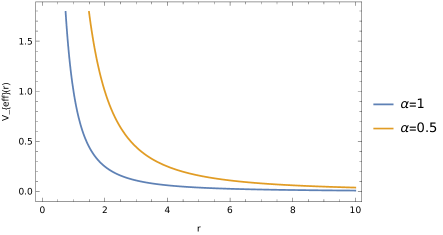
- Deriving the effective potential for both null and time-like geodesics, explicitly dependent on 𝛼 and 𝜖.
- Using the weak field approximation to analytically compute the deflection angle of light rays.
- Expanding the deflection angle in powers of 𝜖/𝛽² to isolate contributions from cosmic strings and EiBI gravity.
- Comparing the derived deflection angle with known results in topologically charged EiBI space-times to assess relative lensing strength.
Experimental results
Research questions
- RQ1How does the presence of a cosmic string modify the effective potential for geodesic motion in EiBI gravity?
- RQ2What is the analytical expression for the deflection angle of light in the weak field limit within an EiBI cosmic string space-time?
- RQ3How do the parameters 𝛼 (cosmic string) and 𝜖 (EiBI nonlinearity) influence the deflection angle of photons?
- RQ4How does the lensing effect in this cosmic string-EiBI system compare quantitatively to that in a topologically charged EiBI space-time?
- RQ5What is the relative contribution of cosmic string effects versus EiBI gravity effects to the total deflection angle?
Key findings
- The effective potential for both null and time-like geodesics is explicitly modified by the cosmic string parameter 𝛼 and EiBI nonlinearity parameter 𝜖.
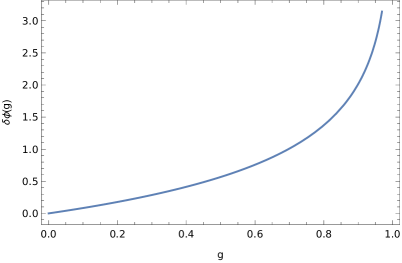
- The deflection angle of light is given by the expression 𝛿𝜙 = −(𝜋/4)(𝜖/𝛽²) + (9𝜋/64)(𝜖/𝛽²)² + 𝒪((𝜖/𝛽²)³) in the weak field limit, with contributions from both cosmic strings and EiBI gravity.
- The first term in the deflection expression corresponds solely to the cosmic string effect, while the second term arises from the combined influence of EiBI gravity and cosmic strings.
- The deflection angle in the cosmic string-EiBI space-time is larger than in the topologically charged EiBI space-time, as shown by comparison with Equation (19).
- Graphical analysis confirms that increasing the cosmic string parameter 𝛼 leads to a measurable increase in the deflection angle, indicating a stronger lensing effect.
- The result for 𝛼 → 1 reduces to the known deflection angle in an Ellis-Bronnikov wormhole within EiBI gravity, validating consistency with prior work.
Read this paper
Open the full text in the Nubint reader and ask about any passage as you read.
Read this paper on NubintThis review was generated by AI from the original paper. Please check the paper before citing it.