
[Paper Review] GRB 221009A, its precursor and two afterglows in the Fermi data
This study analyzes Fermi data of GRB 221009A, the brightest gamma-ray burst ever observed, and provides the first direct evidence of an afterglow from a weak precursor event occurring three minutes before the main burst. Using calibrated Large Area Telescope (LAT) data at large incidence angles, the authors detect a statistically significant afterglow in the 10–200 MeV range 50 seconds after the precursor, with a spectral index of α = −2.5 ± 0.5, indicating a distinct external shock origin.
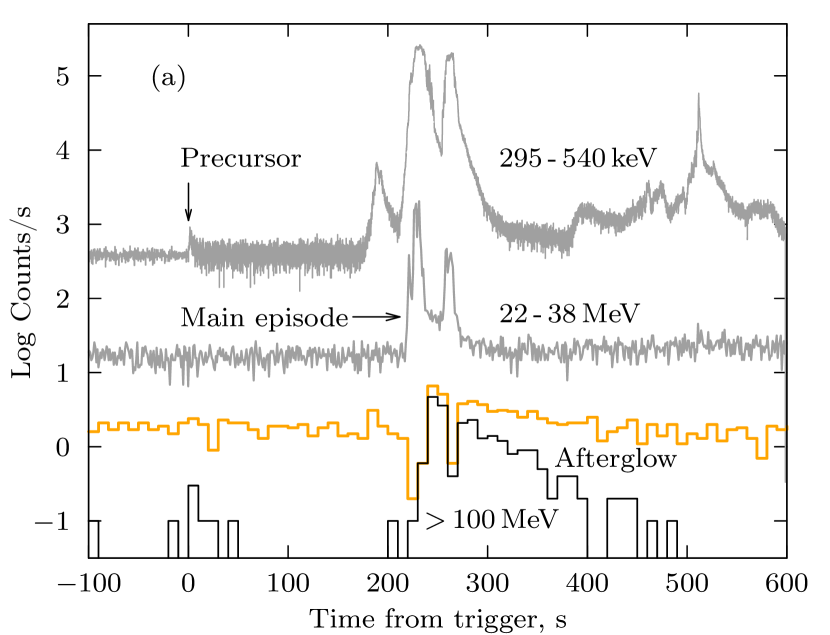
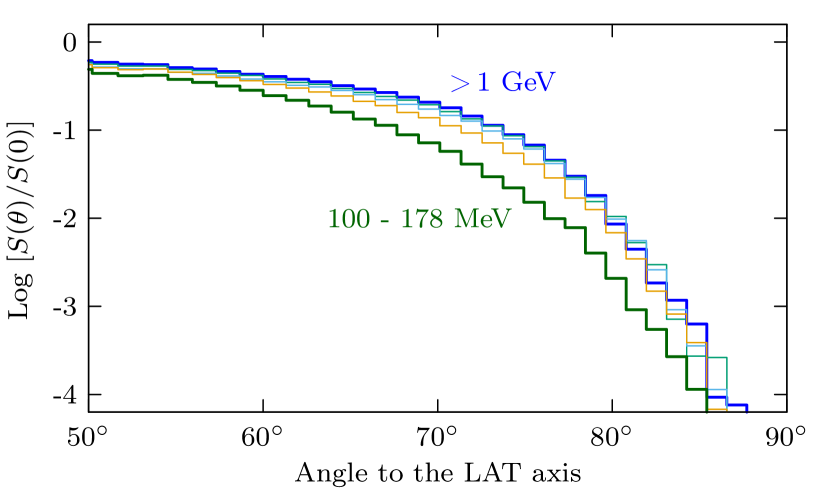
We study GRB 221009A, the brightest gamma-ray burst in the history of observations, using Fermi data. To calibrate them for large inclination angles, we use the Vela X gamma-ray source. Light curves in different spectral ranges demonstrate a 300 s overlap of afterglow and delayed episodes of soft prompt emission. We demonstrate that a relatively weak burst precursor that occurs 3 minutes before the main episode has its own afterglow, i.e., presumably, its own external shock. The main afterglow is the brightest one, includes a photon with an energy of 400 GeV 9 hours after the burst, and is visible in the LAT data for up to two days.
Motivation & Objective
- To investigate whether GRB precursors—weak, early emission episodes—can produce their own afterglows, challenging the assumption that only main bursts generate external shocks.
- To calibrate Fermi LAT performance at large incidence angles (>75°) due to the burst's position near the edge of the field of view.
- To determine the spectral and temporal properties of both the precursor afterglow and the main afterglow in the GeV range.
- To resolve discrepancies between Fermi LAT data and HAWC's non-detection of TeV afterglow emission beyond 8 hours.
- To assess the physical implications of a precursor with a bright afterglow, suggesting potential differences in emission mechanisms from the main burst.
Proposed method
- Calibrated LAT detection efficiency at large angles using the Vela X pulsar as a stable, bright GeV source, with a 8° angular aperture to account for off-axis response.
- Used 9.4 million photons from Vela X and 2 million background photons from a nearby Milky Way region to model angular and energy-dependent effective area.
- Applied energy-dependent response functions from Ajello et al. (2021) to correct for spectral energy bias in high-incidence-angle observations.
- Performed statistical analysis on LAT photon counts in the 50-second window after the precursor, finding 6 photons vs. an expected 0.64, yielding a 4σ significance.
- Fitted the spectral energy distribution of the 6 post-precursor photons to estimate a photon index α = −2.5 ± 0.5.
- Compared Fermi afterglow flux with HAWC's upper limit (4.16 × 10⁻¹² erg cm⁻² s⁻¹) to assess spectral evolution and potential cutoffs.
Experimental results
Research questions
- RQ1Does a weak GRB precursor, separated from the main burst by several minutes, produce its own afterglow via an external shock?
- RQ2How can Fermi LAT data be reliably calibrated for large incidence angles (>75°) to detect faint afterglow emission?
- RQ3What is the spectral and temporal behavior of the afterglow following the precursor compared to the main burst afterglow?
- RQ4Why is there a discrepancy between Fermi's detection of a bright afterglow and HAWC's non-detection above 100 GeV beyond 8 hours?
- RQ5Could the precursor and its afterglow represent a fundamentally different emission mechanism from the main GRB event?
Key findings
- The precursor of GRB 221009A, with a peak count rate ~300 times weaker and energy fluence ~2,000 times lower than the main burst, produced a statistically significant afterglow detectable in Fermi LAT data.
- The afterglow emission, observed 50 seconds after the precursor, consists of 6 photons in the 10–200 MeV range, with a significance of 4σ, confirming a real astrophysical signal.
- The spectral index of the precursor afterglow is α = −2.5 ± 0.5, consistent with the main afterglow's index (α ≈ −2), indicating similar emission mechanisms.
- The main afterglow is the brightest ever recorded, with a 400 GeV photon detected 9 hours after the trigger, and remains visible in LAT data for up to two days.
- The afterglow fluence of the precursor and its afterglow is ~1.5 × 10⁻⁵ erg cm⁻², comparable to the precursor’s fluence (~1.7 × 10⁻⁵ erg cm⁻²), suggesting a physically linked emission process.
- The absence of a spectral cutoff in the 400 GeV photon and the tension with HAWC’s upper limit suggest a possible sharp spectral decline between 10 GeV and TeV energies, though this remains unconfirmed.
Read this paper
Open the full text in the Nubint reader and ask about any passage as you read.
Read this paper on NubintThis review was generated by AI from the original paper. Please check the paper before citing it.