
[Paper Review] GREAT Score: Global Robustness Evaluation of Adversarial Perturbation using Generative Models
This paper proposes GREAT Score, a novel, efficient, and scalable framework for global adversarial robustness evaluation using generative models. By leveraging a generative model to approximate the true data distribution, GREAT Score computes a certified lower bound on the mean minimal adversarial perturbation across all generated samples, enabling privacy-preserving, black-box robustness auditing with high correlation to attack-based benchmarks and significantly reduced computational cost.
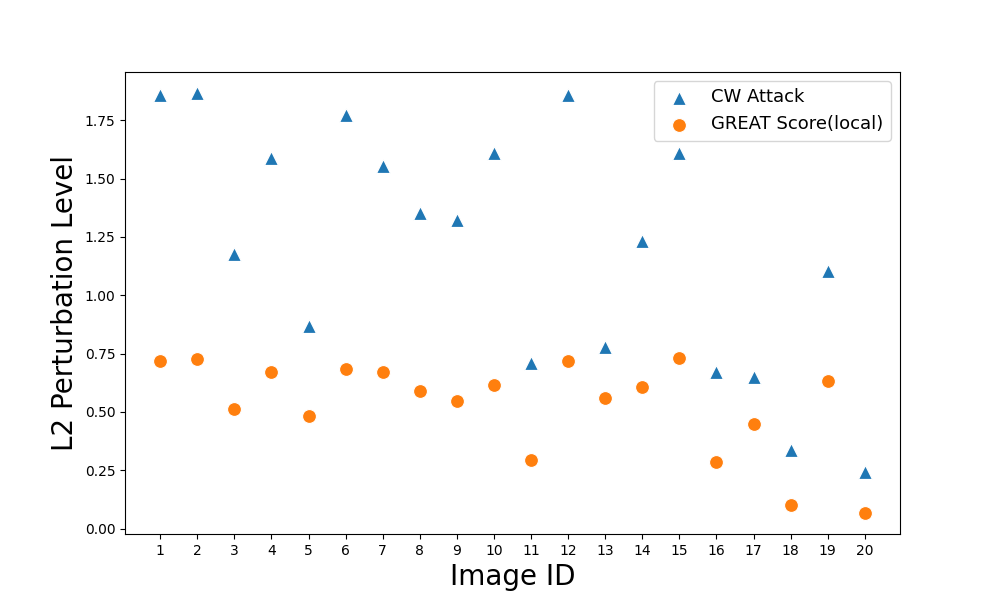
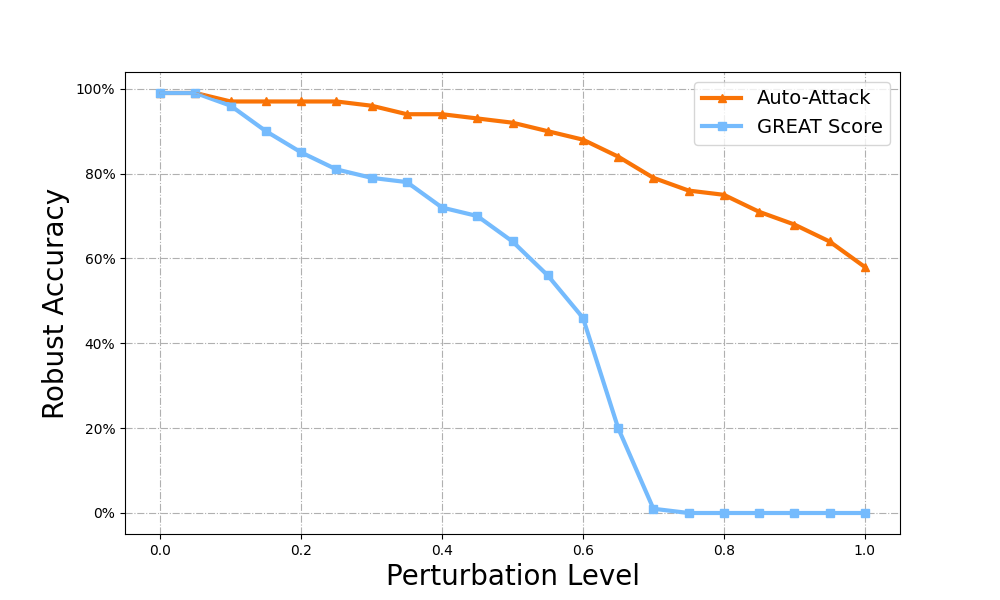
Current studies on adversarial robustness mainly focus on aggregating local robustness results from a set of data samples to evaluate and rank different models. However, the local statistics may not well represent the true global robustness of the underlying unknown data distribution. To address this challenge, this paper makes the first attempt to present a new framework, called GREAT Score , for global robustness evaluation of adversarial perturbation using generative models. Formally, GREAT Score carries the physical meaning of a global statistic capturing a mean certified attack-proof perturbation level over all samples drawn from a generative model. For finite-sample evaluation, we also derive a probabilistic guarantee on the sample complexity and the difference between the sample mean and the true mean. GREAT Score has several advantages: (1) Robustness evaluations using GREAT Score are efficient and scalable to large models, by sparing the need of running adversarial attacks. In particular, we show high correlation and significantly reduced computation cost of GREAT Score when compared to the attack-based model ranking on RobustBench (Croce,et. al. 2021). (2) The use of generative models facilitates the approximation of the unknown data distribution. In our ablation study with different generative adversarial networks (GANs), we observe consistency between global robustness evaluation and the quality of GANs. (3) GREAT Score can be used for remote auditing of privacy-sensitive black-box models, as demonstrated by our robustness evaluation on several online facial recognition services.
Motivation & Objective
- To address the lack of global robustness evaluation that reflects the true data distribution rather than biased local samples.
- To enable efficient, scalable, and privacy-preserving robustness evaluation of black-box models without requiring model parameters or real data.
- To develop a certified, attack-independent metric that provides a global statistic of adversarial robustness with theoretical sample complexity guarantees.
- To demonstrate the feasibility and effectiveness of using generative models as proxies for data distribution in robustness benchmarking.
Proposed method
- Formally define GREAT Score as the mean of a certified lower bound on minimal adversarial perturbation over samples from a generative model, representing global robustness.
- Use off-the-shelf generative models like GANs or diffusion models to synthesize data that approximates the true data distribution.
- Derive a probabilistic guarantee on the difference between the sample mean and true mean of GREAT Score, quantifying sample complexity.
- Compute GREAT Score via a single forward pass through the target model on generated samples, avoiding iterative attacks or gradient computation.
- Leverage the closed-form nature of the score to enable remote auditing of privacy-sensitive black-box models using only model outputs.
- Apply Stein's Lemma to derive a tractable expression for the certified lower bound under L2-norm perturbations.
Experimental results
Research questions
- RQ1Can a generative model be used to approximate the true data distribution for global adversarial robustness evaluation?
- RQ2How does GREAT Score compare to attack-based benchmarks like those on RobustBench in terms of correlation and efficiency?
- RQ3Can GREAT Score enable privacy-preserving, remote auditing of black-box models such as online facial recognition APIs?
- RQ4What is the sample complexity of GREAT Score, and how stable is its estimation with finite generated samples?
- RQ5Does the consistency of GREAT Score across different GAN architectures reflect the quality of the underlying generative model?
Key findings
- GREAT Score shows high correlation with attack-based model rankings on RobustBench, achieving comparable robustness assessment with significantly reduced computation cost.
- The estimation of GREAT Score stabilizes with as few as 500 generated samples, demonstrating low sample complexity and robustness to small sample sizes.
- On six online facial recognition APIs, GREAT Score revealed that models exhibit significantly lower robustness when classifying faces with eyeglasses compared to those without, indicating a spurious feature bias.
- For DEEPFACE, a higher GREAT Score (0.979 for Old, 0.774 for Young) consistently corresponded to higher robust accuracy (84.40% and 72.60%) under square attack, validating its predictive power.
- Baidu and Luxand achieved the highest overall GREAT Scores (1.048 and 0.944), indicating superior global robustness across all evaluated groups.
- The framework enables remote, privacy-preserving auditing of black-box models using only synthetic data and model outputs, without accessing real data or model internals.
Read this paper
Open the full text in the Nubint reader and ask about any passage as you read.
Read this paper on NubintThis review was generated by AI from the original paper. Please check the paper before citing it.