
[Paper Review] Group DETR: Fast DETR Training with Group-Wise One-to-Many Assignment
Group DETR accelerates DETR training by introducing group-wise one-to-many assignment, where multiple object query groups enable competitive learning within each group while maintaining standard inference. This method improves training convergence and performance across DETR variants without architectural changes, achieving up to 3.1 mAP gain with 12 training epochs and 64.5 mAP on COCO test-dev.
Detection transformer (DETR) relies on one-to-one assignment, assigning one ground-truth object to one prediction, for end-to-end detection without NMS post-processing. It is known that one-to-many assignment, assigning one ground-truth object to multiple predictions, succeeds in detection methods such as Faster R-CNN and FCOS. While the naive one-to-many assignment does not work for DETR, and it remains challenging to apply one-to-many assignment for DETR training. In this paper, we introduce Group DETR, a simple yet efficient DETR training approach that introduces a group-wise way for one-to-many assignment. This approach involves using multiple groups of object queries, conducting one-to-one assignment within each group, and performing decoder self-attention separately. It resembles data augmentation with automatically-learned object query augmentation. It is also equivalent to simultaneously training parameter-sharing networks of the same architecture, introducing more supervision and thus improving DETR training. The inference process is the same as DETR trained normally and only needs one group of queries without any architecture modification. Group DETR is versatile and is applicable to various DETR variants. The experiments show that Group DETR significantly speeds up the training convergence and improves the performance of various DETR-based models. Code will be available at \url{https://github.com/Atten4Vis/GroupDETR}.
Motivation & Objective
- To address the slow convergence of DETR training by introducing more supervision during optimization.
- To enable effective one-to-many assignment in DETR, which traditionally fails with naive approaches.
- To improve training stability and performance without modifying the inference pipeline or architecture.
- To explore the equivalence of group-wise assignment to parameter-sharing multi-head networks with query augmentation.
- To demonstrate broad applicability across various DETR variants, including Deformable DETR and DINO.
Proposed method
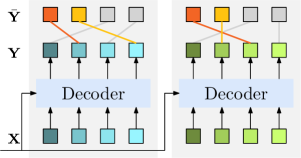
- Group DETR uses K groups of object queries, each with independent one-to-one assignment to ground-truth objects.
- Within each group, predictions compete via self-attention, encouraging high scores for correct assignments and low scores for duplicates.
- Self-attention is performed separately per group, decoupling inter-group interactions and stabilizing training.
- The method is equivalent to training parallel decoders with shared weights, effectively increasing supervision.
- During inference, only a single group of queries is used, preserving the original DETR architecture and inference speed.
- The approach is compatible with existing DETR variants and can be combined with other techniques like denoising queries or EMA.
Experimental results
Research questions
- RQ1Can one-to-many assignment be effectively applied to DETR training, overcoming the failure of naive implementations?
- RQ2Does group-wise assignment with intra-group competition improve training convergence and model performance?
- RQ3Can the method be universally applied to various DETR variants without architectural modifications?
- RQ4How does group-wise assignment compare to existing stabilization techniques like denoising in DN-DETR?
- RQ5Does the improved training dynamics also benefit the encoder, beyond the decoder?
Key findings
- Group DETR achieves a 3.1 mAP gain on COCO val2017 with only 12 training epochs when applied to SAM-DETR.
- With 50 epochs, Group DETR improves SAM-DETR++ by 1.3 mAP, demonstrating consistent gains across training schedules.
- The method achieves 64.5 mAP on COCO test-dev using ViT-Huge, outperforming larger models with more pre-training data.
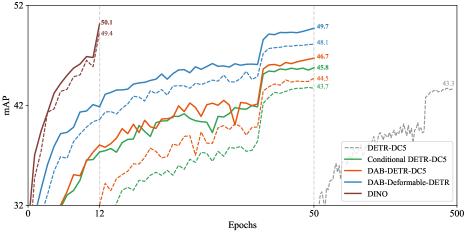
- Group DETR improves training convergence speed, as shown by faster loss reduction curves in training curves on COCO.
- The method is complementary to existing techniques: combining Group DETR with DINO or DN-DETR further boosts performance.
- Experiments show that increasing denoising queries in DN-DETR does not improve performance beyond 100 queries, unlike Group DETR’s consistent gains.
Read this paper
Open the full text in the Nubint reader and ask about any passage as you read.
Read this paper on NubintThis review was generated by AI from the original paper. Please check the paper before citing it.