
[Paper Review] Guaranteed Approximation Bounds for Mixed-Precision Neural Operators
This paper proposes a mixed-precision training routine for Fourier Neural Operators (FNO) that reduces memory usage by up to 50% and increases training throughput by up to 58% with minimal accuracy loss. By applying a tanh pre-activation and frequency mode truncation, the method stabilizes half-precision training in the complex-valued Fourier domain, enabling efficient, high-resolution PDE solution learning without sacrificing model performance.
Neural operators, such as Fourier Neural Operators (FNO), form a principled approach for learning solution operators for PDEs and other mappings between function spaces. However, many real-world problems require high-resolution training data, and the training time and limited GPU memory pose big barriers. One solution is to train neural operators in mixed precision to reduce the memory requirement and increase training speed. However, existing mixed-precision training techniques are designed for standard neural networks, and we find that their direct application to FNO leads to numerical overflow and poor memory efficiency. Further, at first glance, it may appear that mixed precision in FNO will lead to drastic accuracy degradation since reducing the precision of the Fourier transform yields poor results in classical numerical solvers. We show that this is not the case; in fact, we prove that reducing the precision in FNO still guarantees a good approximation bound, when done in a targeted manner. Specifically, we build on the intuition that neural operator learning inherently induces an approximation error, arising from discretizing the infinite-dimensional ground-truth input function, implying that training in full precision is not needed. We formalize this intuition by rigorously characterizing the approximation and precision errors of FNO and bounding these errors for general input functions. We prove that the precision error is asymptotically comparable to the approximation error. Based on this, we design a simple method to optimize the memory-intensive half-precision tensor contractions by greedily finding the optimal contraction order. Through extensive experiments on different state-of-the-art neural operators, datasets, and GPUs, we demonstrate that our approach reduces GPU memory usage by up to 50% and improves throughput by 58% with little or no reduction in accuracy.
Motivation & Objective
- To address the high memory and compute demands of training FNOs on high-resolution PDE data.
- To enable mixed-precision training in the complex-valued Fourier domain, where standard mixed-precision techniques do not apply.
- To study numerical stability and precision trade-offs in half-precision FNO training.
- To develop a robust, high-throughput training pipeline that maintains accuracy while reducing resource usage.
- To demonstrate the method’s effectiveness on real-world PDEs like Navier-Stokes and Darcy flow, including zero-shot super-resolution.
Proposed method
- Profiling full and mixed-precision training to identify performance bottlenecks and potential gains.
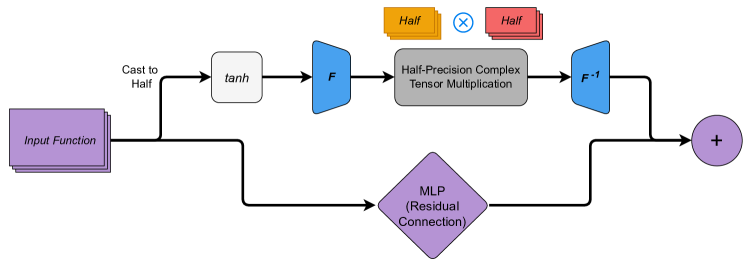
- Applying a tanh pre-activation before the Fourier transform to stabilize numerical values in half precision.
- Truncating high-frequency modes to reduce the impact of half-precision representation errors.
- Implementing a precision schedule that transitions from half to mixed to full precision during training.
- Using cuFFT with half-precision complex number handling via vector casting for efficient computation.
- Validating the method on Navier-Stokes and Darcy flow datasets with varying resolutions and precision settings.
Experimental results
Research questions
- RQ1Can mixed-precision training be safely applied to FNOs despite their complex-valued, function-space operations?
- RQ2What numerical instabilities arise in half-precision FNO training, and how can they be mitigated?
- RQ3How does frequency mode truncation affect the accuracy and stability of half-precision FNOs?
- RQ4To what extent can memory usage and training throughput be reduced without sacrificing model accuracy?
- RQ5Does the proposed method preserve resolution invariance in FNOs for zero-shot super-resolution?
Key findings
- The proposed mixed-precision FNO training routine reduces GPU memory usage by up to 50% on Navier-Stokes and Darcy flow problems.
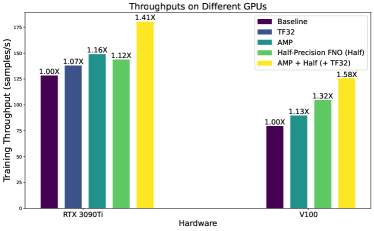
- Training throughput increases by up to 58% when using the optimized mixed-precision pipeline.
- The combination of tanh pre-activation and frequency mode truncation effectively prevents numerical overflow and underflow in half-precision training.
- Half-precision FNOs show only a small accuracy drop (e.g., L2 error increase from 0.00213 to 0.00236 on 1024×1024 Navier-Stokes) compared to full precision.
- The precision schedule method achieves significantly better accuracy than pure half-precision, with L2 error reduced from 0.00236 to 0.00170 on 1024×1024 Navier-Stokes.
- The method preserves resolution invariance, enabling accurate zero-shot super-resolution up to 1024×1024 resolution with minimal performance degradation.
Read this paper
Open the full text in the Nubint reader and ask about any passage as you read.
Read this paper on NubintThis review was generated by AI from the original paper. Please check the paper before citing it.