
[Paper Review] Guiding Large Language Models via Directional Stimulus Prompting
DSP uses a small tunable policy model to generate instance-specific directional prompts that guide black-box LLMs toward desired outputs, improving performance with limited labeled data across summarization, dialogue, and reasoning tasks.
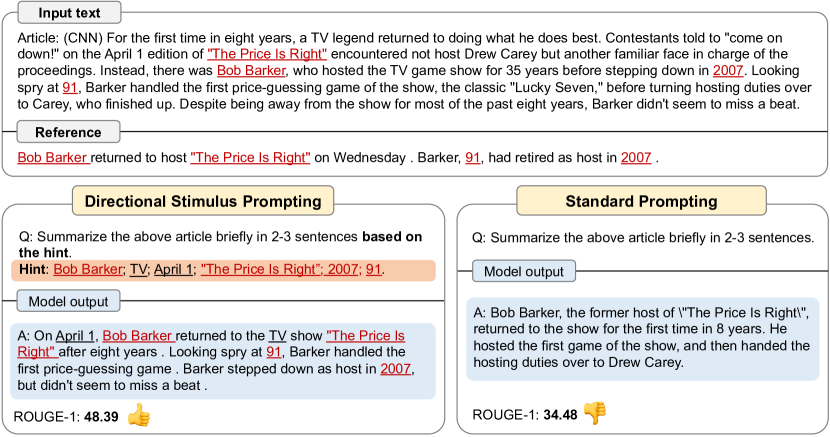
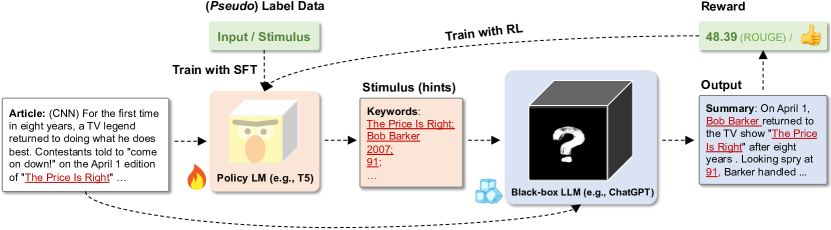
We introduce Directional Stimulus Prompting, a novel framework for guiding black-box large language models (LLMs) toward specific desired outputs. Instead of directly adjusting LLMs, our method employs a small tunable policy model (e.g., T5) to generate an auxiliary directional stimulus prompt for each input instance. These directional stimulus prompts act as nuanced, instance-specific hints and clues to guide LLMs in generating desired outcomes, such as including specific keywords in the generated summary. Our approach sidesteps the challenges of direct LLM tuning by optimizing the policy model to explore directional stimulus prompts that align LLMs with desired behaviors. The policy model can be optimized through 1) supervised fine-tuning using labeled data and 2) reinforcement learning from offline or online rewards based on the LLM's output. We assess our method across summarization, dialogue response generation, and chain-of-thought reasoning tasks. Our experiments demonstrate that the framework consistently improves LLMs' (e.g., ChatGPT, Codex, InstructGPT) performance on these supervised tasks using minimal labeled data. Notably, using just 80 dialogues on the MultiWOZ dataset, our approach enhances ChatGPT's performance by an impressive 41.4%, matching or surpassing some fully supervised start-of-the-art models. Additionally, the instance-specific chain-of-thought prompt generated by our approach improves InstructGPT's reasoning accuracy compared to human-crafted or automatically generated prompts. The code and data are publicly available at \url{https://github.com/Leezekun/Directional-Stimulus-Prompting}.
Motivation & Objective
- Motivate a lightweight method to steer black-box LLMs without fine-tuning them.
- Introduce a directional stimulus that provides instance-specific hints in prompts.
- Show how a small policy model can be optimized via supervised fine-tuning and reinforcement learning.
- Demonstrate improvements on summarization, dialogue response generation, and chain-of-thought reasoning.
Proposed method
- Introduce a small tunable policy model to generate a directional stimulus z for each input x.
- Concatenate the stimulus z with x to form a prompt for the black-box LLM, whose parameters are not accessible.
- Train the policy model by supervised fine-tuning on x, z* pairs and then optionally by reinforcement learning to optimize downstream rewards R.
- Define R in terms of LLM outputs (e.g., ROUGE for summarization, task success metrics for dialogue, chain-of-thought effectiveness).
- Use PPO (NLPO variant) with top-p masking to handle large action spaces and apply a KL-divergence penalty to keep the policy close to initialization.
Experimental results
Research questions
- RQ1Can a small policy model generate instance-specific prompts that steer black-box LLMs toward desired outputs?
- RQ2Does RL-based optimization of directional stimuli outperform supervised prompts in guiding LLMs?
- RQ3Are gains consistent across summarization, dialogue systems, and chain-of-thought tasks with limited labeled data?
Key findings
- DSP improves LLM performance on summarization, dialogue, and reasoning tasks despite minimal labeled data.
- For summarization, 4,000 labeled pairs with CNN/Daily Mail yielded 4-13% ROUGE/BLEU gains for ChatGPT.
- On MultiWOZ dialogue, using as few as 80 dialogues for RL-guided prompts boosted ChatGPT scores by up to 41.4% in combined metrics.
- Instance-specific chain-of-thought triggers generated by DSP outperformed human-crafted or auto-generated prompts for InstructGPT.
- RL fine-tuning consistently yields gains over SFT alone, especially as training data size grows.
Read this paper
Open the full text in the Nubint reader and ask about any passage as you read.
Read this paper on NubintThis review was generated by AI from the original paper. Please check the paper before citing it.