
[论文解读] H-AMR: A New GPU-accelerated GRMHD Code for Exascale Computing With 3D Adaptive Mesh Refinement and Local Adaptive Time-stepping
H-AMR 是一种 GPU 加速的 3D 自适应网格加密 GRMHD 代码,支持局部自适应时间步长和球坐标系,可在 5,400 块 V100 GPU 上实现每秒约 10⁹ 个单元循环的百亿亿次级模拟性能。该研究首次揭示,具有纯环向磁场的倾斜薄吸积盘可在自转黑洞的参考系拖曳效应下撕裂为进动的子盘,证明了在无极向磁场的情况下,参考系拖曳可诱导瞬时对齐现象。
General-relativistic magnetohydrodynamic (GRMHD) simulations have revolutionized our understanding of black hole accretion. Here, we present a graphics processing unit (GPU) accelerated GRMHD code \hammer{} with multi-faceted optimizations that, collectively, accelerate computation by 2-5 orders of magnitude for a wide range of applications. Firstly, it introduces a spherical grid with 3D adaptive mesh refinement that operates in each of the 3 dimensions independently. This allows us to circumvent the Courant condition near the polar singularity, which otherwise cripples high-resolution computational performance. Secondly, we demonstrate that local adaptive time-stepping (LAT) on a logarithmic spherical-polar grid accelerates computation by a factor of $\lesssim10$ compared to traditional hierarchical time-stepping approaches. Jointly, these unique features lead to an effective speed of $\sim10^9$ zone-cycles-per-second-per-node on 5,400 NVIDIA V100 GPUs (i.e., 900 nodes of the OLCF Summit supercomputer). We illustrate \hammer{}'s computational performance by presenting the first GRMHD simulation of a tilted thin accretion disk threaded by a toroidal magnetic field around a rapidly spinning black hole. With an effective resolution of $13$,$440 imes4$,$608 imes8$,$092$ cells, and a total of $\lesssim22$ billion cells and $\sim0.65 imes10^8$ timesteps, it is among the largest astrophysical simulations ever performed. We find that frame-dragging by the black hole tears up the disk into two independently precessing sub-disks. The innermost sub-disk rotation axis intermittently aligns with the black hole spin, demonstrating for the first time that such long-sought alignment is possible in the absence of large-scale poloidal magnetic fields.
研究动机与目标
- 为克服黑洞吸积 GRMHD 模拟中的计算瓶颈,特别是极区奇点附近以及长时间尺度动力学问题。
- 实现对倾斜、薄吸积盘在弱磁场条件下的高分辨率、长时间模拟,此类系统对建模 X 射线双星状态至关重要,但此前难以实现。
- 开发一种可扩展的、GPU 优化的代码,具备实现天体物理模拟中复杂物理过程与自适应分辨率的百亿亿次级性能。
- 研究在无初始极向磁通量条件下的盘面撕裂与进动动力学,该领域此前因分辨率与时间尺度限制而无法探索。
提出的方法
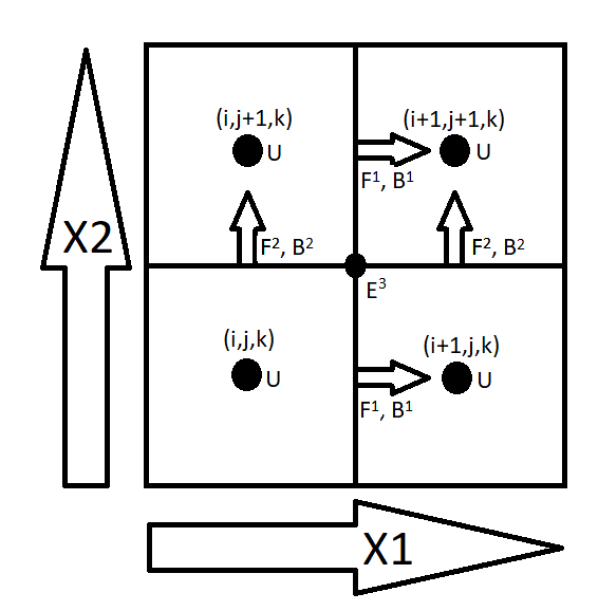
- 代码采用球坐标系,结合三维自适应网格加密(AMR),在径向、极向和方位方向独立进行,以避免极区处出现 Courant 条件失效。
- 在对数球坐标网格上实现局部自适应时间步长(LAT),使不同区域可采用独立时间步长,从而降低全局时间步长限制。
- 采用高阶有限体积格式与 HLLD Riemann 求解器求解 GRMHD 方程,适配具有 AMR 的非均匀曲面网格。
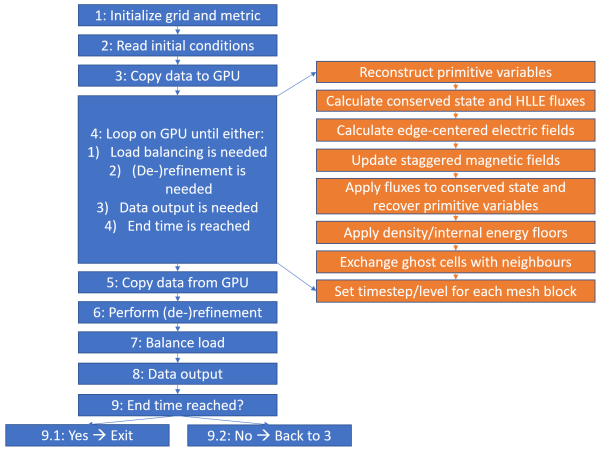
- 代码完全基于 CUDA 实现 GPU 加速,优化内存访问模式,实现 NVIDIA V100 GPU 上高效的数据传输与内核启动。
- 模拟框架集成 Chombo AMR 基础设施,支持基于物理梯度(如密度、磁场、速度)的动态加密。
- 在 OLCF Summit 超算系统上进行基准测试,实现 900 个节点(5,400 块 V100 GPU)下每秒约 10⁹ 个单元循环的性能,证明具备百亿亿次级模拟能力。
实验结果
研究问题
- RQ1在无初始极向磁通量的条件下,GRMHD 模拟能否对具有纯环向磁场的倾斜、薄吸积盘实现足够高的空间分辨率与动态范围,以解析 MRI 紊乱与盘面撕裂?
- RQ2快速旋转黑洞的参考系拖曳是否可在无大尺度极向磁场的条件下诱导内盘与黑洞自旋轴的瞬时对齐?
- RQ3与分层时间步长相比,局部自适应时间步长(LAT)在高分辨率、长时间尺度 GRMHD 模拟中能将计算成本降低多少?
- RQ43D AMR 与 LAT 的结合是否能首次实现有效网格数超过 200 亿单元、时间步长达 0.65×10⁸ 的无喷流、高亮度吸积盘模拟?
主要发现
- H-AMR 在 5,400 块 V100 GPU 上实现了每节点约 10⁹ 个单元循环的有效性能,支持百亿亿次级 GRMHD 模拟。
- 对倾角为 65°、厚高比 h/r = 0.02、β ~ 10 且自旋参数 a = 0.94 的薄盘模拟显示,由于参考系拖曳效应,盘面撕裂为两个独立进动的子盘。
- 内层子盘间歇性地与黑洞自旋轴对齐,首次证明此类对齐可在无初始极向磁通量的条件下发生。
- 整个模拟过程中盘面始终保持无喷流状态,证实了在无大尺度极向磁场条件下,X 射线双星处于高/软态。
- 发生了多次撕裂循环,内层子盘在被吸积前已进动多个周期,与 Type-C quasi-periodic oscillations (QPOs) 的产生机制一致。
- MRI 被解析为每标高约 25–30 个网格点,每 MRI 波长超过 20 个网格点,湍流驱动的 α-黏性系数在前所未有的高分辨率下实现收敛。
更好的研究,从现在开始
从阅读论文到最终审阅,大幅缩短您的研究时间。
无需绑定信用卡
本解读由 AI 生成,并经人工编辑审核。