
[Paper Review] H-InDex: Visual Reinforcement Learning with Hand-Informed Representations for Dexterous Manipulation
H-InDex proposes a visual reinforcement learning framework that leverages pre-trained 3D human hand pose representations to enhance robotic dexterous manipulation. By fine-tuning only 0.36% of parameters via self-supervised keypoint detection and EMA BatchNorm adaptation, it achieves state-of-the-art performance across 12 challenging manipulation tasks, outperforming recent visual foundation models.
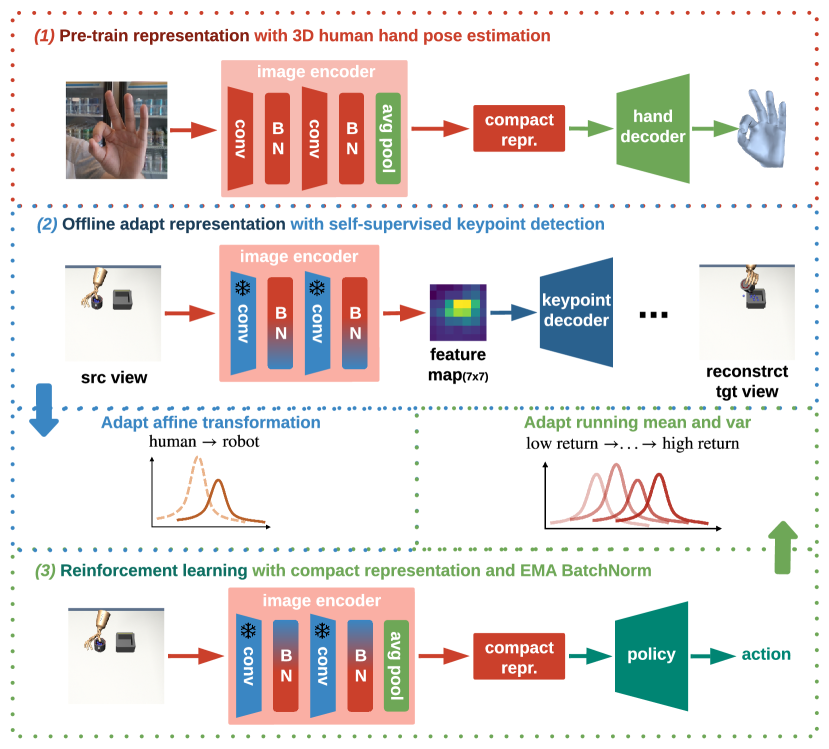
Human hands possess remarkable dexterity and have long served as a source of inspiration for robotic manipulation. In this work, we propose a human $ extbf{H}$and$ extbf{-In}$formed visual representation learning framework to solve difficult $ extbf{Dex}$terous manipulation tasks ($ extbf{H-InDex}$) with reinforcement learning. Our framework consists of three stages: (i) pre-training representations with 3D human hand pose estimation, (ii) offline adapting representations with self-supervised keypoint detection, and (iii) reinforcement learning with exponential moving average BatchNorm. The last two stages only modify $0.36\%$ parameters of the pre-trained representation in total, ensuring the knowledge from pre-training is maintained to the full extent. We empirically study 12 challenging dexterous manipulation tasks and find that H-InDex largely surpasses strong baseline methods and the recent visual foundation models for motor control. Code is available at https://yanjieze.com/H-InDex .
Motivation & Objective
- To improve dexterous manipulation in robotic hands using visual representations derived from human hand dexterity.
- To address the challenge of transferring human hand knowledge to robotic policy learning in visual reinforcement learning.
- To minimize catastrophic forgetting during adaptation by updating only a small fraction of parameters in pre-trained models.
- To demonstrate that off-the-shelf human hand pose estimators can serve as effective visual priors for robotic control without full retraining.
Proposed method
- Pre-trains visual representations using a 3D human hand pose estimator (FrankMocap) to embed human dexterity into the feature encoder.
- Adapts the pre-trained representation via self-supervised keypoint detection, updating only 0.18% of parameters (affine transformations in BatchNorm layers).
- Applies exponential moving average (EMA) BatchNorm during reinforcement learning to dynamically adjust normalization statistics for better adaptation.
- Maintains the convolutional backbone frozen during adaptation, preserving pre-trained knowledge while enabling domain shift generalization.
- Uses a standard visual RL pipeline with the adapted representation as input, keeping policy and reward design unchanged for orthogonal evaluation.
- Employs a three-stage pipeline: (1) pre-training on human hand pose, (2) offline adaptation with minimal fine-tuning, (3) end-to-end RL training with EMA BatchNorm.
![Figure 1 : Normalized average score for our algorithm H-InDex and the baselines (VC-1 [ 17 ] , MVP [ 31 ] , R3M [ 18 ] , and RRL [ 27 ] ).](https://ar5iv.labs.arxiv.org/html/2310.01404/assets/x1.png)
Experimental results
Research questions
- RQ1Can pre-trained 3D human hand pose representations improve sample efficiency and performance in robotic dexterous manipulation tasks?
- RQ2Does fine-tuning only a small subset of parameters (0.18%) in a pre-trained visual model preserve human dexterity while adapting to robotic domains?
- RQ3How does EMA BatchNorm improve policy training stability and performance in visual RL with adapted representations?
- RQ4Can a model pre-trained for human hand understanding generalize effectively to robotic manipulation tasks without task-specific pre-training?
- RQ5How does H-InDex compare to recent visual foundation models like VC-1, MVP, and R3M in terms of performance and robustness?
Key findings
- H-InDex outperforms strong baselines including VC-1, MVP, R3M, and RRL across 12 challenging dexterous manipulation tasks, as shown in normalized average score comparisons.
- The method achieves superior performance by preserving 99.64% of the pre-trained model’s parameters, minimizing catastrophic forgetting during adaptation.
- Adapting only 0.18% of parameters (BatchNorm affine weights) yields better results than fine-tuning all parameters, confirming the benefit of parameter-efficient adaptation.
- EMA BatchNorm in Stage 3 significantly improves training stability and final performance, as ablation studies confirm its necessity.
- H-InDex generalizes better than VC-1 to novel backgrounds, as demonstrated in the relocate potted meat can task with changed scene backgrounds.
- Visualization confirms that the adapted model successfully attends to hand and object keypoints, even with minimal parameter updates, indicating effective feature alignment.
Better researchstarts right now
From reading papers to final review, dramatically reduce your research time.
No credit card · Free plan available
This review was created by AI and reviewed by human editors.