
[Paper Review] Habits of Mind: Reusing Action Sequences for Efficient Planning
This paper proposes MCTS-with-HABITS, a planning algorithm that leverages Bayesian action chunking to reuse statistically reliable action sequences from past experience, improving planning efficiency by biasing tree search toward frequently used paths and enabling multi-step expansions. The method reduces search depth and node count, significantly accelerating solution finding in physical construction tasks while maintaining accuracy.
When we exercise sequences of actions, their execution becomes more fluent and precise. Here, we consider the possibility that exercised action sequences can also be used to make planning faster and more accurate by focusing expansion of the search tree on paths that have been frequently used in the past, and by reducing deep planning problems to shallow ones via multi-step jumps in the tree. To capture such sequences, we use a flexible Bayesian action chunking mechanism which finds and exploits statistically reliable structure at different scales. This gives rise to shorter or longer routines that can be embedded into a Monte-Carlo tree search planner. We show the benefits of this scheme using a physical construction task patterned after tangrams.
Motivation & Objective
- To investigate whether repeated action sequences from past experience can be reused to accelerate planning.
- To develop a computationally efficient, cognitively plausible method for integrating learned action patterns into Monte-Carlo Tree Search (MCTS).
- To reduce the computational burden of deep planning by replacing long action sequences with reusable chunks.
- To test whether such chunk reuse improves performance under resource constraints in a physically constrained construction task.
- To explore how value-free statistical regularities in behavior can guide model-based planning.
Proposed method
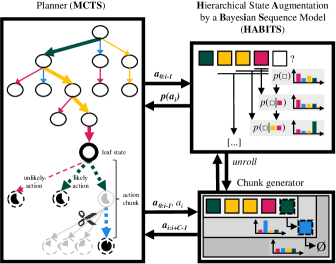
- A hierarchical Dirichlet process (HDP) Bayesian sequence model is used to discover statistically reliable action sequences of varying lengths from past planning episodes.
- The HABITS model infers multi-step action chunks that are predictably repeated in the action trace, enabling open-loop, multi-step tree expansions.
- The MCTS-with-HABITS algorithm integrates the HABITS model into the tree policy, favoring actions and action chunks with higher predicted likelihoods.
- The planner uses both one-step action predictions and multi-step chunk expansions, with chunks allowing jumps over intermediate states and reducing tree depth.
- Node values are estimated via rollouts using a uniform random policy, and results are backpropagated through the tree.
- The system balances exploration and exploitation using an Upper Confidence Bound (UCB) style bonus in the tree policy.
Experimental results
Research questions
- RQ1Can past action sequences be leveraged to improve planning efficiency in complex, deep decision problems?
- RQ2Does reusing statistically reliable action chunks reduce the number of nodes evaluated during planning?
- RQ3To what extent do multi-step action expansions enable deeper search with fewer computational resources?
- RQ4How does the integration of value-free statistical patterns (action chunks) enhance model-based planning?
- RQ5Is the use of action chunks a cognitively plausible strategy for reducing planning costs?
Key findings
- The MCTS-with-HABITS model evaluated significantly fewer nodes than the baseline MCTS, achieving faster solution discovery under node budget constraints.
- The model preferred action chunks over primitive actions when the same chunked path had higher predicted likelihood and comparable or better value.
- Multi-step expansions enabled deeper exploration along predictable paths, effectively reducing the effective depth of the search tree.
- In sequence-ambiguous problems, solutions preserving learned chunks were preferred by the model, indicating robust reuse of action patterns.
- The full MCTS-with-HABITS model found solutions with the least number of node evaluations across all tested conditions.
- The method demonstrated a clear trade-off between planning cost and performance, favoring efficient, shallow search along reliable paths.
Read this paper
Open the full text in the Nubint reader and ask about any passage as you read.
Read this paper on NubintThis review was generated by AI from the original paper. Please check the paper before citing it.