
[Paper Review] Halo: Estimation and Reduction of Hallucinations in Open-Source Weak Large Language Models
This paper proposes HaloCheck, a lightweight BlackBox framework to estimate hallucination severity in open-source small LLMs like BLOOM7B, and introduces knowledge injection and a selective teacher-student distillation approach to reduce hallucinations. It demonstrates that combining knowledge injection with dynamic teacher guidance significantly improves factual consistency, reducing reliance on the teacher while outperforming baseline fine-tuning across multiple hallucination thresholds.
Large Language Models (LLMs) have revolutionized Natural Language Processing (NLP). Although convenient for research and practical applications, open-source LLMs with fewer parameters often suffer from severe hallucinations compared to their larger counterparts. This paper focuses on measuring and reducing hallucinations in BLOOM 7B, a representative of such weaker open-source LLMs that are publicly available for research and commercial applications. We introduce HaloCheck, a lightweight BlackBox knowledge-free framework designed to quantify the severity of hallucinations in LLMs. Additionally, we explore techniques like knowledge injection and teacher-student approaches to alleviate hallucinations in low-parameter LLMs. Our experiments effectively demonstrate the reduction of hallucinations in challenging domains for these LLMs.
Motivation & Objective
- To address the lack of effective, automated metrics for quantifying hallucination severity in smaller, open-source LLMs.
- To enhance factual knowledge in weak LLMs without relying on instruction tuning or costly human-generated prompts.
- To investigate whether a stronger teacher model (e.g., GPT-4) can guide weaker LLMs effectively while minimizing computational cost.
- To evaluate the synergy between knowledge injection and teacher-student distillation in reducing hallucinations in low-parameter models.
Proposed method
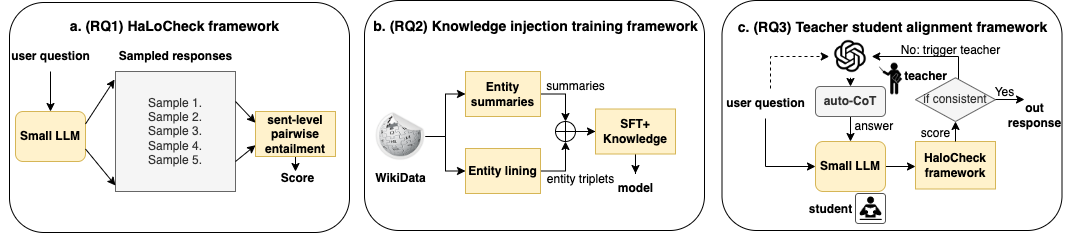
- HaloCheck uses a sampling-based, BlackBox approach that evaluates sentence-level entailment across multiple model generations to estimate hallucination severity.
- Knowledge injection is performed via fine-tuning BLOOM7B with entity summaries and triplets from WikiData, enhancing domain-specific factual knowledge without instruction tuning.
- A teacher-student distillation framework selectively invokes GPT-4 for high-hallucination instances, using auto-CoT to improve reasoning quality in teacher outputs.
- The framework employs a threshold-based strategy to trigger teacher involvement only when hallucination severity exceeds a predefined level, optimizing cost and consistency.
- Model consistency is evaluated using a domain-specific NBA question-answering dataset, with hallucination severity measured via entailment-based agreement across generations.
Experimental results
Research questions
- RQ1How can we quantify the severity of hallucinations in LLMs in a knowledge-free, automated, and efficient manner?
- RQ2Can knowledge injection enhance factual consistency in weak LLMs without instruction tuning?
- RQ3Can a stronger teacher LLM improve the consistency of weaker LLMs, and does selective engagement reduce computational cost?
- RQ4How do knowledge injection and teacher-student distillation interact to reduce hallucinations?
Key findings
- HaloCheck outperforms existing BlackBox metrics in estimating hallucination severity, offering a fast and accurate method for evaluating model consistency.
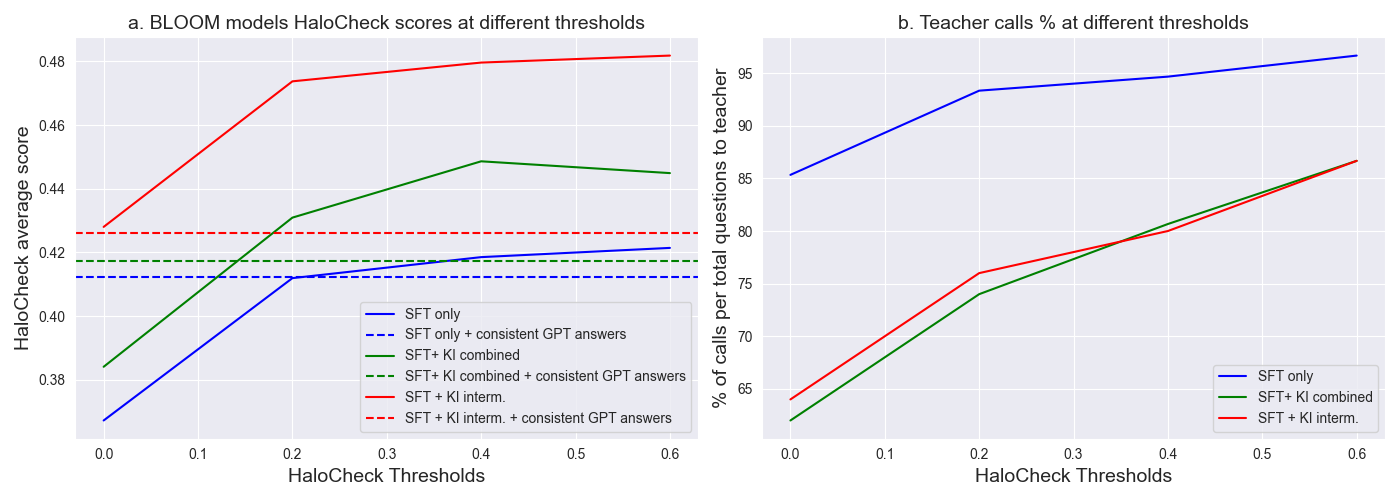
- Knowledge injection using WikiData entity summaries and triplets significantly improves factual consistency, reducing hallucinations across all thresholds.
- Models using both knowledge injection and selective teacher guidance outperform SFT-only models, especially at higher hallucination thresholds (e.g., 0.2), with improved consistency and reduced reliance on teacher queries.
- Restricting teacher involvement to high-hallucination instances leads to better performance than constant teacher use, demonstrating the value of dynamic engagement.
- Even with knowledge injection, ~65% of questions still require teacher assistance at the 0 threshold, indicating persistent inconsistency in the base model.
- Incorrect teacher answers can mislead the student model, but auto-CoT in teacher responses helps mitigate such errors by providing more detailed reasoning.
Read this paper
Open the full text in the Nubint reader and ask about any passage as you read.
Read this paper on NubintThis review was generated by AI from the original paper. Please check the paper before citing it.