
[Paper Review] HAN: An Efficient Hierarchical Self-Attention Network for Skeleton-Based Gesture Recognition
This paper proposes HAN, a lightweight hierarchical self-attention network for skeleton-based gesture recognition that replaces CNNs, RNNs, and GCNs with pure self-attention mechanisms. By modeling hand joints hierarchically—capturing finger-level features via joint self-attention, hand-level aggregation via finger self-attention, temporal dynamics via temporal self-attention, and final fusion via fusion self-attention—the method achieves state-of-the-art accuracy on three benchmark datasets with significantly reduced computational complexity.
Previous methods for skeleton-based gesture recognition mostly arrange the skeleton sequence into a pseudo picture or spatial-temporal graph and apply deep Convolutional Neural Network (CNN) or Graph Convolutional Network (GCN) for feature extraction. Although achieving superior results, these methods have inherent limitations in dynamically capturing local features of interactive hand parts, and the computing efficiency still remains a serious issue. In this work, the self-attention mechanism is introduced to alleviate this problem. Considering the hierarchical structure of hand joints, we propose an efficient hierarchical self-attention network (HAN) for skeleton-based gesture recognition, which is based on pure self-attention without any CNN, RNN or GCN operators. Specifically, the joint self-attention module is used to capture spatial features of fingers, the finger self-attention module is designed to aggregate features of the whole hand. In terms of temporal features, the temporal self-attention module is utilized to capture the temporal dynamics of the fingers and the entire hand. Finally, these features are fused by the fusion self-attention module for gesture classification. Experiments show that our method achieves competitive results on three gesture recognition datasets with much lower computational complexity.
Motivation & Objective
- To address the limitations of CNNs and GCNs in capturing dynamic, interactive features among skeleton joints in gesture recognition.
- To overcome the fixed structural constraints of pseudo-images and spatial-temporal graphs in modeling joint interactions.
- To design a lightweight, efficient deep learning architecture for real-time skeleton-based gesture recognition.
- To exploit the hierarchical structure of hand joints (fingers and palm) to improve feature representation and classification accuracy.
Proposed method
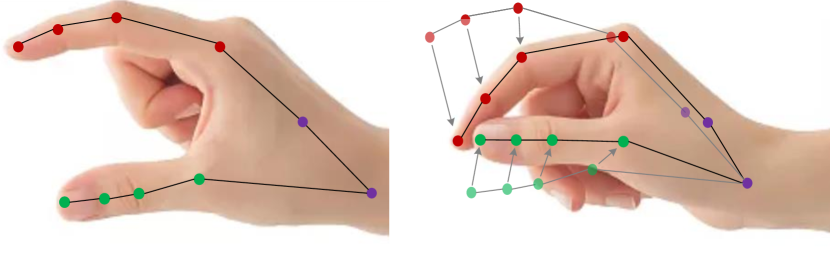
- The method divides hand joints into 6 parts (5 fingers and palm) to enable hierarchical feature learning.
- Joint self-attention (J-Att) captures spatial features within each finger by modeling attention among its four joints.
- Finger self-attention (F-Att) aggregates features across all fingers and the palm to form a holistic hand representation.
- Temporal self-attention (T-Att) models long-range temporal dependencies across frames for both finger-level and hand-level features.
- Fusion self-attention (Fusion-Att) combines temporal features from fingers and hand for final gesture classification.
- The network uses multi-head self-attention with shared weights across J-Att and T-Att modules to reduce parameters and prevent overfitting.
Experimental results
Research questions
- RQ1Can a pure self-attention mechanism outperform CNN- and GCN-based methods in skeleton-based gesture recognition while reducing computational cost?
- RQ2How effectively can hierarchical attention capture local finger dynamics and global hand interactions in gesture sequences?
- RQ3Does attention visualization confirm that the model focuses on the most discriminative joints and frames during gesture recognition?
- RQ4What hyper-parameter settings (e.g., head count, dimension, dropout) yield optimal performance on small gesture datasets?
- RQ5Can weight sharing across J-Att and T-Att modules maintain performance while reducing model complexity?
Key findings
- HAN achieves 95.00% accuracy on the SHREC’17 Track 14-gesture dataset, outperforming prior methods with significantly lower computational complexity.
- The optimal number of attention heads is 8, with performance saturating beyond this point.
- A head dimension of 32 provides the best balance between feature representation and overfitting.
- A dropout rate of 0.1 yields the best generalization, with higher rates causing underfitting.
- Weight sharing in both J-Att and T-Att modules reduces parameters and improves performance, achieving 95.00% accuracy.
- Attention visualization confirms that the model focuses on the most dynamic joints (e.g., thumb and index finger in 'Pinch') and key frames, validating its interpretability.
Read this paper
Open the full text in the Nubint reader and ask about any passage as you read.
Read this paper on NubintThis review was generated by AI from the original paper. Please check the paper before citing it.