
[Paper Review] Hand-Object Contact Consistency Reasoning for Human Grasps Generation
This paper proposes a novel framework for generating natural and stable human grasps on 3D objects by enforcing hand-object contact consistency. It introduces a dual-network architecture with a CVAE-based grasp generator and a contact map predictor, using self-supervised test-time adaptation to improve generalization on unseen and out-of-domain objects, achieving state-of-the-art performance in grasp quality and stability.
While predicting robot grasps with parallel jaw grippers have been well studied and widely applied in robot manipulation tasks, the study on natural human grasp generation with a multi-finger hand remains a very challenging problem. In this paper, we propose to generate human grasps given a 3D object in the world. Our key observation is that it is crucial to model the consistency between the hand contact points and object contact regions. That is, we encourage the prior hand contact points to be close to the object surface and the object common contact regions to be touched by the hand at the same time. Based on the hand-object contact consistency, we design novel objectives in training the human grasp generation model and also a new self-supervised task which allows the grasp generation network to be adjusted even during test time. Our experiments show significant improvement in human grasp generation over state-of-the-art approaches by a large margin. More interestingly, by optimizing the model during test time with the self-supervised task, it helps achieve larger gain on unseen and out-of-domain objects. Project page: https://hwjiang1510.github.io/GraspTTA/
Motivation & Objective
- To address the challenge of generating natural, physically plausible human grasps on 3D objects with complex hand-object interactions.
- To model mutual consistency between predicted hand contact points and object contact regions to improve grasp realism and stability.
- To enable test-time adaptation without ground-truth supervision by leveraging self-supervised consistency between hand and object contact predictions.
- To improve generalization to out-of-domain and unseen objects through online, adaptive refinement during inference.
Proposed method
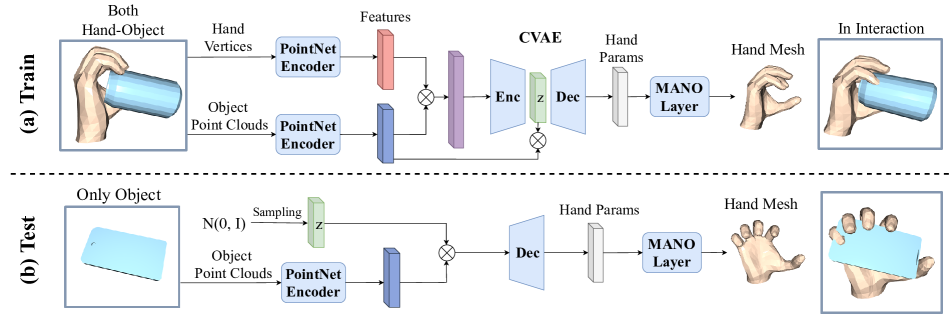
- A Conditional Variational Autoencoder (CVAE) is trained to generate MANO hand parameters conditioned on 3D object point clouds, with novel losses enforcing hand proximity to object surface and alignment with ground-truth contact regions.
- A separate ContactNet is trained to predict object contact maps from the generated hand pose and object geometry, providing supervision for test-time adaptation.
- A self-supervised consistency loss is introduced to align predicted hand contact points with the object contact map from ContactNet during test-time adaptation.
- Test-time adaptation (TTA) is performed online by fine-tuning the grasp generator using the consistency loss, enabling dynamic refinement per test instance without external supervision.
- The framework supports both offline and online TTA variants, with online TTA showing superior performance due to continual optimization.
- The method leverages mutual consistency between hand and object contact to guide both training and inference, enhancing stability and reducing penetration.

Experimental results
Research questions
- RQ1How can hand-object contact consistency be modeled to improve the realism and stability of generated human grasps?
- RQ2Can a self-supervised task based on contact consistency enable effective test-time adaptation for unseen or out-of-domain objects?
- RQ3How does enforcing mutual agreement between hand contact points and object contact regions affect generalization in zero-shot and cross-domain settings?
- RQ4What is the impact of online vs. offline test-time adaptation on grasp quality and penetration control?
Key findings
- The proposed method achieves significant improvements in grasp generation quality over state-of-the-art approaches, especially on unseen and out-of-domain objects.
- Online test-time adaptation (TTA) yields the largest performance gain, reducing penetration depth and increasing contact ratio while maintaining low simulation displacement.
- The self-supervised consistency task enables effective adaptation without ground-truth labels, improving grasp stability and naturalness on novel inputs.
- Contact consistency constraints during training lead to more physically plausible grasps with reduced hand-object penetration and better contact distribution.
- On the HO-3D and FPHA datasets, the method outperforms baseline models and even matches or exceeds ground truth in terms of stability and penetration balance.
- The online TTA variant achieves superior results compared to offline counterparts, demonstrating the benefit of continual optimization during inference.
Read this paper
Open the full text in the Nubint reader and ask about any passage as you read.
Read this paper on NubintThis review was generated by AI from the original paper. Please check the paper before citing it.