
[Paper Review] Haptic Transparency and Interaction Force Control for a Lower-Limb Exoskeleton
This paper proposes a whole-exoskeleton closed-loop compensation (WECC) method for lower-limb exoskeletons with feet, using whole-body dynamics and joint torque measurements to accurately track desired interaction torques in real time. The WECC controller achieves consistently low interaction torque error across the gait cycle, outperforming simplified models and passive exoskeletons in transparency and force tracking.
Controlling the interaction forces between a human and an exoskeleton is crucial for providing transparency or adjusting assistance or resistance levels. However, it is an open problem to control the interaction forces of lower-limb exoskeletons designed for unrestricted overground walking. For these types of exoskeletons, it is challenging to implement force/torque sensors at every contact between the user and the exoskeleton for direct force measurement. Moreover, it is important to compensate for the exoskeleton's whole-body gravitational and dynamical forces, especially for heavy lower-limb exoskeletons. Previous works either simplified the dynamic model by treating the legs as independent double pendulums, or they did not close the loop with interaction force feedback. The proposed whole-exoskeleton closed-loop compensation (WECC) method calculates the interaction torques during the complete gait cycle by using whole-body dynamics and joint torque measurements on a hip-knee exoskeleton. Furthermore, it uses a constrained optimization scheme to track desired interaction torques in a closed loop while considering physical and safety constraints. We evaluated the haptic transparency and dynamic interaction torque tracking of WECC control on three subjects. We also compared the performance of WECC with a controller based on a simplified dynamic model and a passive version of the exoskeleton. The WECC controller results in a consistently low absolute interaction torque error during the whole gait cycle for both zero and nonzero desired interaction torques. In contrast, the simplified controller yields poor performance in tracking desired interaction torques during the stance phase.
Motivation & Objective
- Address the challenge of controlling interaction forces in floating-base lower-limb exoskeletons with feet, which lack direct ground contact and face high inertial and gravitational loads.
- Overcome limitations of prior methods that use simplified dynamic models (e.g., independent double pendulums) or lack interaction force feedback.
- Enable accurate, safe, and transparent human-robot interaction during unrestricted overground walking by compensating for the exoskeleton’s full-body dynamics and gravity.
- Develop a constrained optimization-based control framework that respects physical and safety limits while tracking desired interaction torques.
- Validate the method’s performance in transparency and haptic rendering tasks across multiple human subjects.
Proposed method
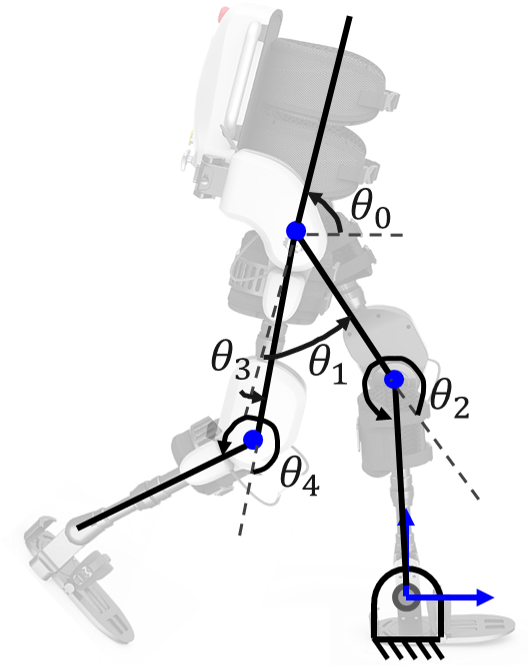
- Formulate a whole-exoskeleton dynamic model that captures the coupled motion of the entire system, including both legs and the trunk, during gait.
- Use joint torque sensors and ground reaction force measurements to estimate interaction torques via a closed-loop feedback mechanism.
- Implement a constrained optimization scheme to compute the required joint torques that minimize the error between actual and desired interaction torques.
- Apply interpolation between left and right stance dynamics using a time-varying factor α derived from vertical ground reaction forces.
- Model the exoskeleton’s gravity and Coriolis/centrifugal forces using a full-body dynamics formulation, including reflected inertia from foot-ground contact.
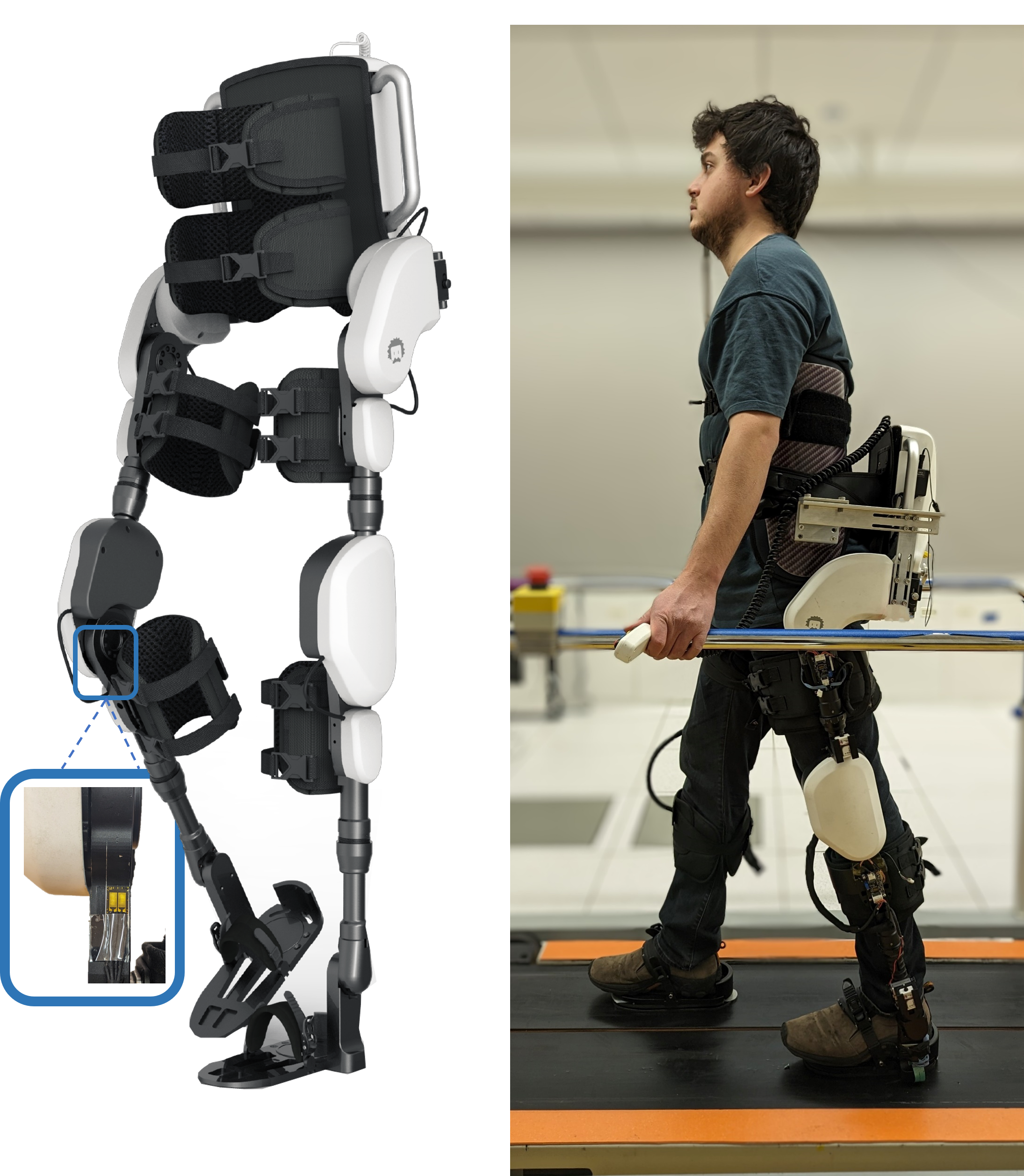
- Integrate the controller into a real-time system on the ExoMotus-X2 exoskeleton for human-in-the-loop testing.
Experimental results
Research questions
- RQ1Can a whole-exoskeleton closed-loop control method achieve accurate interaction torque tracking during overground walking in a floating-base exoskeleton with feet?
- RQ2How does the performance of the WECC controller compare to a simplified dynamic model and a passive exoskeleton in terms of interaction torque error and transparency?
- RQ3To what extent does the WECC method maintain low error across the entire gait cycle, including double-stance phases?
- RQ4How does the controller handle the challenge of compensating for the exoskeleton’s full-body gravity and dynamic effects under varying load conditions?
- RQ5Can the WECC controller support both transparent control (zero interaction force) and haptic rendering (nonzero interaction torque) with consistent performance?
Key findings
- The WECC controller achieves consistently low absolute interaction torque error throughout the entire gait cycle, including during double-stance and stance phases.
- For zero desired interaction torque (transparency condition), the WECC controller maintains near-zero interaction torque error, demonstrating high haptic transparency.
- In haptic rendering tasks with nonzero desired torques, the WECC controller tracks the reference torques with minimal error, confirming effective force modulation.
- The simplified controller based on independent double-pendulum dynamics exhibits poor tracking performance during the stance phase, particularly in high-inertia conditions.
- The passive exoskeleton shows significantly higher interaction torque errors compared to both active controllers, highlighting the necessity of active compensation.
- Joint trajectories during WECC trials show reduced range of motion during haptic rendering, consistent with the applied virtual spring and damper forces.
Better researchstarts right now
From reading papers to final review, dramatically reduce your research time.
No credit card · Free plan available
This review was created by AI and reviewed by human editors.