
[Paper Review] HEAL-ViT: Vision Transformers on a spherical mesh for medium-range weather forecasting
HEAL-ViT introduces a novel architecture that applies Vision Transformers (ViT) to a spherical mesh for medium-range weather forecasting, combining the spatial homogeneity of graph-based models with the efficient attention mechanisms of ViTs. It achieves superior performance over ECMWF IFS in key metrics, with reduced bias accumulation and blurring, while maintaining a lower compute footprint for operational use.
In recent years, a variety of ML architectures and techniques have seen success in producing skillful medium range weather forecasts. In particular, Vision Transformer (ViT)-based models (e.g. Pangu-Weather, FuXi) have shown strong performance, working nearly "out-of-the-box" by treating weather data as a multi-channel image on a rectilinear grid. While a rectilinear grid is appropriate for 2D images, weather data is inherently spherical and thus heavily distorted at the poles on a rectilinear grid, leading to disproportionate compute being used to model data near the poles. Graph-based methods (e.g. GraphCast) do not suffer from this problem, as they map the longitude-latitude grid to a spherical mesh, but are generally more memory intensive and tend to need more compute resources for training and inference. While spatially homogeneous, the spherical mesh does not lend itself readily to be modeled by ViT-based models that implicitly rely on the rectilinear grid structure. We present HEAL-ViT, a novel architecture that uses ViT models on a spherical mesh, thus benefiting from both the spatial homogeneity enjoyed by graph-based models and efficient attention-based mechanisms exploited by transformers. HEAL-ViT produces weather forecasts that outperform the ECMWF IFS on key metrics, and demonstrate better bias accumulation and blurring than other ML weather prediction models. Further, the lowered compute footprint of HEAL-ViT makes it attractive for operational use as well, where other models in addition to a 6-hourly prediction model may be needed to produce the full set of operational forecasts required.
Motivation & Objective
- To address the spatial inhomogeneity and pole distortion inherent in rectilinear grids used by standard Vision Transformers in weather modeling.
- To combine the benefits of spherical mesh representations—spatial homogeneity—with the long-range attention capabilities of Vision Transformers.
- To reduce computational and memory overhead compared to graph-based models like GraphCast, enabling practical operational deployment.
- To improve forecast quality by minimizing bias accumulation and blurring, especially in small-scale atmospheric features.
- To enable the use of standard ViT architectures on spherical meshes, facilitating integration with advancements in computer vision.
Proposed method
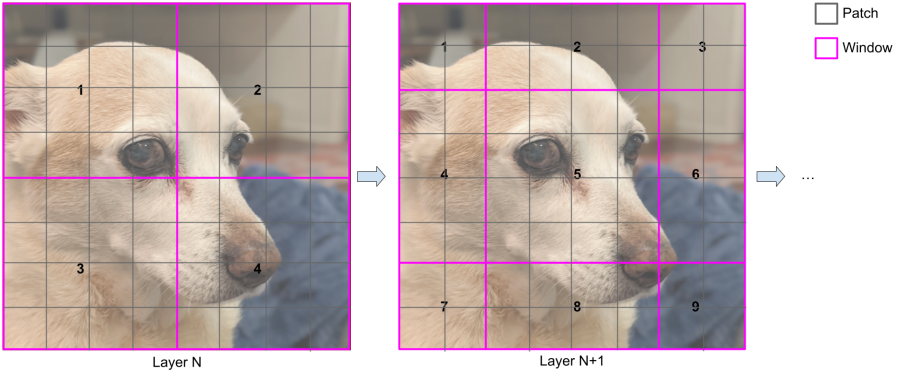
- Adapts the SWIN Transformer architecture to operate on a HEALPix spherical mesh instead of a rectilinear grid.
- Uses a graph-based encoder to map longitude-latitude grid data to a spherical icosahedral mesh with uniform node distribution.
- Employs a standard Vision Transformer processor on the spherical mesh to model long-range atmospheric teleconnections efficiently.
- Applies a graph-based decoder to map the processed mesh back to the original longitude-latitude forecast grid.
- Introduces a mesh-to-grid attention mechanism that preserves spatial structure during encoding and decoding.
- Leverages the regular ring structure of the HEALPix mesh to support localized attention and context window mechanisms.
Experimental results
Research questions
- RQ1Can Vision Transformers be effectively applied to a spherical mesh to improve medium-range weather forecasting?
- RQ2Does using a spatially homogeneous spherical mesh reduce bias accumulation and blurring compared to rectilinear grid-based ViT models?
- RQ3Can the computational efficiency of ViT-based models be preserved while operating on a spherical mesh, enabling operational deployment?
- RQ4How does the performance of HEAL-ViT compare to state-of-the-art models like ECMWF IFS and GraphCast in terms of RMSE, bias, and spectral energy distribution?
- RQ5To what extent does the choice of encoder and mesh structure influence forecast quality and spectral fidelity?
Key findings
- HEAL-ViT outperforms the ECMWF IFS model in key forecast quality metrics, including RMSE reduction across multiple atmospheric variables.
- HEAL-ViT demonstrates significantly reduced bias accumulation over time compared to other ML weather prediction models.
- The model produces less blurred forecasts, as evidenced by higher zonal energy spectra at smaller scales—particularly for WS10 and Z500—indicating better preservation of small-scale atmospheric features.
- HEAL-ViT maintains relatively constant energy spectra across lead times, similar to the ERA5-IFS baseline, suggesting stable forecast dynamics.
- The model's memory and compute footprint are lower than graph-based models like GraphCast, making it suitable for operational environments requiring multiple concurrent forecasts.
- The encoder’s use of a spherical mesh reduces spectral spikes seen in patch-based encoders (e.g., FuXi), indicating fewer artifacts from grid-to-mesh discretization.

Read this paper
Open the full text in the Nubint reader and ask about any passage as you read.
Read this paper on NubintThis review was generated by AI from the original paper. Please check the paper before citing it.