
[Paper Review] Health-LLM: Large Language Models for Health Prediction via Wearable Sensor Data
The paper evaluates eight state-of-the-art LLMs on 13 health-prediction tasks using six public wearable-sensor datasets, showing that context-enhanced prompts and fine-tuned Health-Alpaca achieve strong performance, sometimes rivaling GPT-4/3.5. It also analyzes prompt context types and dataset generalization.
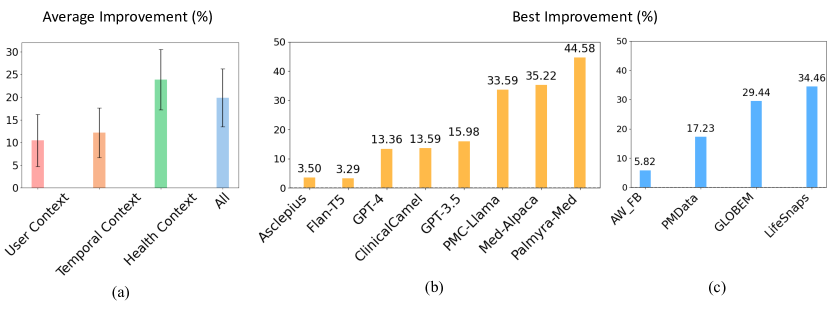
Large language models (LLMs) are capable of many natural language tasks, yet they are far from perfect. In health applications, grounding and interpreting domain-specific and non-linguistic data is crucial. This paper investigates the capacity of LLMs to make inferences about health based on contextual information (e.g. user demographics, health knowledge) and physiological data (e.g. resting heart rate, sleep minutes). We present a comprehensive evaluation of 12 state-of-the-art LLMs with prompting and fine-tuning techniques on four public health datasets (PMData, LifeSnaps, GLOBEM and AW_FB). Our experiments cover 10 consumer health prediction tasks in mental health, activity, metabolic, and sleep assessment. Our fine-tuned model, HealthAlpaca exhibits comparable performance to much larger models (GPT-3.5, GPT-4 and Gemini-Pro), achieving the best performance in 8 out of 10 tasks. Ablation studies highlight the effectiveness of context enhancement strategies. Notably, we observe that our context enhancement can yield up to 23.8% improvement in performance. While constructing contextually rich prompts (combining user context, health knowledge and temporal information) exhibits synergistic improvement, the inclusion of health knowledge context in prompts significantly enhances overall performance.
Motivation & Objective
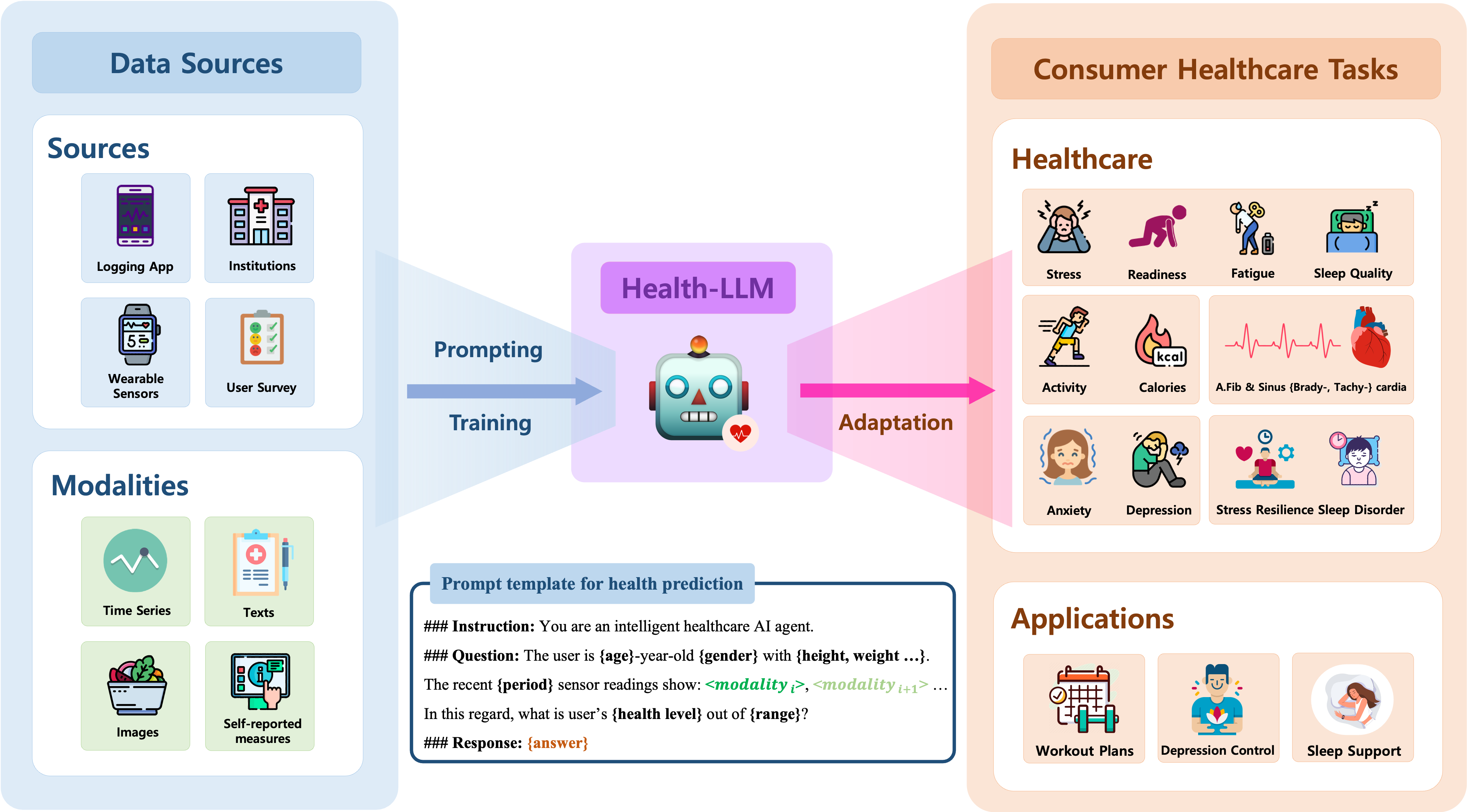
- Bridge the gap between pre-trained LLM knowledge and consumer health problems using multi-modal wearable sensor data.
- Assess zero-shot, few-shot, and fine-tuned LLM performance on 13 health-prediction tasks.
- Investigate the impact of prompting context (user health knowledge, temporal context) on model performance.
- Compare a range of open and closed LLMs to establish practical guidance for health-domain applications.
Proposed method
- Evaluate eight LLMs (Med-Alpaca, PMC-Llama, Asclepius, ClinicalCamel, Flan-T5, Palmyra-Med, GPT-3.5, GPT-4) on 13 tasks across six datasets.
- Use zero-shot, few-shot with CoT and SC, instructional fine-tuning, and PEFT tuning (LoRA) regimes.
- Introduce context-enhancement prompts with: 1) user context, 2) health knowledge context, 3) temporal context, 4) combinations of these.
- Fine-tune a health-oriented model Health-Alpaca (and Health-Alpaca-LoRa) and compare to larger GPT models.
- Assess generalization across datasets and analyze training-size effects for fine-tuning.
- Provide an open-source Health-LLM framework and a Health-Alpaca model.
Experimental results
Research questions
- RQ1Can off-the-shelf LLMs ground multi-modal wearable sensor data for health prediction tasks?
- RQ2How do prompting strategies (zero-shot vs few-shot with CoT/SC) affect performance on health prediction using wearables?
- RQ3Does instructional or PEFT fine-tuning enable smaller models to match or beat larger LLMs on health tasks?
- RQ4What is the benefit of context-enhanced prompts (user, health knowledge, temporal) in health predictions?
- RQ5How well do fine-tuned Health-LLMs generalize across datasets and different task types?
Key findings
- Zero-shot prompting yields competitive results against task-specific baselines for some tasks.
- Few-shot prompting with GPT-3.5/GPT-4 yields significant improvements over zero-shot for numerical time-series grounding, outperforming some baselines.
- The Health-Alpaca model (25x–250x smaller than GPT-3.5/4) achieves best performance on 5 of 13 tasks when fully fine-tuned.
- Context enhancement can boost performance by up to 23.8% depending on task, dataset, and model, with health-knowledge context often providing the strongest gains.
- Health-Alpaca-LoRa also improves many tasks, showing the viability of parameter-efficient fine-tuning for health tasks.
- Fine-tuning on a single dataset often yields strong results, but multi-dataset Health-Alpaca demonstrates reasonable generalization across tasks.
Read this paper
Open the full text in the Nubint reader and ask about any passage as you read.
Read this paper on NubintThis review was generated by AI from the original paper. Please check the paper before citing it.