
[Paper Review] HETAL: Efficient Privacy-preserving Transfer Learning with Homomorphic Encryption
HETAL provides practical encrypted training for transfer learning using CKKS, achieving near-nonencrypted accuracy with significantly accelerated encrypted matrix multiplication and a wide-domain softmax approximation, enabling training on multiple benchmarks within an hour.
Transfer learning is a de facto standard method for efficiently training machine learning models for data-scarce problems by adding and fine-tuning new classification layers to a model pre-trained on large datasets. Although numerous previous studies proposed to use homomorphic encryption to resolve the data privacy issue in transfer learning in the machine learning as a service setting, most of them only focused on encrypted inference. In this study, we present HETAL, an efficient Homomorphic Encryption based Transfer Learning algorithm, that protects the client's privacy in training tasks by encrypting the client data using the CKKS homomorphic encryption scheme. HETAL is the first practical scheme that strictly provides encrypted training, adopting validation-based early stopping and achieving the accuracy of nonencrypted training. We propose an efficient encrypted matrix multiplication algorithm, which is 1.8 to 323 times faster than prior methods, and a highly precise softmax approximation algorithm with increased coverage. The experimental results for five well-known benchmark datasets show total training times of 567-3442 seconds, which is less than an hour.
Motivation & Objective
- Address client privacy in transfer learning by performing encrypted training on the server side.
- Leverage CKKS homomorphic encryption to enable training on encrypted data.
- Develop and evaluate efficient encrypted matrix multiplication and softmax approximation to reduce computation.
- Demonstrate that encrypted training can match nonencrypted accuracy on standard benchmarks.
Proposed method
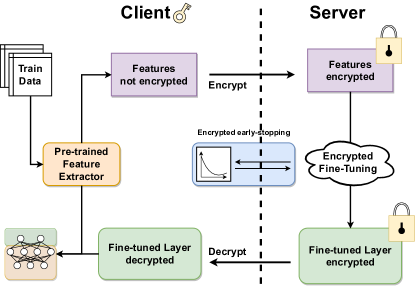
- Use CKKS-based homomorphic encryption to encrypt client features before server-side transfer learning.
- Apply validation-based early stopping to regulate training without exposing plaintext data.
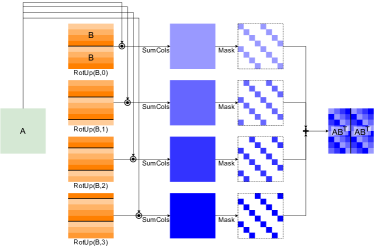
- Propose DiagABT and DiagATB encrypted matrix multiplication algorithms to speed up AB^T and A^T B computations.
- Introduce a wide-domain softmax approximation (ASoftmax) with domain extension to enable training over many epochs.
- Provide theoretical error bounds for the softmax approximation.
- Evaluate on five benchmarks with pre-trained feature extractors (ViT, MPNet) and report training times and accuracy.
Experimental results
Research questions
- RQ1Can encrypted transfer learning with CKKS achieve competitive accuracy compared to plaintext training?
- RQ2How can encrypted matrix multiplications be optimized to dramatically reduce training time under homomorphic encryption?
- RQ3Can a softmax approximation with an expanded domain support long training runs without large accuracy loss?
- RQ4What are the practical runtimes and accuracy trade-offs of HETAL on diverse datasets and pre-trained models?
Key findings
- Encrypted training attains 0.5% maximum accuracy loss relative to plaintext on the tested datasets.
- Total training times range from 567 to 3442 seconds (less than an hour) across five benchmarks.
- Accuracy with encryption drops are at most 0.51% (MNIST) and as low as 0.00% (Face Mask Detection) for certain datasets.
- Matrix multiplication optimizations (DiagABT/DiagATB) achieve 1.8 to 323x speedups over prior methods.
- ASoftmax provides high-precision softmax approximation over [-128,128], enabling extensive training without substantial error.
- Training efficiency is aided by GPU-accelerated CKKS and optimized domain-extension-based softmax.
Read this paper
Open the full text in the Nubint reader and ask about any passage as you read.
Read this paper on NubintThis review was generated by AI from the original paper. Please check the paper before citing it.