
[Paper Review] Hete-CF: Social-Based Collaborative Filtering Recommendation using Heterogeneous Relations
Hete-CF proposes a general collaborative filtering recommendation framework that leverages all three types of relations—user-user, user-item, and item-item—in heterogeneous social networks (e.g., EBSNs, LBSNs) using meta-paths to model heterogeneous relations. By integrating multiple relational signals and dynamically weighting social information, Hete-CF significantly improves recommendation performance on sparse data, as validated on DBLP and Meetup datasets.
Collaborative filtering algorithms haven been widely used in recommender systems. However, they often suffer from the data sparsity and cold start problems. With the increasing popularity of social media, these problems may be solved by using social-based recommendation. Social-based recommendation, as an emerging research area, uses social information to help mitigate the data sparsity and cold start problems, and it has been demonstrated that the social-based recommendation algorithms can efficiently improve the recommendation performance. However, few of the existing algorithms have considered using multiple types of relations within one social network. In this paper, we investigate the social-based recommendation algorithms on heterogeneous social networks and proposed Hete-CF, a Social Collaborative Filtering algorithm using heterogeneous relations. Distinct from the exiting methods, Hete-CF can effectively utilize multiple types of relations in a heterogeneous social network. In addition, Hete-CF is a general approach and can be used in arbitrary social networks, including event based social networks, location based social networks, and any other types of heterogeneous information networks associated with social information. The experimental results on two real-world data sets, DBLP (a typical heterogeneous information network) and Meetup (a typical event based social network) show the effectiveness and efficiency of our algorithm.
Motivation & Objective
- Address data sparsity and cold start problems in collaborative filtering by incorporating rich social relations from heterogeneous networks.
- Overcome the limitation of existing social-based recommendation methods that only exploit partial relations (e.g., user-user or user-item).
- Develop a general-purpose recommendation framework applicable to diverse heterogeneous social networks, including event-based and location-based social networks.
- Intelligently weigh social information to prevent bias when historical user-item ratings are not sparse.
- Integrate multiple heterogeneous relations (user-user, user-item, item-item) into a unified collaborative filtering model using meta-path-based representation.
Proposed method
- Model user-user, user-item, and item-item relations using meta-paths to capture semantic relationships in heterogeneous information networks (HINs).
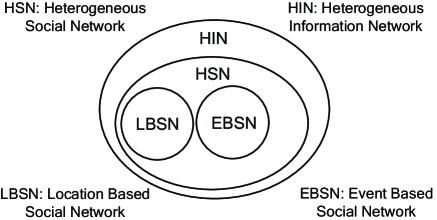
- Construct a unified network structure that combines all three relation types into a single heterogeneous social network (HSN) model.
- Apply a social regularization technique to incorporate social relations into the collaborative filtering framework, enhancing latent factor learning.
- Design a dynamic weighting mechanism to evaluate the contribution of social information based on data sparsity, reducing bias in dense rating scenarios.
- Use matrix factorization with meta-path-aware regularization to learn user and item embeddings that reflect multi-relational interactions.
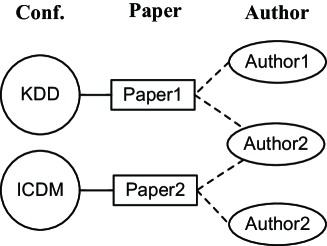
- Leverage the structural information from HINs to propagate preferences across heterogeneous entities (e.g., authors, papers, conferences in DBLP; users, events, locations in Meetup).
Experimental results
Research questions
- RQ1Can a collaborative filtering model effectively utilize multiple types of relations (user-user, user-item, item-item) in heterogeneous social networks to improve recommendation performance?
- RQ2How does the integration of heterogeneous relations impact recommendation accuracy and robustness under data sparsity?
- RQ3Can the proposed method generalize across different types of heterogeneous social networks, such as EBSNs and LBSNs?
- RQ4What is the optimal way to weight social information to avoid bias when user-item rating matrices are not sparse?
- RQ5How does Hete-CF compare to existing social-based and collaborative filtering methods in terms of effectiveness and efficiency?
Key findings
- Hete-CF significantly improves recommendation accuracy on sparse datasets by leveraging multi-relational information from heterogeneous social networks.
- The method achieves better performance than baseline collaborative filtering and social-based recommendation algorithms on both DBLP and Meetup datasets.
- The dynamic weighting mechanism effectively reduces the negative impact of social information when user-item ratings are dense, preventing performance degradation.
- The integration of user-user, user-item, and item-item relations through meta-paths leads to more robust and semantically meaningful user and item representations.
- Hete-CF demonstrates strong generalization capability across diverse heterogeneous social networks, including EBSNs and LBSNs.
- Experimental results confirm that Hete-CF is both effective and efficient, with scalable performance on real-world data.
Read this paper
Open the full text in the Nubint reader and ask about any passage as you read.
Read this paper on NubintThis review was generated by AI from the original paper. Please check the paper before citing it.