
[Paper Review] HIC-YOLOv5: Improved YOLOv5 For Small Object Detection
HIC-YOLOv5 proposes an improved YOLOv5 model for small object detection by introducing a dedicated small object detection head (SODH) for high-resolution feature maps, an involution block to enhance channel information between backbone and neck, and a lightweight CBAM attention module at the backbone end. The method achieves a 6.42% absolute improvement in mAP@[.5:.95] and 9.38% in mAP@0.5 on the VisDrone-2019-DET dataset, with reduced computational cost compared to prior attention-based approaches.
Small object detection has been a challenging problem in the field of object detection. There has been some works that proposes improvements for this task, such as adding several attention blocks or changing the whole structure of feature fusion networks. However, the computation cost of these models is large, which makes deploying a real-time object detection system unfeasible, while leaving room for improvement. To this end, an improved YOLOv5 model: HIC-YOLOv5 is proposed to address the aforementioned problems. Firstly, an additional prediction head specific to small objects is added to provide a higher-resolution feature map for better prediction. Secondly, an involution block is adopted between the backbone and neck to increase channel information of the feature map. Moreover, an attention mechanism named CBAM is applied at the end of the backbone, thus not only decreasing the computation cost compared with previous works but also emphasizing the important information in both channel and spatial domain. Our result shows that HIC-YOLOv5 has improved mAP@[.5:.95] by 6.42% and mAP@0.5 by 9.38% on VisDrone-2019-DET dataset.
Motivation & Objective
- Address the challenge of small object detection in UAV-based imaging, where objects appear tiny due to high-altitude capture.
- Overcome limitations of YOLOv5 in detecting small and tiny objects due to low-resolution feature maps and insufficient channel representation.
- Reduce computational cost while improving detection accuracy compared to existing attention-based or structural modifications.
- Maintain real-time inference capability by minimizing architectural complexity and parameter growth.
Proposed method
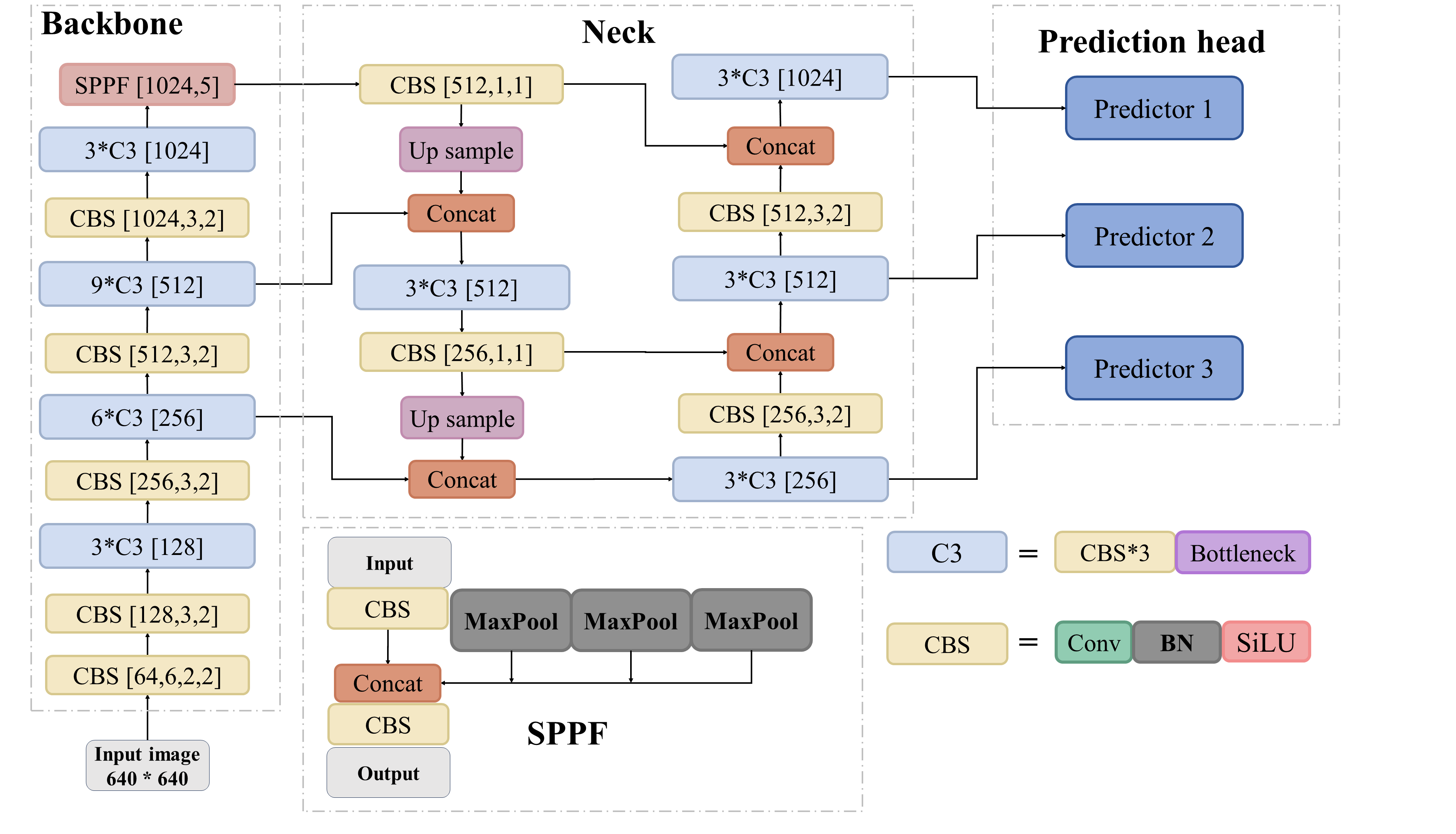
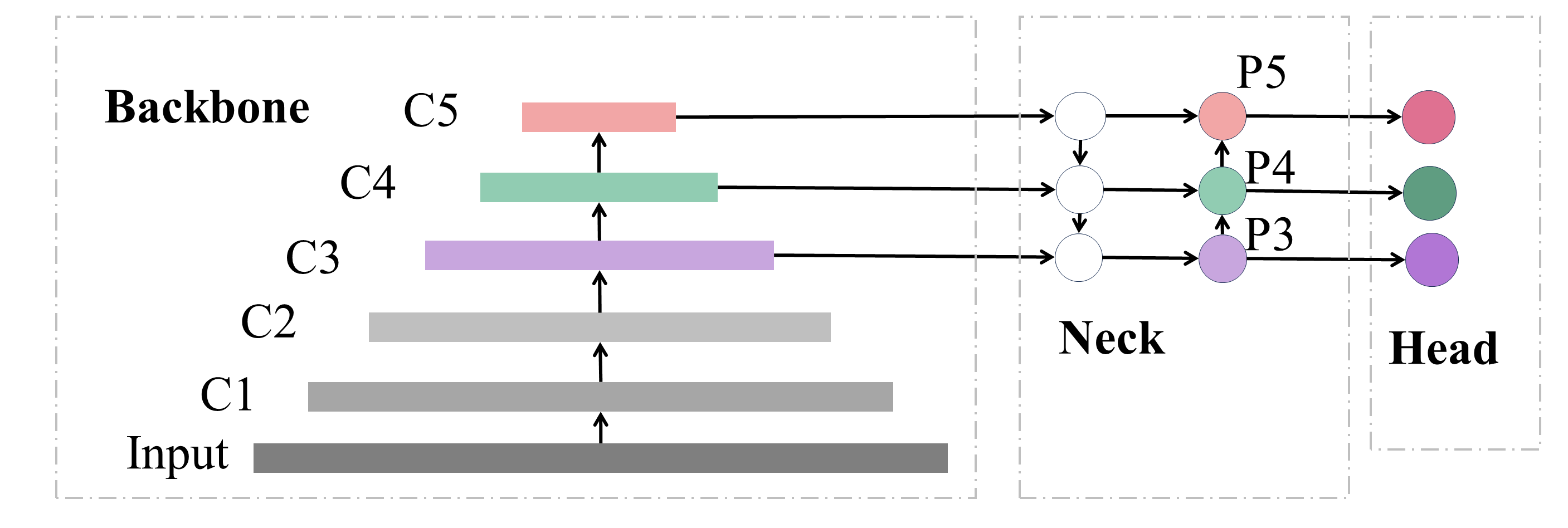
- Introduce a dedicated Small Object Detection Head (SODH) that processes high-resolution feature maps to improve localization and classification of tiny and small objects.
- Insert an Involution block between the backbone and neck to enhance inter-channel feature interactions and enrich channel-wise representation without increasing parameters significantly.
- Apply a lightweight CBAM attention module at the end of the backbone to selectively emphasize important spatial and channel features, reducing redundant computation.
- Use data augmentation techniques including center crop to improve robustness and generalization on small object detection.
- Integrate the three components—SODH, involution, and CBAM—into the YOLOv5-6.0 architecture to form HIC-YOLOv5, preserving real-time inference capability.
Experimental results
Research questions
- RQ1Can a dedicated high-resolution prediction head improve detection performance for small objects in YOLOv5?
- RQ2Does introducing an involution block between the backbone and neck enhance feature representation for small object detection without increasing computational cost?
- RQ3Can a lightweight CBAM attention module outperform heavier attention mechanisms like transformers in small object detection while reducing inference overhead?
- RQ4To what extent do the individual components (SODH, involution, CBAM) contribute to overall mAP improvement on the VisDrone-2019-DET dataset?
Key findings
- HIC-YOLOv5 achieves a 6.42% absolute improvement in mAP@[.5:.95] and 9.38% in mAP@0.5 on the VisDrone-2019-DET test set compared to YOLOv5s.
- The addition of the SODH alone improves mAP@.5 by 8.31% and mAP@[.5:.95] by 5.51%, demonstrating its dominant contribution.
- The involution block contributes an additional 0.66% increase in mAP@.5 and 0.57% in mAP@[.5:.95] when combined with the SODH.
- CBAM contributes 0.41% and 0.34% improvement in mAP@.5 and mAP@[.5:.95] respectively, showing its effectiveness in feature refinement with low overhead.
- The ablation study confirms that individual components like CBAM or involution alone are insufficient without the SODH, highlighting the necessity of multi-scale feature utilization.
- HIC-YOLOv5 reduces model parameters and gradients compared to prior attention-based models (e.g., Wang et al. [11]), with 8.39M parameters vs. 14.58M, confirming lower computational cost.
Read this paper
Open the full text in the Nubint reader and ask about any passage as you read.
Read this paper on NubintThis review was generated by AI from the original paper. Please check the paper before citing it.