
[Paper Review] Hidden in Plain Sight: Exploring the Intersections of Mental Health, Eating Disorders, and Content Moderation on TikTok
This study investigates how users on TikTok evade content moderation by using coded hashtags to share eating disorder-related content, revealing that these 'moderation evaders' co-occur with mainstream mental health hashtags and generate significantly more negative emotional expressions in video descriptions and comments compared to mainstream content, highlighting risks for vulnerable users and the need for improved platform moderation strategies.
Social media platforms actively moderate content glorifying harmful behaviors like eating disorders, which include anorexia and bulimia. However, users have adapted to evade moderation by using coded hashtags. Our study investigates the prevalence of moderation evaders on the popular social media platform TikTok and contrasts their use and emotional valence with mainstream hashtags. We notice that moderation evaders and mainstream hashtags appear together, indicating that vulnerable users might inadvertently encounter harmful content even when searching for mainstream terms. Additionally, through an analysis of emotional expressions in video descriptions and comments, we find that mainstream hashtags generally promote positive engagement, while moderation evaders evoke a wider range of emotions, including heightened negativity. These findings provide valuable insights for content creators, platform moderation efforts, and interventions aimed at cultivating a supportive online environment for discussions on mental health and eating disorders.
Motivation & Objective
- To examine how moderation evader hashtags—coded alternatives to banned terms—co-occur with mainstream mental health and wellness hashtags on TikTok.
- To analyze emotional expression differences in video descriptions and user comments between content using mainstream hashtags versus moderation evaders.
- To assess whether emotional tone in video descriptions correlates with user comments, and how this differs across mainstream and moderation-evading content.
- To identify risks of vulnerable users, especially adolescents, being exposed to harmful eating disorder content through mainstream search terms.
- To inform content moderation strategies and mental health interventions by uncovering the emotional dynamics of coded content on social media platforms.
Proposed method
- Collected public TikTok video data using hashtags related to eating disorders, including both mainstream and moderation-evading variants (e.g., #edtt, misspellings, or references to 'ED' in artist names).
- Performed automated emotion detection on video descriptions and user comments using NLP-based models to classify emotional valence (e.g., joy, sadness, fear, anger).
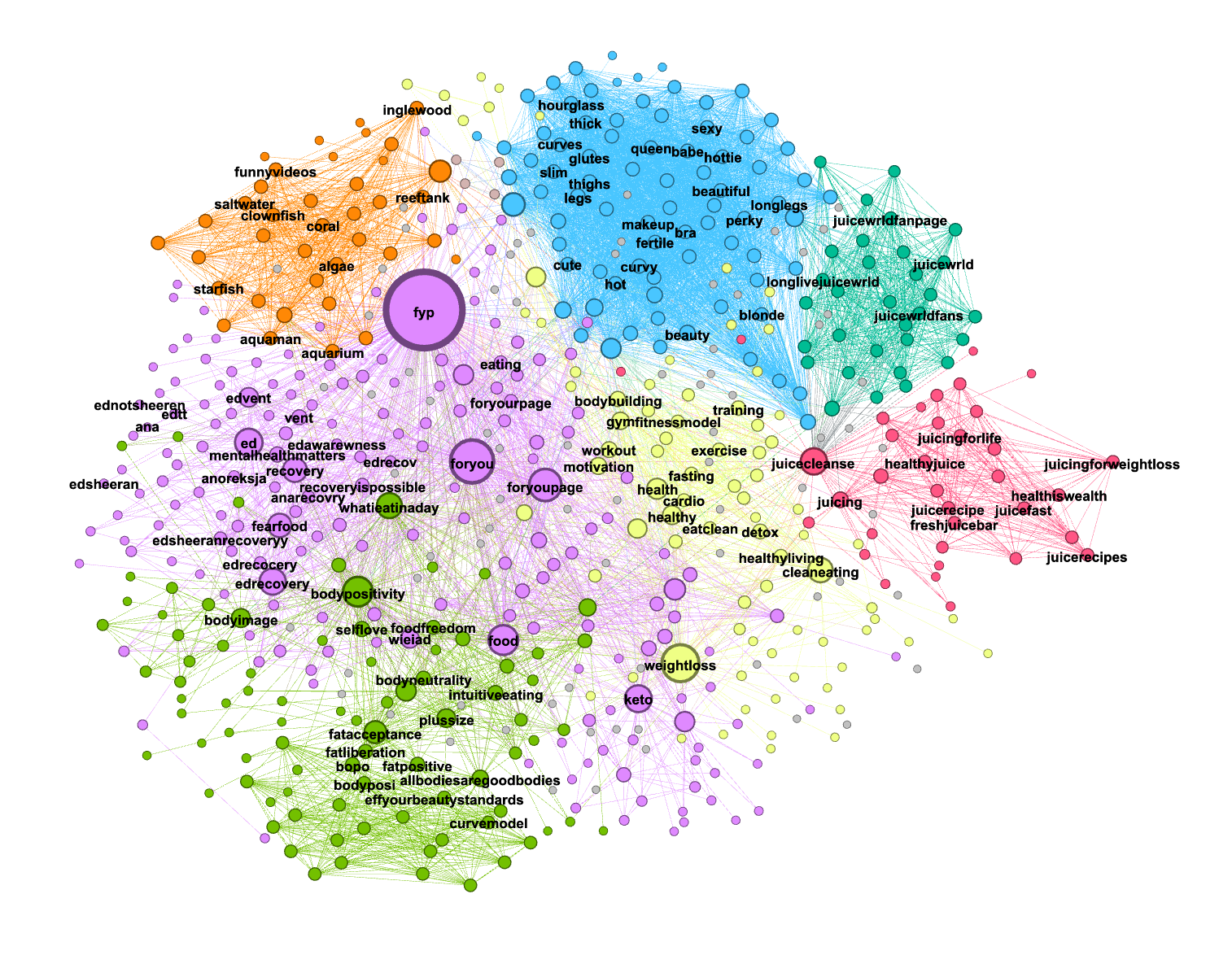
- Analyzed co-occurrence patterns between moderation evader hashtags and mainstream hashtags to assess cross-promotion risks.
- Compared emotional expression distributions across mainstream and moderation-evading content, focusing on differences in positive, negative, and neutral sentiment.
- Conducted manual review of a subset of videos to validate automated emotion detection and contextualize findings.
- Applied statistical analysis to compare emotional intensity and distribution between video descriptions and user comments across hashtag types.
Experimental results
Research questions
- RQ1Do moderation evaders co-occur with mainstream hashtags related to mental health and healthy living on TikTok?
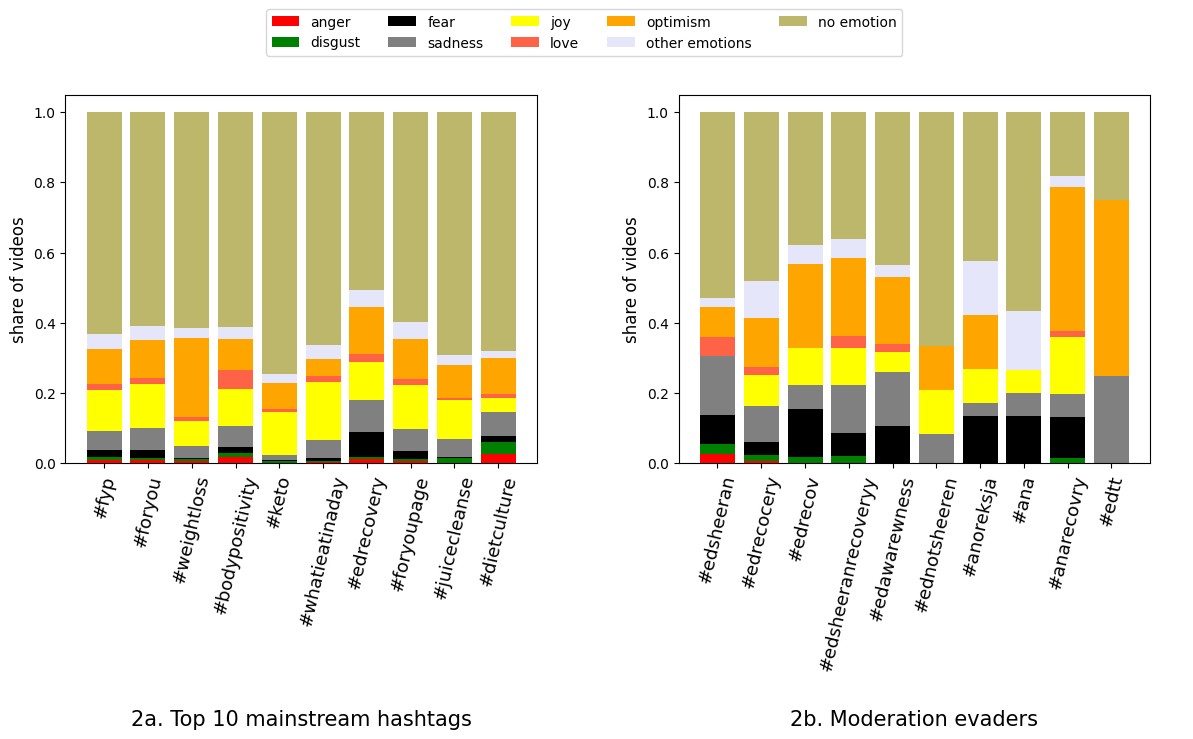
- RQ2How do emotional expressions in TikTok video descriptions differ between content associated with mainstream hashtags and moderation evaders?
- RQ3How do emotional expressions in TikTok video descriptions correlate with those in user comments, and how does this interaction differ across mainstream hashtags and moderation evaders?
- RQ4What is the emotional tone of content associated with moderation evaders, particularly in relation to negative emotions like fear, sadness, and anger?
- RQ5To what extent do mainstream hashtags serve as gateways to harmful content through co-occurrence with moderation evaders?
Key findings
- Moderation evader hashtags frequently co-occur with mainstream mental health and wellness hashtags, increasing the risk that users searching for supportive content may inadvertently encounter harmful material.
- Video descriptions associated with moderation evaders exhibit significantly higher levels of negative emotions, including sadness, fear, and anger, compared to the more balanced emotional tone seen in mainstream hashtag content.
- User comments on videos with mainstream hashtags are more emotionally charged than their video descriptions, with joy and optimism being the dominant emotions.
- In contrast, user comments on moderation evader content are less emotionally charged overall than their video descriptions, though they still show a notable presence of negative emotions.
- Despite some hashtags (e.g., #edtt) being blocked, harmful content with 'dark humor' and ED-glorification persists, indicating gaps in algorithmic detection and moderation effectiveness.
- The emotional disparity between mainstream and moderation-evading content suggests that coded hashtags are used strategically to evade detection while amplifying negative affect, particularly in vulnerable user communities.
Read this paper
Open the full text in the Nubint reader and ask about any passage as you read.
Read this paper on NubintThis review was generated by AI from the original paper. Please check the paper before citing it.