
[Paper Review] Hidden Markov modeling of single particle diffusion with stochastic tethering
This paper proposes a Hidden Markov Model (HMM) with an alternating maximization algorithm to infer transient tethering states and physical parameters—such as diffusion coefficient, tethering rate, and confinement area—from 2D single-particle trajectories. The method uses a saddle-point approximation to identify the most likely hidden state sequence and reliably estimates parameters across diverse regimes, with robustness to initialization and validation via synthetic data.
The statistics of the diffusive motion of particles often serve as an experimental proxy for their interaction with the environment. However, inferring the physical properties from the observed trajectories is challenging. Inspired by a recent experiment, here we analyze the problem of particles undergoing two-dimensional Brownian motion with transient tethering to the surface. We model the problem as a Hidden Markov Model where the physical position is observed, and the tethering state is hidden. We develop an alternating maximization algorithm to infer the hidden state of the particle and estimate the physical parameters of the system. The crux of our method is a saddle-point-like approximation, which involves finding the most likely sequence of hidden states and estimating the physical parameters from it. Extensive numerical tests demonstrate that our algorithm reliably finds the model parameters, and is insensitive to the initial guess. We discuss the different regimes of physical parameters and the algorithm's performance in these regimes. We also provide a ready-to-use open source implementation of our algorithm.
Motivation & Objective
- To address the challenge of inferring hidden tethering states and physical parameters from experimentally observed 2D particle trajectories where tethering is not directly measurable.
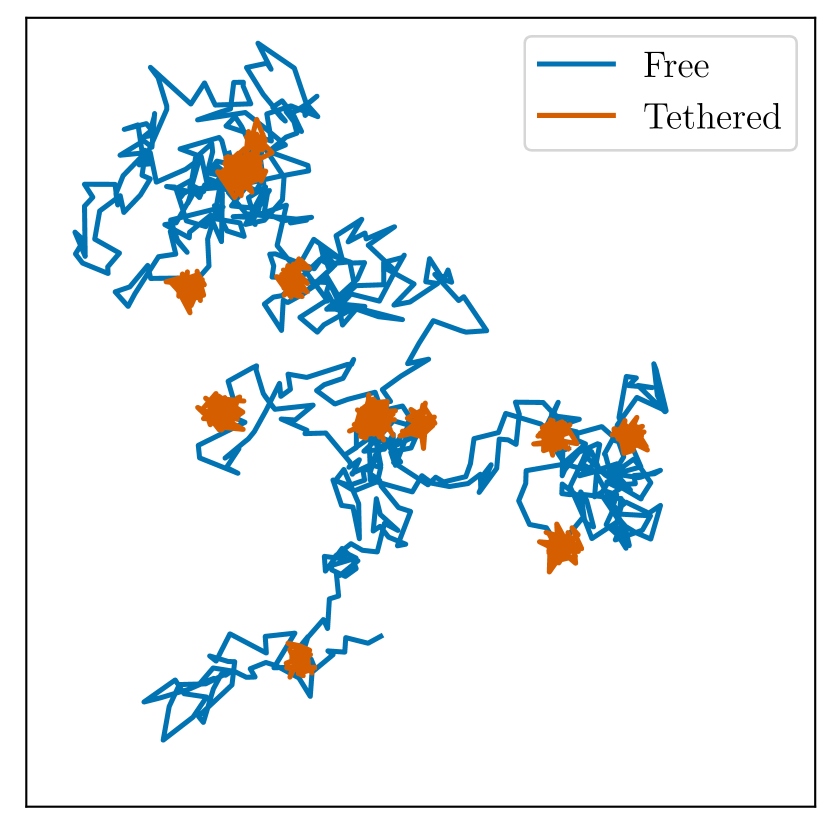
- To model transient tethering as a two-state continuous-time Markov process with normal diffusion in free state and Ornstein-Uhlenbeck dynamics in tethered state.
- To develop a computationally efficient algorithm that estimates diffusion coefficient, tethering/untethering rates, and effective confinement area from sparse, noisy trajectory data.
- To ensure robustness to initialization and applicability across different physical regimes, including short and long tethering times.
- To provide a free, open-source implementation for practical use in experimental data analysis.
Proposed method
- Model the system as a Hidden Markov Model where the observed position is the visible variable and the tethering state (free/tethered) is hidden.
- Use a continuous-time Markov chain with exponential waiting times for tethering ($\tau_0$) and untethering ($\tau_1$) events.
- Formulate the dynamics using an Ornstein-Uhlenbeck process with state-dependent harmonic potential during tethering, governed by the ratio $k/\gamma$.
- Apply an alternating maximization algorithm that iteratively estimates the most likely hidden path (via Viterbi-like search) and updates model parameters via maximum likelihood estimation.
- Implement a saddle-point approximation by replacing the sum over all hidden paths with the likelihood of the single most likely path, reducing computational complexity.
- Allow for generalization to other diffusion types and non-Poissonian tethering by adjusting transition probabilities and dynamics, with optional extension to top-K most likely paths for improved accuracy.
![Figure 1: A snapshot of an experimental microscopy video of peptide-coated microparticles, in a system similar to that of Chakraborty et. al. [ 9 ] . The colored curve represents the top-right particle’s recorded trajectory in the 320 seconds preceding the snapshot. The trajectory is colored based o](https://ar5iv.labs.arxiv.org/html/2308.01100/assets/x1.png)
Experimental results
Research questions
- RQ1Can a Hidden Markov Model effectively infer transient tethering states from 2D single-particle trajectories when tethering is not directly observable?
- RQ2How accurately can the algorithm estimate key physical parameters—diffusion coefficient, tethering/untethering rates, and confinement area—under varying parameter regimes?
- RQ3To what extent is the algorithm robust to initialization and sensitive to noise or sampling rate in trajectory data?
- RQ4Does the saddle-point approximation using the most likely path yield reliable parameter estimates compared to full path integration?
- RQ5Can the method be generalized to non-Poissonian tethering or anomalous diffusion with minimal modification?
Key findings
- The algorithm successfully recovers all model parameters (diffusion coefficient, tethering/untethering rates, confinement area) with high accuracy across diverse physical regimes.
- The method is robust to initialization, showing consistent performance regardless of initial parameter guesses.
- The algorithm remains accurate even when the time step $\Delta t$ is comparable to or longer than the equilibration time of the tethered state, with downsampling preserving accuracy.
- The top-K path extension (up to K=100) provides no significant improvement in estimation, as the most likely paths are qualitatively similar and differ only in minor perturbations of tethering/untethering times.
- The algorithm correctly identifies the absence of brief tethered or free intervals in some cases, consistent with the underlying statistical model and trajectory characteristics.
Better researchstarts right now
From reading papers to final review, dramatically reduce your research time.
No credit card · Free plan available
This review was created by AI and reviewed by human editors.