
[Paper Review] Hierarchical Evaluation Framework: Best Practices for Human Evaluation
This paper proposes a hierarchical evaluation framework that standardizes human evaluation in NLP by assessing both inputs and outputs of NLP systems in a structured, interdependent manner. The framework improves comprehensive system assessment, with validation showing significant associations between input and output quality in a Machine Reading Comprehension system (χ² = 4.56, p=0.03).
Human evaluation plays a crucial role in Natural Language Processing (NLP) as it assesses the quality and relevance of developed systems, thereby facilitating their enhancement. However, the absence of widely accepted human evaluation metrics in NLP hampers fair comparisons among different systems and the establishment of universal assessment standards. Through an extensive analysis of existing literature on human evaluation metrics, we identified several gaps in NLP evaluation methodologies. These gaps served as motivation for developing our own hierarchical evaluation framework. The proposed framework offers notable advantages, particularly in providing a more comprehensive representation of the NLP system's performance. We applied this framework to evaluate the developed Machine Reading Comprehension system, which was utilized within a human-AI symbiosis model. The results highlighted the associations between the quality of inputs and outputs, underscoring the necessity to evaluate both components rather than solely focusing on outputs. In future work, we will investigate the potential time-saving benefits of our proposed framework for evaluators assessing NLP systems.
Motivation & Objective
- Address the lack of standardized human evaluation metrics in NLP, especially for system inputs and extrinsic performance.
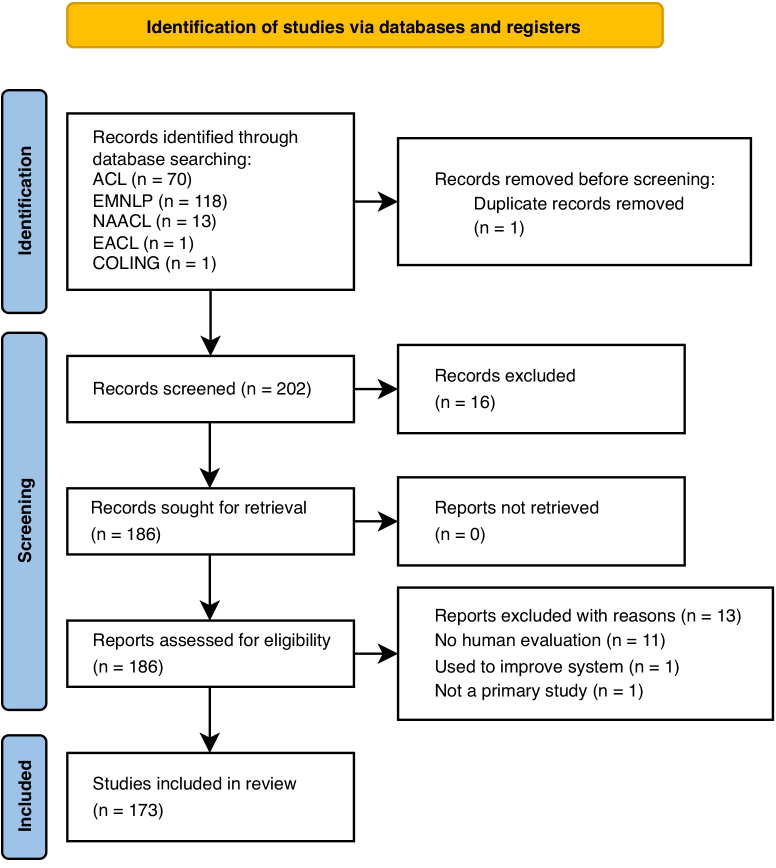
- Identify critical gaps in current human evaluation practices through a scoping review of 173 recent NLP papers.
- Develop a unified, hierarchical evaluation framework that captures interdependencies among system characteristics.
- Validate the framework in a real-world human-AI symbiosis setting using a Machine Reading Comprehension system.
- Enable more holistic, reliable, and scalable human evaluation of NLP systems beyond isolated output assessment.
Proposed method
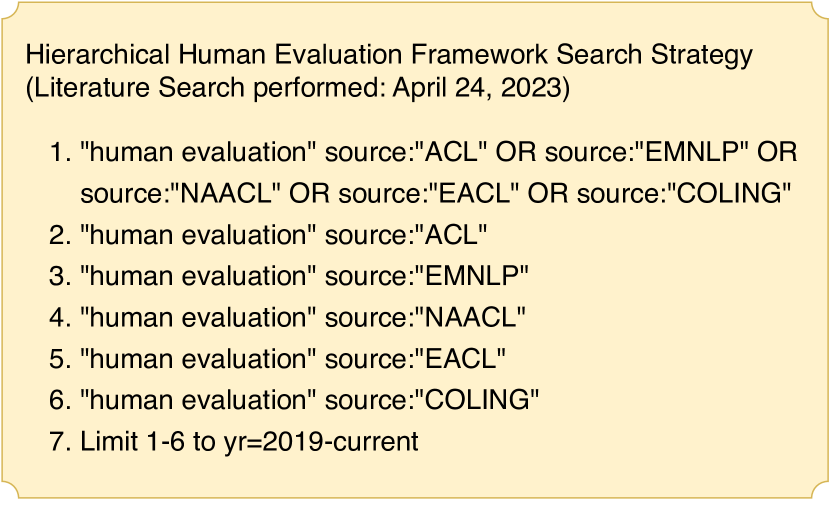
- Conducted a scoping review of 173 NLP papers from top venues (ACL, EMNLP, NAACL, EACL, COLING) published between 2019–2023 using PRISMA-ScR guidelines.
- Identified three key gaps: absence of input evaluation metrics, lack of consideration for interdependencies among system features, and limited use of extrinsic evaluation metrics.
- Designed a two-phase hierarchical framework: (1) testing phase to generate inputs and outputs, and (2) evaluation phase to score both using structured criteria.
- Defined input evaluation metrics including relevance, factoid nature, answerability, grammar, spelling, and difficulty; output metrics included clarity, relevance, clinical accuracy, and usefulness.
- Used a composite scoring system to compute an overall quality score reflecting interdependencies between input and output quality.
- Applied the framework in a pilot randomized controlled trial (RCT) with 10 health coaches evaluating 387 question-answer pairs from an MRC system.
Experimental results
Research questions
- RQ1What are the major gaps in current human evaluation practices for NLP systems, particularly regarding inputs and interdependencies?
- RQ2How can a standardized, hierarchical evaluation framework improve the comprehensiveness and reliability of human evaluation in NLP?
- RQ3What is the relationship between input quality and output quality in NLP systems, particularly in human-AI interaction settings?
- RQ4Can the proposed framework be practically applied to real-world NLP systems like Machine Reading Comprehension in a human-AI symbiosis model?
- RQ5To what extent does evaluating both inputs and outputs yield more holistic insights into NLP system performance than evaluating outputs alone?
Key findings
- A significant association was found between input and output quality in the MRC system (χ² = 4.56, p = 0.03), indicating that input quality strongly influences output performance.
- The hierarchical framework successfully captured interdependencies among system characteristics, enabling a more holistic evaluation than isolated metric assessment.
- The evaluation of inputs revealed that factors like question difficulty, grammar, and answerability significantly impacted the quality of generated answers.
- The framework demonstrated practical applicability in a real-world human-AI symbiosis setting, with 10 health coaches evaluating 387 question-answer pairs.
- The results support the necessity of evaluating both inputs and outputs together to obtain a complete picture of NLP system effectiveness.
- The framework shows potential for scalability and time efficiency, though further validation is needed in future work.
Read this paper
Open the full text in the Nubint reader and ask about any passage as you read.
Read this paper on NubintThis review was generated by AI from the original paper. Please check the paper before citing it.