
[Paper Review] Hierarchical Semantic Tree Concept Whitening for Interpretable Image Classification
This paper proposes Hierarchical Semantic Tree Concept Whitening (HaST-CW), a method that enhances interpretability in deep image classification by aligning latent representations with a hierarchical tree of semantic concepts through a novel semantic constraint (SC) loss. The approach preserves hierarchical relationships between concepts, improves disentanglement, and maintains classification accuracy, as validated on the Agri-ImageNet dataset with ResNet backbones.
With the popularity of deep neural networks (DNNs), model interpretability is becoming a critical concern. Many approaches have been developed to tackle the problem through post-hoc analysis, such as explaining how predictions are made or understanding the meaning of neurons in middle layers. Nevertheless, these methods can only discover the patterns or rules that naturally exist in models. In this work, rather than relying on post-hoc schemes, we proactively instill knowledge to alter the representation of human-understandable concepts in hidden layers. Specifically, we use a hierarchical tree of semantic concepts to store the knowledge, which is leveraged to regularize the representations of image data instances while training deep models. The axes of the latent space are aligned with the semantic concepts, where the hierarchical relations between concepts are also preserved. Experiments on real-world image datasets show that our method improves model interpretability, showing better disentanglement of semantic concepts, without negatively affecting model classification performance.
Motivation & Objective
- To address the lack of interpretability in deep neural networks by proactively embedding human-understandable semantic concepts into latent representations, rather than relying on post-hoc analysis.
- To model hierarchical relationships between concepts—such as disease stages or agricultural object categories—within the latent space of deep learning models.
- To improve disentanglement of semantic concepts in latent representations while preserving classification performance.
- To provide a global, structured understanding of how models encode and relate concepts across layers.
- To enable clearer, more trustworthy AI by aligning model representations with domain knowledge through structured semantic constraints.
Proposed method
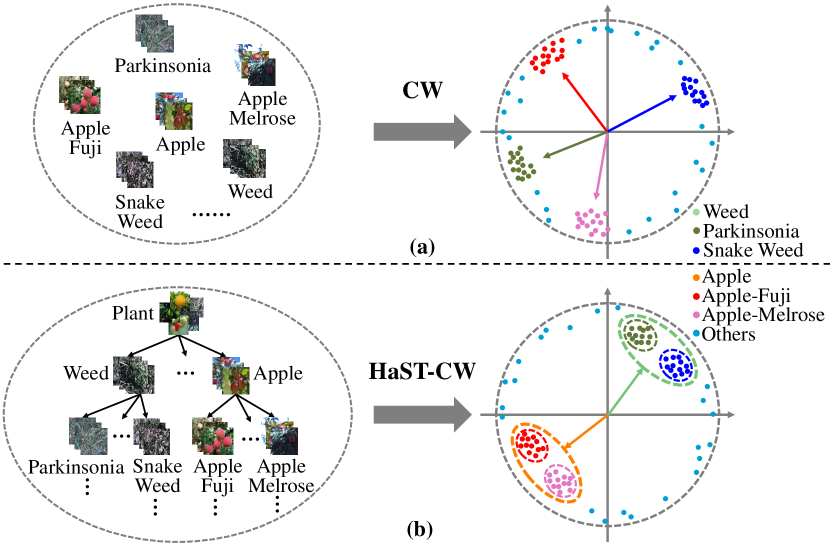
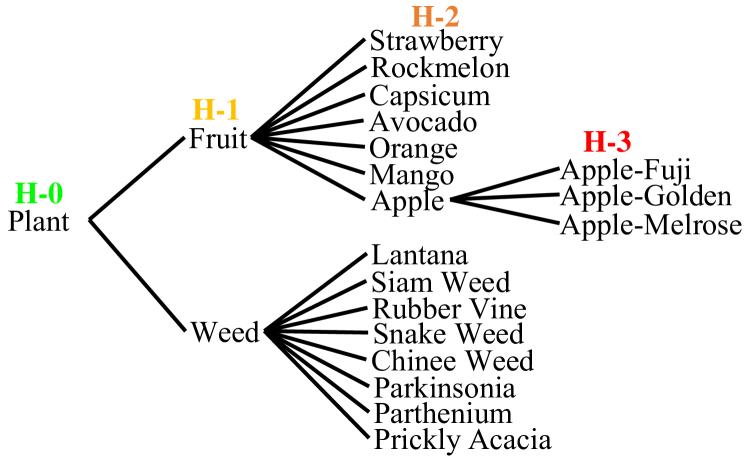
- The method constructs a hierarchical tree of semantic concepts, where each node represents a concept (e.g., 'Weed', 'Snake Weed') and parent-child relationships reflect semantic granularity.
- A novel Semantic Constraint (SC) loss function is introduced to regularize latent representations so that semantically similar concepts are closer in the latent space.
- Hierarchical Concept Whitening (HCW) decorrelates activations across latent dimensions, aligning each concept with one or more specific dimensions while preserving hierarchical structure.
- The SC loss enforces that data instances of related concepts (e.g., 'Weed' and 'Snake Weed') are mapped to nearby regions in the latent space.
- The method is trained end-to-end using cross-entropy loss combined with the SC loss, enabling joint optimization of classification and interpretability.
- The approach is evaluated using ResNet18 and ResNet50 backbones on the Agri-ImageNet dataset, with visualization of hierarchical activation trees to assess concept alignment.
Experimental results
Research questions
- RQ1Can we improve the interpretability of deep image classifiers by proactively embedding hierarchical semantic concepts into the latent space?
- RQ2How does preserving hierarchical relationships between concepts affect disentanglement and representation quality in latent space?
- RQ3Does the proposed SC loss function effectively align semantically similar concepts in the latent space while maintaining classification accuracy?
- RQ4To what extent can HaST-CW reveal the progressive learning of concepts across network layers, as visualized through hierarchical activation trees?
- RQ5Can the method generalize to real-world domains such as agriculture and healthcare, where concept hierarchies are semantically meaningful?
Key findings
- The HaST-CW model with the SC loss achieved a test accuracy of 69.49% ± 3.20 on the Agri-ImageNet dataset using ResNet50, slightly outperforming the baseline CW method (69.30% ± 3.75) and the standard cross-entropy baseline (69.25% ± 3.93).
- Visualization of hierarchical activation trees confirmed that images were correctly activated along the semantic hierarchy, with the highest activations on parent and child concepts (e.g., 'Weed' and 'Snake Weed' for a Snake Weed image).
- The SC loss effectively grouped images of related concepts (e.g., 'Weed' and 'Apple') into coherent blocks in the latent space, unlike the scattered distribution seen in standard concept whitening.
- The method preserved hierarchical structure in representations, with sub-concepts like 'Snake Weed' and 'Apple-Melrose' forming distinct clusters aligned with their parent concepts.
- The results demonstrate that HaST-CW improves disentanglement and interpretability without degrading classification performance, as shown by clearer, more structured latent space organization.
- The approach enables a global, concept-level understanding of model behavior, supporting human-AI collaboration and trust in critical domains like healthcare and agriculture.
Read this paper
Open the full text in the Nubint reader and ask about any passage as you read.
Read this paper on NubintThis review was generated by AI from the original paper. Please check the paper before citing it.