
[Paper Review] Hierarchical Side-Tuning for Vision Transformers
This paper proposes Hierarchical Side-Tuning (HST), a parameter-efficient transfer learning method for Vision Transformers that uses a lightweight, learnable hierarchical side network (HSN) to generate multi-scale features from intermediate backbone activations. HST achieves state-of-the-art performance with only 0.78M trainable parameters, surpassing full fine-tuning on VTAB-1k (76.0% Top-1 accuracy) and outperforming existing PETL methods on COCO for object detection and segmentation.
Fine-tuning pre-trained Vision Transformers (ViTs) has showcased significant promise in enhancing visual recognition tasks. Yet, the demand for individualized and comprehensive fine-tuning processes for each task entails substantial computational and memory costs, posing a considerable challenge. Recent advancements in Parameter-Efficient Transfer Learning (PETL) have shown potential for achieving high performance with fewer parameter updates compared to full fine-tuning. However, their effectiveness is primarily observed in simple tasks like image classification, while they encounter challenges with more complex vision tasks like dense prediction. To address this gap, this study aims to identify an effective tuning method that caters to a wider range of visual tasks. In this paper, we introduce Hierarchical Side-Tuning (HST), an innovative PETL method facilitating the transfer of ViT models to diverse downstream tasks. Diverging from existing methods that focus solely on fine-tuning parameters within specific input spaces or modules, HST employs a lightweight Hierarchical Side Network (HSN). This network leverages intermediate activations from the ViT backbone to model multi-scale features, enhancing prediction capabilities. To evaluate HST, we conducted comprehensive experiments across a range of visual tasks, including classification, object detection, instance segmentation, and semantic segmentation. Remarkably, HST achieved state-of-the-art performance in 13 out of the 19 tasks on the VTAB-1K benchmark, with the highest average Top-1 accuracy of 76.1%, while fine-tuning a mere 0.78M parameters. When applied to object detection and semantic segmentation tasks on the COCO and ADE20K testdev benchmarks, HST outperformed existing PETL methods and even surpassed full fine-tuning.
Motivation & Objective
- To address the high computational and memory cost of fine-tuning large Vision Transformers for diverse downstream tasks.
- To close the performance gap between parameter-efficient transfer learning (PETL) and full fine-tuning in dense prediction tasks such as object detection and segmentation.
- To design a flexible, parameter-efficient framework that leverages intermediate features from the backbone for improved generalization.
- To enable high performance with minimal trainable parameters while maintaining low inference overhead.
Proposed method
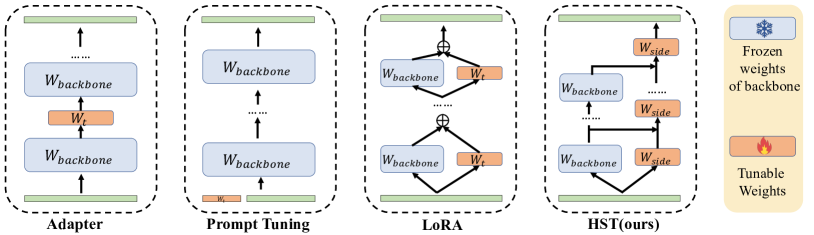
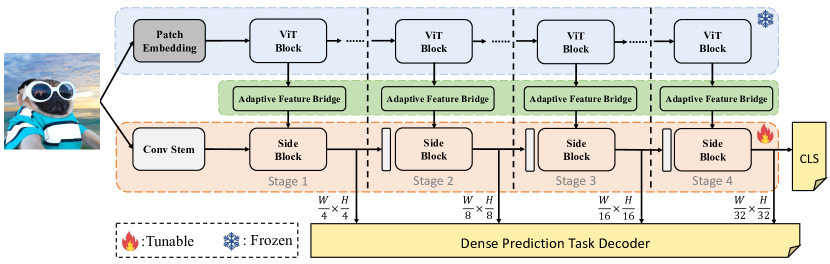
- Introduces a Hierarchical Side Network (HSN) that decouples trainable parameters from the pre-trained ViT backbone, enabling efficient adaptation.
- Employs Meta-Tokens (MetaT) to inject learnable prompts into the input embeddings, enhancing feature representation learning.
- Designs an Adaptive Feature Bridge (AFB) to preprocess and align intermediate activations from the backbone for effective injection into the HSN.
- Uses a novel Side block in HSN composed of Cross-Attention and Feed-Forward Network (FFN) modules to fuse multi-scale features from different levels.
- Applies Fine-Grained Injection to inject intermediate features at multiple stages in the HSN, improving feature refinement.
- Utilizes linear weight sharing and global token pooling to enhance efficiency and global context integration.
Experimental results
Research questions
- RQ1Can a parameter-efficient method achieve performance comparable to full fine-tuning on dense prediction tasks like object detection and segmentation?
- RQ2How does the hierarchical structure of the side network improve multi-scale feature learning in Vision Transformers?
- RQ3What is the optimal configuration of Meta-Tokens and injection mechanisms for balancing performance and efficiency?
- RQ4Does separating trainable parameters into a side network reduce computational cost without sacrificing accuracy?
Key findings
- HST achieves a state-of-the-art average Top-1 accuracy of 76.0% on VTAB-1k, outperforming full fine-tuning (65.6%) with only 0.78M trainable parameters.
- On the COCO testdev benchmark, HST achieves 49.7 box AP and 43.2 mask AP with Cascade Mask R-CNN, surpassing full fine-tuning.
- Ablation studies show that the Fine-Grained Injection mechanism contributes the largest gain, improving APb by 5.5 and APM by 5.0 compared to baseline.
- Using a single Meta-Token yields better performance than multiple tokens in classification tasks, while up to 8 tokens are optimal for dense prediction tasks.
- The HSN with linear weight sharing and global token pooling improves efficiency and performance, reducing the need for multiple dense layers.
- t-SNE and Grad-CAM visualizations confirm that HST learns more discriminative and localized features compared to other PETL methods.
Read this paper
Open the full text in the Nubint reader and ask about any passage as you read.
Read this paper on NubintThis review was generated by AI from the original paper. Please check the paper before citing it.