
[Paper Review] High-Dimensional Conditionally Gaussian State Space Models with Missing Data
This paper proposes a precision-based MCMC sampling method for high-dimensional conditionally Gaussian state space models with complex missing data patterns, leveraging the sparsity of the precision matrix to efficiently draw all missing observations in one step. The approach significantly accelerates computation in large Bayesian VARs and dynamic factor models with mixed-frequency or unbalanced panel data.
We develop an efficient sampling approach for handling complex missing data patterns and a large number of missing observations in conditionally Gaussian state space models. Two important examples are dynamic factor models with unbalanced datasets and large Bayesian VARs with variables in multiple frequencies. A key insight underlying the proposed approach is that the joint distribution of the missing data conditional on the observed data is Gaussian. Moreover, the inverse covariance or precision matrix of this conditional distribution is sparse, and this special structure can be exploited to substantially speed up computations. We illustrate the methodology using two empirical applications. The first application combines quarterly, monthly and weekly data using a large Bayesian VAR to produce weekly GDP estimates. In the second application, we extract latent factors from unbalanced datasets involving over a hundred monthly variables via a dynamic factor model with stochastic volatility.
Motivation & Objective
- Address the challenge of efficiently estimating large-scale time-series models with complex missing data patterns, such as mixed-frequency data and unbalanced panels.
- Overcome the computational bottleneck of existing Kalman-filter-based methods when handling a large number of missing observations in high-dimensional state space models.
- Develop a modular, general-purpose sampling framework applicable to conditionally Gaussian state space models, including dynamic factor models and large Bayesian VARs with flexible features.
- Enable timely and comprehensive macroeconomic analysis by integrating real-time, multi-frequency data sources with robust statistical modeling.
- Extend fast estimation techniques for complete-data models to missing-data settings, preserving computational efficiency while maintaining model flexibility.
Proposed method
- Propose a precision-based MCMC sampler that draws all missing data conditional on observed data in a single step, exploiting the Gaussian nature of the conditional distribution.
- Leverage the sparsity and banded structure of the precision matrix (inverse covariance) of the missing data distribution to enable fast matrix operations.
- Apply the precision-based sampling algorithm of Chan and Jeliazkov (2009) to high-dimensional state space models with missing data, replacing computationally intensive Kalman filtering.
- Use the Durbin-Koopman simulation smoother to efficiently sample the full state path, including missing observations, in models with inter-temporal constraints.
- Formulate the state vector to include lagged states and use block-structured transition and measurement matrices to embed mixed-frequency and missing data constraints.
- Ensure modularity by allowing integration with any efficient sampler for complete-data conditionally Gaussian state space models, enabling broad applicability.
Experimental results
Research questions
- RQ1How can high-dimensional state space models with complex missing data patterns be estimated efficiently without relying on computationally intensive Kalman filtering?
- RQ2To what extent does exploiting the sparsity of the precision matrix of missing data improve computational speed in large Bayesian VARs and dynamic factor models?
- RQ3Can a single-step sampling approach for missing data outperform sequential or filtering-based methods in terms of MCMC efficiency and convergence in high-dimensional settings?
- RQ4How does the proposed method perform in real-world macroeconomic applications involving mixed-frequency data and unbalanced panels?
- RQ5What is the impact of missing data patterns—such as ragged edges or irregular release schedules—on the estimation efficiency and forecast accuracy of large-scale time-series models?
Key findings
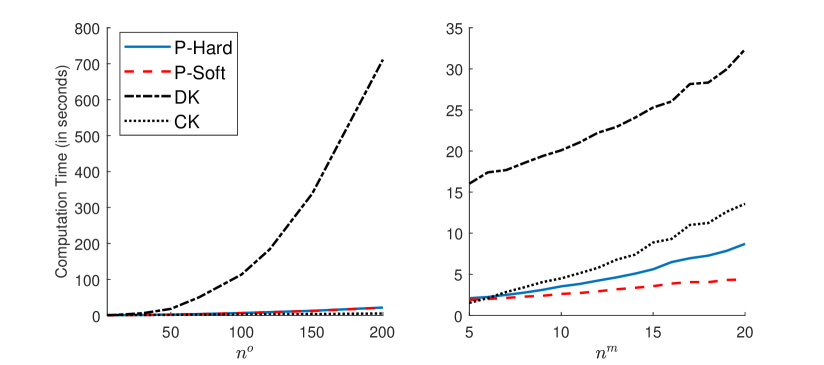
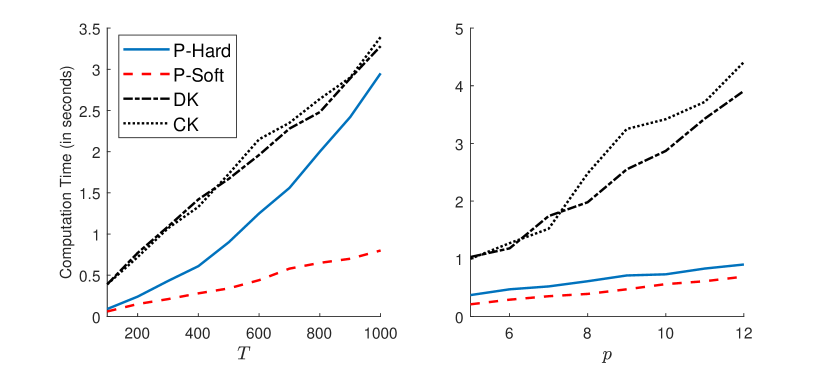
- The proposed precision-based sampler achieves substantial computational speedups compared to standard Kalman-filter-based methods, especially when the number of missing observations is large.
- The joint distribution of missing data conditional on observed data is Gaussian, and its precision matrix is sparse and banded, enabling efficient matrix inversion and sampling.
- In the weekly GDP estimation application, the model successfully combines quarterly, monthly, and weekly data to produce high-frequency GDP forecasts using a large Bayesian VAR.
- For the dynamic factor model with over 100 monthly variables, the method effectively extracts latent factors from unbalanced datasets with complex missing data patterns.
- Inefficiency factors from MCMC samples indicate that the sampler for missing data and model parameters achieves reasonable mixing efficiency, with median inefficiency factors below 10 in most cases.
- The method maintains high estimation accuracy and robustness even under ragged-edge data patterns and non-synchronous data releases, outperforming traditional approaches in computational scalability.
Read this paper
Open the full text in the Nubint reader and ask about any passage as you read.
Read this paper on NubintThis review was generated by AI from the original paper. Please check the paper before citing it.