
[Paper Review] High-Dimensional Low-Rank Tensor Autoregressive Time Series Modeling
This paper proposes a high-dimensional low-rank tensor autoregressive (LRTAR) model that leverages Tucker decomposition with nuclear-norm regularization to efficiently model complex, multi-dimensional time series such as global trade flows. By exploiting low-rank structure in the transition tensor, the method achieves substantial dimension reduction while enabling interpretable multi-dimensional dynamic factor modeling, with theoretical guarantees and strong empirical performance on real-world data.
Modern technological advances have enabled an unprecedented amount of structured data with complex temporal dependence, urging the need for new methods to efficiently model and forecast high-dimensional tensor-valued time series. This paper provides a new modeling framework to accomplish this task via autoregression (AR). By considering a low-rank Tucker decomposition for the transition tensor, the proposed tensor AR can flexibly capture the underlying low-dimensional tensor dynamics, providing both substantial dimension reduction and meaningful multi-dimensional dynamic factor interpretations. For this model, we first study several nuclear-norm-regularized estimation methods and derive their non-asymptotic properties under the approximate low-rank setting. In particular, by leveraging the special balanced structure of the transition tensor, a novel convex regularization approach based on the sum of nuclear norms of square matricizations is proposed to efficiently encourage low-rankness of the coefficient tensor. To further improve the estimation efficiency under exact low-rankness, a non-convex estimator is proposed with a gradient descent algorithm, and its computational and statistical convergence guarantees are established. Simulation studies and an empirical analysis of tensor-valued time series data from multi-category import-export networks demonstrate the advantages of the proposed approach.
Motivation & Objective
- To address the challenge of modeling high-dimensional, multi-way tensor-valued time series with complex temporal and cross-sectional dependencies.
- To reduce the dimensionality of high-dimensional tensor autoregressive models by exploiting low-rank structure in the transition tensor.
- To develop estimation methods that are both computationally efficient and statistically consistent under high-dimensional asymptotics.
- To provide interpretable dynamic factor structures through Tucker decomposition of the coefficient tensor.
- To demonstrate the model’s effectiveness on real-world global trade flow data with multi-category, multi-country, and multi-time dimensions.
Proposed method
- Proposes a tensor autoregressive model using Tucker decomposition of the coefficient tensor to represent low-dimensional dynamics in high-dimensional tensor time series.
- Introduces a novel convex regularization method based on the sum of nuclear norms of square matricizations to encourage low-rank structure in the transition tensor.
- Develops a non-convex estimator with gradient descent for improved efficiency under exact low-rank assumptions, with convergence guarantees.
- Employs an ADMM algorithm for solving the (T)SSN estimator, ensuring computational tractability.
- Derives non-asymptotic statistical properties for both convex and non-convex estimators under approximate low-rank settings.
- Connects the model to existing frameworks such as matrix and multilinear tensor autoregression, showing it as a more flexible and parsimonious generalization.
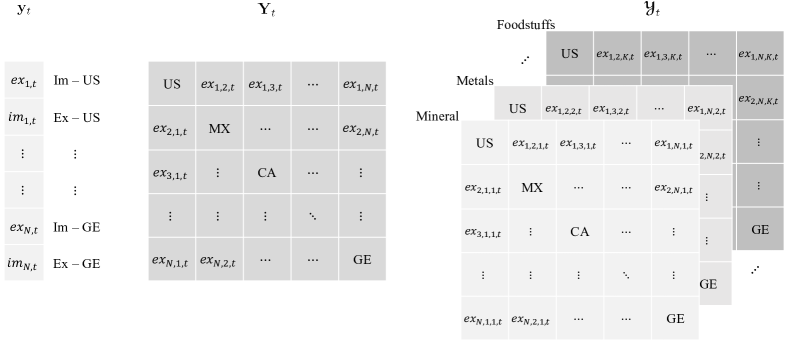
Experimental results
Research questions
- RQ1Can a low-rank Tucker decomposition of the transition tensor effectively reduce dimensionality in high-dimensional tensor autoregressive models?
- RQ2How can convex regularization via sum of nuclear norms of matricized components promote low-rank structure in the coefficient tensor?
- RQ3What are the statistical and computational properties of a non-convex estimator for exact low-rank tensor autoregression?
- RQ4How does the proposed model compare to existing models like MAR and MTAR in terms of model parsimony and forecasting accuracy?
- RQ5Can the model uncover meaningful multi-dimensional dynamic factor structures in real-world tensor-valued time series such as global trade flows?
Key findings
- The proposed convex estimator based on sum of nuclear norms achieves non-asymptotic error bounds under approximate low-rank assumptions, ensuring statistical consistency.
- The non-convex estimator with gradient descent achieves faster convergence and improved estimation accuracy under exact low-rank conditions, with both computational and statistical convergence guarantees.
- Simulation studies show the method outperforms standard VAR and MAR models in forecasting accuracy and parameter estimation under high-dimensional settings.
- Empirical analysis on multi-category import-export networks confirms the model’s ability to capture complex cross-country and cross-product trade dynamics with significant dimension reduction.
- The model is shown to be a generalization of both the matrix autoregressive (MAR) and multilinear tensor autoregressive (MTAR) models, subsuming them as special cases.
- The Tucker-based decomposition enables interpretable dynamic factors across multiple modes (e.g., country, product, time), enhancing model transparency.
Read this paper
Open the full text in the Nubint reader and ask about any passage as you read.
Read this paper on NubintThis review was generated by AI from the original paper. Please check the paper before citing it.