
[Paper Review] High-Fidelity Audio Compression with Improved RVQGAN
Introduces Improved RVQGAN, a universal neural audio compressor that achieves ~90x compression of 44.1 kHz audio to 8 kbps discrete tokens, outperforming baselines across speech, music, and environmental sounds.
Language models have been successfully used to model natural signals, such as images, speech, and music. A key component of these models is a high quality neural compression model that can compress high-dimensional natural signals into lower dimensional discrete tokens. To that end, we introduce a high-fidelity universal neural audio compression algorithm that achieves ~90x compression of 44.1 KHz audio into tokens at just 8kbps bandwidth. We achieve this by combining advances in high-fidelity audio generation with better vector quantization techniques from the image domain, along with improved adversarial and reconstruction losses. We compress all domains (speech, environment, music, etc.) with a single universal model, making it widely applicable to generative modeling of all audio. We compare with competing audio compression algorithms, and find our method outperforms them significantly. We provide thorough ablations for every design choice, as well as open-source code and trained model weights. We hope our work can lay the foundation for the next generation of high-fidelity audio modeling.
Motivation & Objective
- Develop a universal neural audio compression model capable of handling speech, music, and environmental sounds at very low bitrates.
- Improve codebook utilization to maximize effective bitrate and reconstruction quality.
- Mitigate artifacts from quantizer dropout and periodic artifacts in high-fidelity audio.
Proposed method
- Use a fully convolutional encoder–decoder with residual vector quantization (RVQ).
- Incorporate periodic Snake activations to bias the generator toward audio-like periodicity.
- Apply factorized codes and L2-normalized codes to improve codebook usage and stability.
- Leverage multiple discriminators (multi-band multi-scale STFT and multi-period) and a multi-scale mel reconstruction loss.
- Employ a frequency-domain reconstruction loss plus adversarial and perceptual losses with fixed weights; use quantizer dropout with a fixed probability.
- Train on a large, balanced mixed-domain audio dataset (speech, music, environmental sounds) at 44.1 kHz; evaluate via objective metrics (ViSQOL, mel and STFT distances, SI-SDR) and MUSHRA-like listening tests.
Experimental results
Research questions
- RQ1How can a single universal neural codec achieve high-fidelity audio compression across diverse domains (speech, music, environmental sounds) at low bitrates?
- RQ2What combination of architectural choices and training losses yields maximal bitrate efficiency and minimal artifacts at high sampling rates?
- RQ3What is the impact of codebook learning tricks, periodic activations, and discriminators on reconstruction quality and artifact reduction?
Key findings
- Achieves 8 kbps (44.1 kHz) with ~90x compression and superior audio quality compared with EnCodec, Lyra, and Opus.
- Periodic Snake activations significantly improve SI-SDR and other quality metrics compared to ReLU baselines.
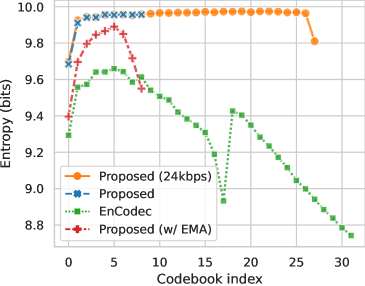
- Factorized codes and L2-normalized codes substantially improve codebook utilization and bitrate efficiency without complex initialization procedures.
- Multi-band multi-scale STFT discriminator and multi-scale mel loss help reduce high-frequency artifacts and improve phase modeling.
- Quantizer dropout, when applied with a fixed probability, maintains full-bandwidth quality while enabling variable bitrate training.
- Balanced data sampling across speech, music, and environmental sounds is essential to preserve full-bandwidth reconstruction across domains.

Read this paper
Open the full text in the Nubint reader and ask about any passage as you read.
Read this paper on NubintThis review was generated by AI from the original paper. Please check the paper before citing it.