
[Paper Review] High-Performance Deterministic Concurrency using Lingua Franca
This paper presents Lingua Franca (LF), a polyglot coordination language that enables high-performance deterministic concurrency by default through a reactor-based model. By statically analyzing data dependencies and enforcing deterministic execution, LF achieves superior performance—1.85x faster than Akka and 1.42x faster than CAF—demonstrating that determinism does not compromise efficiency in concurrent systems.
Actor frameworks and similar reactive programming techniques are widely used for building concurrent systems. They promise to be efficient and scale well to a large number of cores or nodes in a distributed system. However, they also expose programmers to nondeterminism, which often makes implementations hard to understand, debug, and test. The recently proposed reactor model is a promising alternative that enables efficient deterministic concurrency. In this paper, we show that determinacy does neither imply a loss in expressivity nor in performance. To show this, we evaluate Lingua Franca (LF), a reactor-oriented coordination language that equips mainstream programming languages with a concurrency model that automatically takes advantage of opportunities to exploit parallelism that do not introduce nondeterminism. Our implementation of the Savina benchmark suite demonstrates that, in terms of execution time, the runtime performance of LF programs even exceeds popular and highly optimized actor frameworks. We compare against Akka and CAF, which LF outperforms by 1.86x and 1.42x, respectively.
Motivation & Objective
- To address the widespread use of nondeterministic actor frameworks that hinder debugging, testing, and reproducibility in concurrent systems.
- To investigate whether deterministic concurrency can achieve performance comparable to or better than highly optimized, nondeterministic actor frameworks like Akka and CAF.
- To evaluate Lingua Franca (LF), a reactor-oriented coordination language that enforces determinism by default while supporting efficient parallelism.
- To demonstrate that deterministic concurrency does not require performance trade-offs, even in complex, real-world workloads.
- To show that LF’s C++ target can outperform existing frameworks in practical, production-relevant benchmarks like Savina.
Proposed method
- Lingua Franca uses a reactor model where concurrent components (reactors) are composed hierarchically and connected via dataflow semantics to ensure deterministic execution.
- The language enforces determinism by statically analyzing data dependencies and ensuring correct ordering of event processing at runtime.
- LF supports multiple mainstream languages (C, C++, Python, TypeScript, Rust) and compiles to efficient C++ code for high-performance execution.
- The runtime employs a lightweight, lock-free scheduling strategy that exploits fine-grained parallelism without introducing nondeterminism.
- The evaluation uses the Savina benchmark suite, a real-world workload suite for concurrent systems, to compare performance against Akka and CAF.
- Performance is measured via execution time on multicore systems, with results averaged across multiple runs to ensure statistical reliability.
Experimental results
Research questions
- RQ1Can deterministic concurrency be achieved without sacrificing performance in modern, multicore systems?
- RQ2How does the performance of a deterministic coordination model like Lingua Franca compare to highly optimized, nondeterministic actor frameworks such as Akka and CAF?
- RQ3To what extent can static analysis of data dependencies enable efficient, deterministic parallel execution in concurrent systems?
- RQ4Can a polyglot, language-agnostic coordination model like Lingua Franca support both high expressivity and high performance in real-world applications?
- RQ5Does enforcing determinism by default in a concurrent system lead to measurable performance improvements or only to correctness benefits?
Key findings
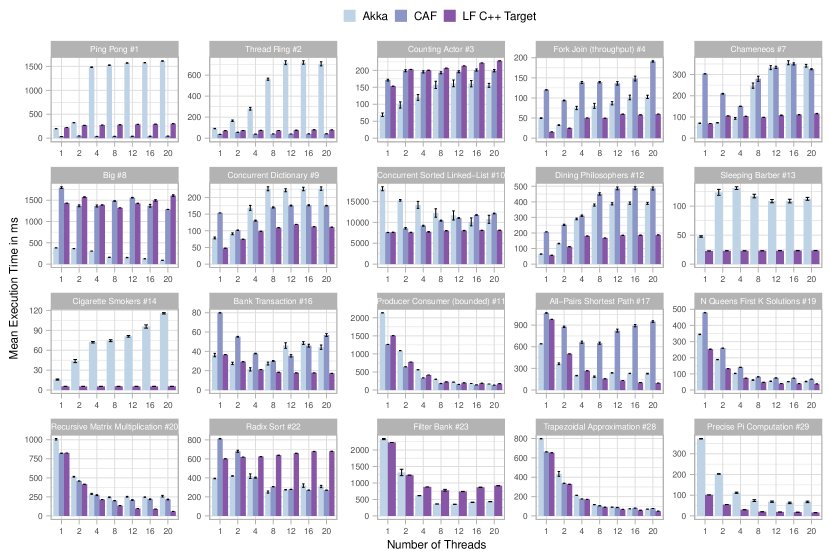
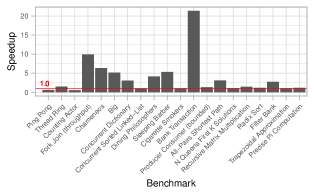
- Lingua Franca’s C++ target achieves an average speedup of 1.85x over Akka and 1.42x over CAF on the Savina benchmark suite, demonstrating superior runtime performance.
- The performance gains are attributed to efficient, lock-free scheduling and effective exploitation of data-parallelism without introducing nondeterminism.
- Deterministic execution does not hinder performance; in fact, it enables better optimization opportunities due to predictable control and data flow.
- The evaluation shows that LF can handle complex, real-world concurrent workloads with predictable, repeatable behavior and high throughput.
- The results indicate that the default determinism in LF does not require performance trade-offs and can even outperform nondeterministic alternatives.
- The authors conclude that determinism and high performance are compatible, and that future scheduling optimizations could further improve performance.
Read this paper
Open the full text in the Nubint reader and ask about any passage as you read.
Read this paper on NubintThis review was generated by AI from the original paper. Please check the paper before citing it.