
[Paper Review] High-Resolution Building and Road Detection from Sentinel-2
The paper trains a student model to predict 50 cm building/road segmentation from stacks of 10 m Sentinel-2 images by imitating a high‑resolution teacher model, achieving 78.3% mIoU for buildings (vs 85.3% for the teacher) and building counts with R2=0.91.
Mapping buildings and roads automatically with remote sensing typically requires high-resolution imagery, which is expensive to obtain and often sparsely available. In this work we demonstrate how multiple 10 m resolution Sentinel-2 images can be used to generate 50 cm resolution building and road segmentation masks. This is done by training a `student' model with access to Sentinel-2 images to reproduce the predictions of a `teacher' model which has access to corresponding high-resolution imagery. While the predictions do not have all the fine detail of the teacher model, we find that we are able to retain much of the performance: for building segmentation we achieve 79.0\% mIoU, compared to the high-resolution teacher model accuracy of 85.5\% mIoU. We also describe two related methods that work on Sentinel-2 imagery: one for counting individual buildings which achieves $R^2 = 0.91$ against true counts and one for predicting building height with 1.5 meter mean absolute error. This work opens up new possibilities for using freely available Sentinel-2 imagery for a range of tasks that previously could only be done with high-resolution satellite imagery.
Motivation & Objective
- Motivate accessible, large-scale mapping of buildings and roads without relying on costly high-resolution imagery.
- Develop an end-to-end framework that learns to reproduce high-resolution predictions from low-resolution Sentinel-2 stacks.
- Leverage a teacher model trained on 50 cm imagery to supervise a student model using Sentinel-2 inputs.
- Enable counting of buildings in a patch via centroid prediction to approximate counts.
- Contribute to Open Buildings dataset development by expanding Sentinel-2 based analysis capabilities.
Proposed method
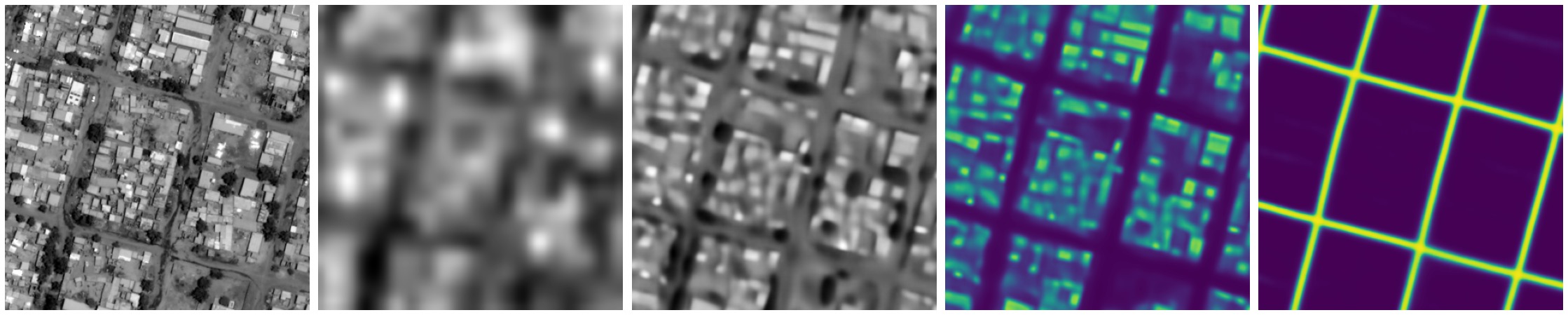
- Use a teacher–student setup where the teacher operates on 50 cm imagery and the student receives a stack of Sentinel-2 frames at 10 m resolution to predict high-resolution semantic masks.
- Employ an encoder–decoder architecture based on HRNet; adapt the first block to preserve higher spatial resolution for LR inputs.
- Fuse temporal information across 32 Sentinel-2 frames via cross-time depthwise convolutions in a residual configuration to capture temporal cues.
- Train a multi-task model outputting building segmentation, road segmentation, building centroids (for counts), and a super-resolved grayscale image to aid registration.
- Use per-pixel Kullback–Leibler Divergence loss with an alignment step that registers label to model output via translation search; include an upsampling-based decoder to reach 50 cm targets.
- Incentivize accurate counts through a centroid-based counting approach, deriving tile counts by summing centroid channel outputs and scaling.

Experimental results
Research questions
- RQ1Can Sentinel-2 stacks at 10 m resolution be used to predict semantic 50 cm building and road masks?
- RQ2How close can Sentinel-2 based predictions approach high-resolution teacher models in mIoU and spatial detail?
- RQ3Is building counting feasible from Sentinel-2 predictions, and how does it compare to true counts?
- RQ4What is the impact of temporal framing and pairing strategies on downstream segmentation performance?
- RQ5How does input/output/label resolution affect performance and how does Sentinel-2 based counting perform across scales?
Key findings
- Building segmentation achieves 78.3% mIoU with Sentinel-2 supervision vs 85.3% mIoU for the high-resolution teacher.
- The building-count task attains R2 = 0.91 against true counts, closely matching the teacher baseline of R2 = 0.95.
- Using 4 m input resolution yields performance comparable to a single-frame high-resolution model trained on 4 m data, and the best Sentinel-2 based model reaches 50 cm output with notable accuracy.
- Performance improves with more timeframes; 32-frame stacks outperform single-frame setups by about 5 percentage points in mIoU for buildings.
- Pairing each timeframe with the 17th frame (nearest in time to the teacher label) provides a significant boost over no pairing; cross-time fusion further enhances results.
- Training scale matters: increasing the training data from 1% to 100% improves building mIoU from 69.1 to 76.6 (with 32 frames).
Better researchstarts right now
From reading papers to final review, dramatically reduce your research time.
No credit card · Free plan available
This review was created by AI and reviewed by human editors.