
[Paper Review] Highly nonperturbative nature of the Mott metal-insulator transition: Two-particle vertex divergences in the coexistence region
This paper demonstrates that the Mott metal-insulator transition (MIT) in the half-filled Hubbard model exhibits a highly nonperturbative character, revealed by an infinite accumulation of two-particle vertex divergence lines in the insulating phase as temperature approaches zero. Using systematic dynamical mean-field theory (DMFT) calculations, the authors show that the number of divergences increases with inverse temperature β, signaling a critical accumulation point at T=0, which underscores the breakdown of perturbation theory at the MIT.
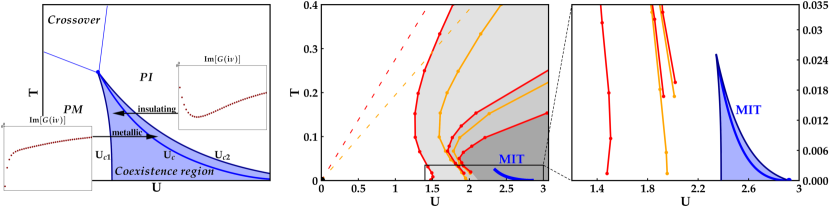
We thoroughly analyze the divergences of the irreducible vertex functions occurring in the charge channel of the half-filled Hubbard model in close proximity to the Mott metal-insulator transition (MIT). In particular, by systematically performing dynamical mean-field theory (DMFT) calculations on the two-particle level, we determine the location and the number of the vertex divergences across the whole coexistence region adjacent to the first-order metal-to-insulator transition. We find that the lines in the parameter space, along which the vertex divergences occur, display a qualitatively different shape in the coexisting metallic and insulating phase, which is also associated to an abrupt jump of the number of divergences across the MIT. Physically, the systematically larger number of divergences on the insulating side of the transition reflects the sudden suppression of local charge fluctuation at the MIT. Further, a systematic analysis of the results demonstrates that the number of divergence lines increases as a function of the inverse temperature ${β\!=\!(k_\mathrm{B} T)^{-1}}$ by approaching the Mott transition in the zero temperature limit. This makes it possible to identify the zero-temperature MIT as an accumulation point of an infinite number of vertex divergence lines, unveiling the highly nonperturbative nature of the underlying transition.
Motivation & Objective
- To resolve the unresolved connection between the breakdown of perturbation theory and the Mott metal-insulator transition (MIT), particularly in the coexistence region.
- To investigate the behavior of irreducible two-particle vertex functions in the charge channel near the Mott transition, focusing on divergence lines in both metallic and insulating phases.
- To determine how the number and structure of vertex divergences evolve across the first-order MIT and in the zero-temperature limit.
- To establish that the zero-temperature MIT is an accumulation point of infinitely many divergence lines, revealing its nonperturbative nature.
Proposed method
- Performing systematic dynamical mean-field theory (DMFT) calculations on the two-particle level for the half-filled Hubbard model on a Bethe lattice with infinite connectivity.
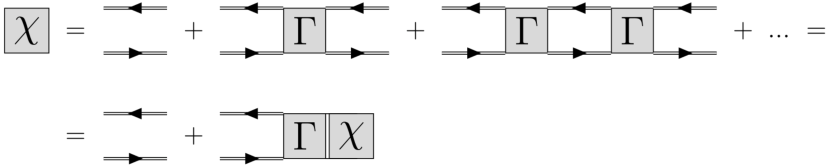
- Computing the irreducible two-particle vertex functions in the charge channel and identifying divergence lines via the Bethe-Salpeter equation kernel.
- Tracking the number of negative eigenvalues $N_{ u<0}$ of the vertex kernel as a proxy for the number of divergence lines across the coexistence region.
- Extrapolating results to zero temperature by increasing the inverse temperature $\beta = (k_B T)^{-1}$, with $\beta$ values up to 200.
- Using polynomial fits to transition lines ($U_{c1}(T)$, $U_c(T)$, $U_{c2}(T)$) and intermediate lines to map divergence behavior across parameter space.
- Constructing an effective Hubbard atom model with $U_{\text{eff}}(U) = U^2 / (U + U_{c1}^{T=0}( heta_0 - 1))$ to approximate the insulating phase's divergence structure, with $\theta_0$ calibrated from slope ratios of $N_{ u<0}(\beta)$.
Experimental results
Research questions
- RQ1How do the locations and numbers of two-particle vertex divergences change across the coexistence region of the Mott MIT?
- RQ2What is the relationship between the number of vertex divergences and the nature of the metallic vs. insulating phases near the MIT?
- RQ3How does the number of divergences scale with inverse temperature $\beta$ as $T \to 0$?
- RQ4Can the zero-temperature Mott transition be understood as an accumulation point of divergence lines, indicating a nonperturbative critical point?
- RQ5To what extent can the insulating phase's divergence structure be captured by an effective Hubbard atom model with renormalized interaction $U_{\text{eff}}$?
Key findings
- The number of vertex divergence lines $N_{ u<0}$ increases with inverse temperature $\beta$, scaling as $p(U) \propto U$ for $\beta \leq 75$, $\propto U^2$ for $\beta = 100, 133$, and $\propto U^3$ for $\beta = 200$, indicating a strong nonlinearity in the divergence accumulation.
- The lines of vertex divergence exhibit qualitatively different shapes in the metallic and insulating phases, with a discontinuous jump in the number of divergences across the first-order transition.
- The insulating phase hosts a systematically larger number of divergences than the metallic phase, reflecting the sudden suppression of local charge fluctuations at the MIT.
- The zero-temperature Mott transition is identified as an accumulation point of an infinite number of divergence lines, confirming its highly nonperturbative character.
- An effective Hubbard atom model with $U_{\text{eff}} = U^2 / (U + U_{c1}^{T=0}( heta_0 - 1))$ and $\theta_0 \approx 1.19$ provides a good quantitative approximation for the number of divergences in the insulating phase, with $\theta_0^{\text{slope}} = 1.22$ derived from slope ratios of $N_{ u<0}(\beta)$.
- At $\beta = 40$, the effective model with $\theta_0^{\text{slope}} = 1.22$ reproduces the exact $N_{ u<0}$ values for the Hubbard model within 1–3% error for $U = 3.1$ and $U = 3.5$.
Read this paper
Open the full text in the Nubint reader and ask about any passage as you read.
Read this paper on NubintThis review was generated by AI from the original paper. Please check the paper before citing it.