
[Paper Review] HOD-informed prior for EFT-based full-shape analyses of LSS
This paper proposes an HOD-informed prior for effective field theory (EFT)-based full-shape analyses of large-scale structure (LSS), using 320,000 HOD mock galaxy catalogs across diverse cosmologies to constrain EFT nuisance parameters. The method reduces prior effects, improving cosmological parameter recovery—e.g., reducing σ-distance for Ωch² from 1.65 to 0.57 in ΛCDM—making it robust and suitable for current and upcoming galaxy surveys.
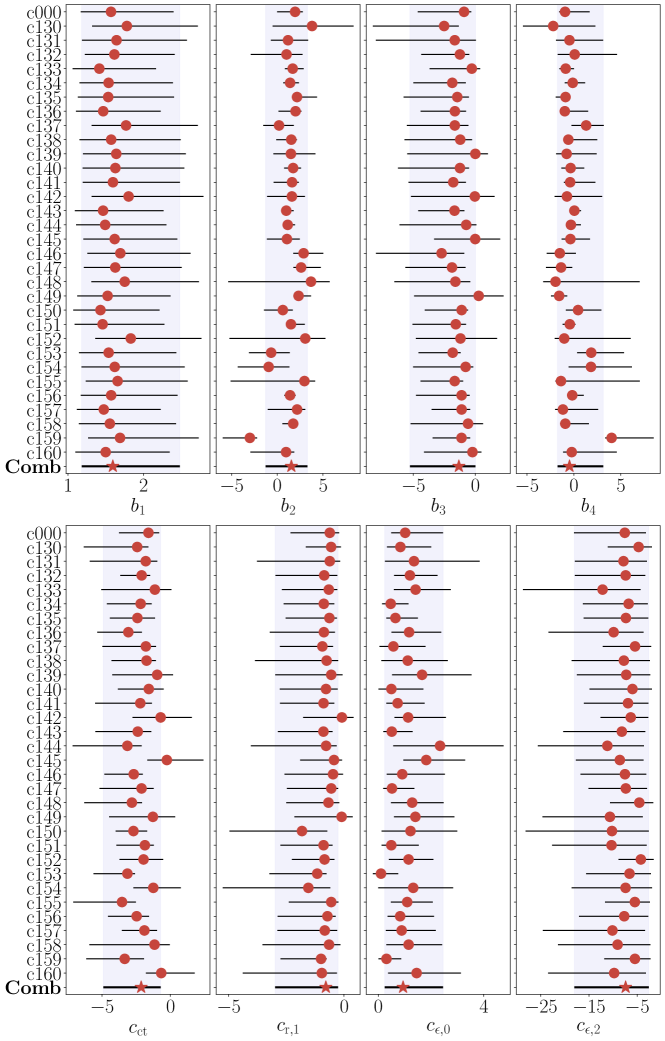
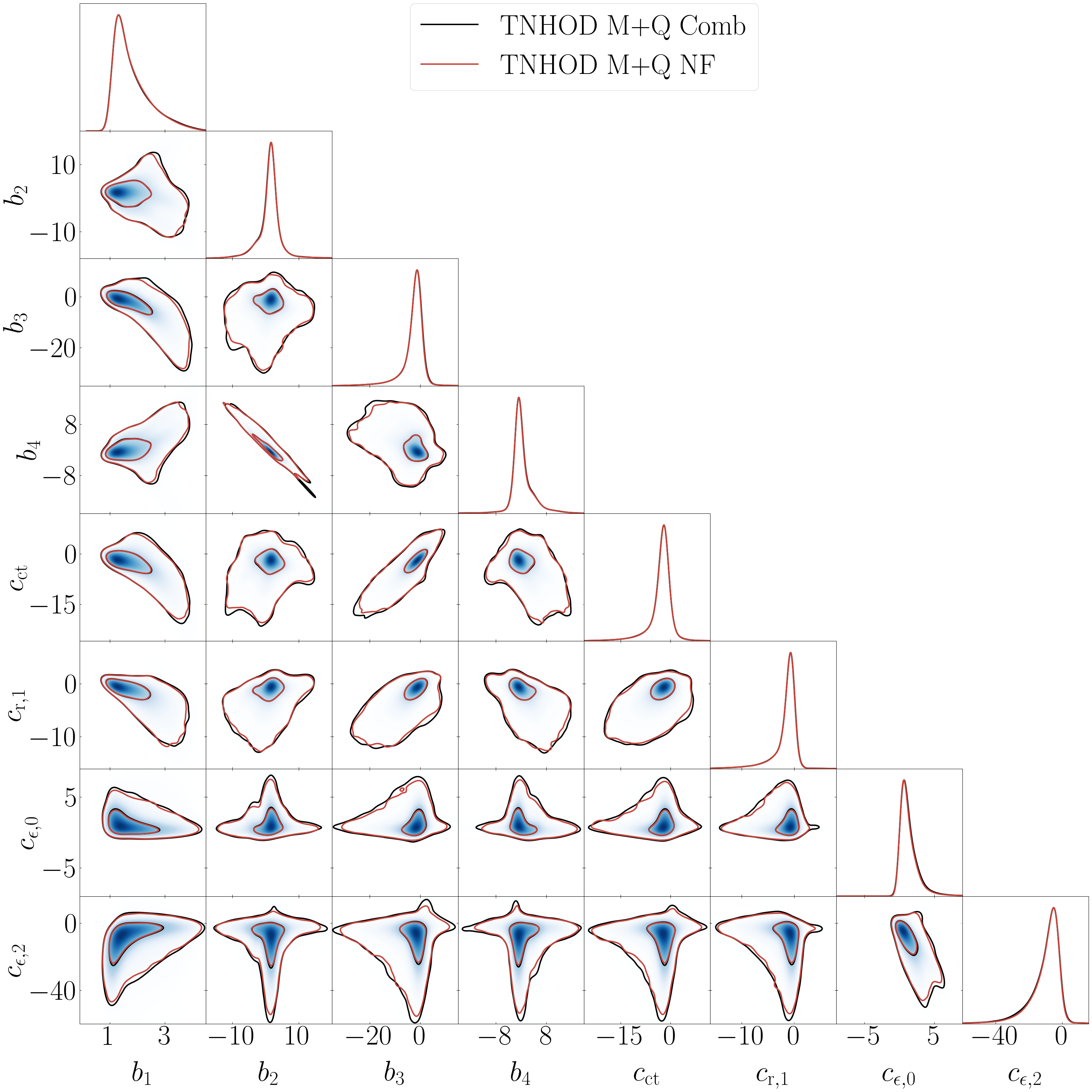
To improve the performance of full-shape analyses of large-scale structure, we consider using a halo occupation distribution (HOD)-informed prior for the effective field theory (EFT) nuisance parameters. We generate 320 000 mock galaxy catalogs using 10 000 sets of HOD parameters across 32 simulation boxes with different cosmologies. We measure and fit the redshift-space power spectra using a fast emulator of the EFT model, and the resulting best-fit EFT parameter distributions are used to create the prior. This prior effectively constrains the EFT nuisance parameter space, limiting it to the space of HOD-mocks that can be well fit by a EFT model. We have tested the stability of the prior under different configurations, including the effect of varying the HOD sample distribution and the inclusion of the hexadecapole moment. We find that our HOD-informed prior and the cosmological parameter constraints derived using it are robust. While cosmological fits using the standard EFT prior suffer from prior effects, sometimes failing to recover the true cosmology within Bayesian credible intervals, the HOD-informed prior mitigates these issues and significantly improves cosmological parameter recovery for $Λ$CDM and beyond. This work lays the foundation for better full-shape large-scale structure analyses in current and upcoming galaxy surveys, making it a valuable tool for addressing key questions in cosmology.
Motivation & Objective
- Address prior effects in EFT-based full-shape analyses of large-scale structure, where unphysical nuisance parameter priors bias cosmological constraints.
- Overcome limitations of standard EFT priors that fail to recover true cosmology within Bayesian credible intervals.
- Develop a physically motivated, simulation-based prior for EFT nuisance parameters using a halo occupation distribution (HOD) framework.
- Ensure robustness across varying cosmologies, HOD sample distributions, and inclusion of higher-order moments like the hexadecapole.
- Enable more accurate cosmological inference from current and upcoming galaxy surveys by constraining the EFT parameter space to physically plausible configurations.
Proposed method
- Generate 320,000 mock galaxy catalogs using 10,000 HOD parameter sets across 32 simulation boxes with different cosmologies.
- Measure redshift-space power spectra from these mocks and fit them using a fast emulator of the EFTofLSS model.
- Extract the distribution of best-fit EFT parameters from the fits to construct an HOD-informed prior.
- Test the prior's robustness by varying cosmological models, HOD sample distributions, and including/excluding the hexadecapole moment.
- Validate the prior using a DESI-like LRG catalog at z=0.8 and a SHAM-based mock from the UNIT simulation to ensure simulation independence.
- Compare cosmological constraints using the HOD-informed prior against the standard EFT prior to quantify improvements in parameter recovery.
Experimental results
Research questions
- RQ1Can an HOD-informed prior effectively reduce prior effects in EFT-based full-shape analyses of large-scale structure?
- RQ2How does the HOD-informed prior perform across different cosmological models, including ΛCDM, wCDM, and w0waCDM?
- RQ3To what extent does the HOD sample distribution influence the shape and robustness of the derived prior?
- RQ4Does the inclusion of the hexadecapole moment affect the stability and performance of the HOD-informed prior?
- RQ5Can the HOD-informed prior be generalized to other galaxy tracers and higher-order statistics like the bispectrum?
Key findings
- The HOD-informed prior significantly reduces prior effects, improving cosmological parameter recovery across all tested models.
- For the ΛCDM model, the σ-distance for Ωch² decreased from 1.65 (standard prior) to 0.57 (HOD-informed prior), indicating a substantial improvement in precision.
- In the wCDM model, the σ-distance dropped from 1.90 to 1.03, and in the w0waCDM model, it fell from 2.00 to 1.00, showing consistent performance across model complexity.
- The prior is largely cosmology-independent, with no significant dependence of EFT parameter distributions on the underlying cosmological model.
- The HOD sample distribution affects the prior's shape but has limited impact on cosmological fitting, confirming robustness to tracer selection.
- The method remains effective when tested on a SHAM-based mock from the UNIT simulation, confirming its simulation-independence and broad applicability.
Read this paper
Open the full text in the Nubint reader and ask about any passage as you read.
Read this paper on NubintThis review was generated by AI from the original paper. Please check the paper before citing it.