
[Paper Review] HOICLIP: Efficient Knowledge Transfer for HOI Detection with Vision-Language Models
HOICLIP proposes a knowledge transfer framework for HOI detection that directly extracts spatial, verb, and linguistic priors from CLIP without knowledge distillation. By using a cross-attention interaction decoder, visual semantic arithmetic for verb representation, and a training-free prompt-based classifier, it achieves state-of-the-art performance with 4.04 mAP gain on HICO-Det and superior data efficiency in few- and zero-shot settings.
Human-Object Interaction (HOI) detection aims to localize human-object pairs and recognize their interactions. Recently, Contrastive Language-Image Pre-training (CLIP) has shown great potential in providing interaction prior for HOI detectors via knowledge distillation. However, such approaches often rely on large-scale training data and suffer from inferior performance under few/zero-shot scenarios. In this paper, we propose a novel HOI detection framework that efficiently extracts prior knowledge from CLIP and achieves better generalization. In detail, we first introduce a novel interaction decoder to extract informative regions in the visual feature map of CLIP via a cross-attention mechanism, which is then fused with the detection backbone by a knowledge integration block for more accurate human-object pair detection. In addition, prior knowledge in CLIP text encoder is leveraged to generate a classifier by embedding HOI descriptions. To distinguish fine-grained interactions, we build a verb classifier from training data via visual semantic arithmetic and a lightweight verb representation adapter. Furthermore, we propose a training-free enhancement to exploit global HOI predictions from CLIP. Extensive experiments demonstrate that our method outperforms the state of the art by a large margin on various settings, e.g. +4.04 mAP on HICO-Det. The source code is available in https://github.com/Artanic30/HOICLIP.
Motivation & Objective
- To address the poor data efficiency and zero-shot generalization of existing HOI detection methods based on knowledge distillation from CLIP.
- To improve performance on long-tailed verb classes and rare interactions without relying on large-scale annotated training data.
- To enable effective, training-free utilization of CLIP’s pre-trained vision-language representations for HOI classification.
- To enhance detection accuracy by fusing CLIP’s spatial and linguistic priors with a detection backbone through a knowledge integration block.
Proposed method
- A transformer-based interaction decoder uses cross-attention to extract localized interaction features from CLIP’s visual feature map, focusing on informative regions.
- A verb classifier is constructed using visual semantic arithmetic to compute class weights from CLIP-learned visual-semantic relationships, avoiding reliance on large-scale verb-specific data.
- A lightweight verb representation adapter is introduced to refine verb representations and improve discrimination of fine-grained interactions.
- A training-free enhancement leverages CLIP’s text encoder to generate zero-shot predictions via prompt-based linguistic representations, integrated at inference time.
- Knowledge integration blocks fuse CLIP’s spatial and linguistic features with the detection backbone’s features to improve human-object pair localization and interaction classification.
- The framework avoids knowledge distillation by directly retrieving and leveraging pre-trained CLIP priors across vision, language, and spatial modalities.
Experimental results
Research questions
- RQ1Can direct retrieval of CLIP’s pre-trained knowledge improve data efficiency in HOI detection compared to knowledge distillation?
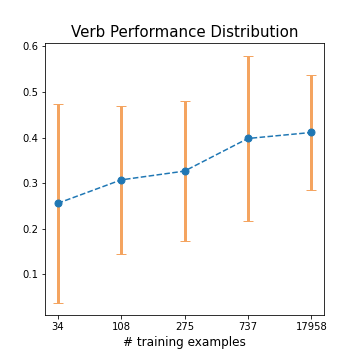
- RQ2How can visual semantic arithmetic enhance verb representation learning under long-tailed and low-data regimes?
- RQ3Can a training-free, prompt-based text classifier improve zero-shot generalization in HOI detection?
- RQ4To what extent does integrating CLIP’s spatial and linguistic priors improve detection accuracy and robustness across full, rare, and non-rare classes?
Key findings
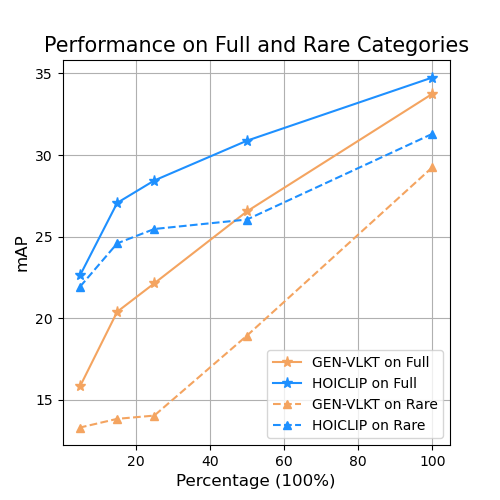
- HOICLIP achieves a +4.04 mAP improvement over the previous state of the art on the HICO-Det dataset under fully supervised settings.
- The model shows superior data efficiency, outperforming baselines like GEN-VLKT even when training data is reduced to 5%.
- The verb classifier using visual semantic arithmetic achieves 1.16 mAP gain over sentence-description methods and 1.45 mAP gain over average HOI representation methods in the full class setting.
- The training-free enhancement with top-k global predictions improves mAP by 0.15 points on average, with minimal inference cost.
- HOICLIP maintains competitive inference speed (55.52 ms/img) on a single A100 GPU, with only a slight increase over GEN-VLKT despite higher performance.
- Ablation studies confirm that each component—spatial feature extraction, verb adapter, and linguistic enhancement—contributes incrementally to overall performance.
Read this paper
Open the full text in the Nubint reader and ask about any passage as you read.
Read this paper on NubintThis review was generated by AI from the original paper. Please check the paper before citing it.