
[Paper Review] HomeRobot: Open-Vocabulary Mobile Manipulation
Defines Open-Vocabulary Mobile Manipulation (OVMM) and provides a reproducible benchmark and software stack (simulation and real-world) for evaluating end-to-end mobile manipulation with open object sets, using Hello Robot Stretch; reports baselines with sim-to-real transfer roughly achieving 20% real-world success.
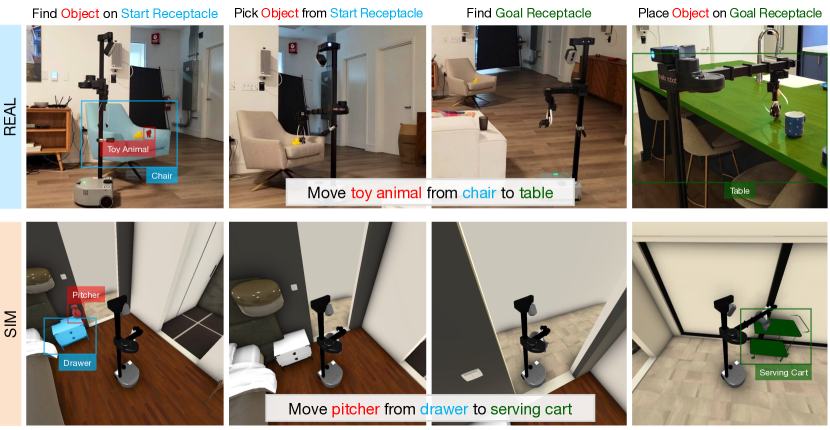
HomeRobot (noun): An affordable compliant robot that navigates homes and manipulates a wide range of objects in order to complete everyday tasks. Open-Vocabulary Mobile Manipulation (OVMM) is the problem of picking any object in any unseen environment, and placing it in a commanded location. This is a foundational challenge for robots to be useful assistants in human environments, because it involves tackling sub-problems from across robotics: perception, language understanding, navigation, and manipulation are all essential to OVMM. In addition, integration of the solutions to these sub-problems poses its own substantial challenges. To drive research in this area, we introduce the HomeRobot OVMM benchmark, where an agent navigates household environments to grasp novel objects and place them on target receptacles. HomeRobot has two components: a simulation component, which uses a large and diverse curated object set in new, high-quality multi-room home environments; and a real-world component, providing a software stack for the low-cost Hello Robot Stretch to encourage replication of real-world experiments across labs. We implement both reinforcement learning and heuristic (model-based) baselines and show evidence of sim-to-real transfer. Our baselines achieve a 20% success rate in the real world; our experiments identify ways future research work improve performance. See videos on our website: https://ovmm.github.io/.
Motivation & Objective
- Motivate and formalize OVMM as a core in-home robotics challenge combining perception, navigation, and manipulation in open-world object sets.
- Provide a reusable benchmark and infrastructure in both simulation and real world to foster reproducible research on OVMM.
- Demonstrate baseline methods (heuristic planning and RL) and assess sim-to-real transfer for nav and place skills.
- Enable cross-lab replication and comparison through standardized hardware stack and APIs.
Proposed method
- Introduce OVMM task: Move an object from a start_receptacle to a goal_receptacle in an unknown single-floor home with open vocabulary object sets.
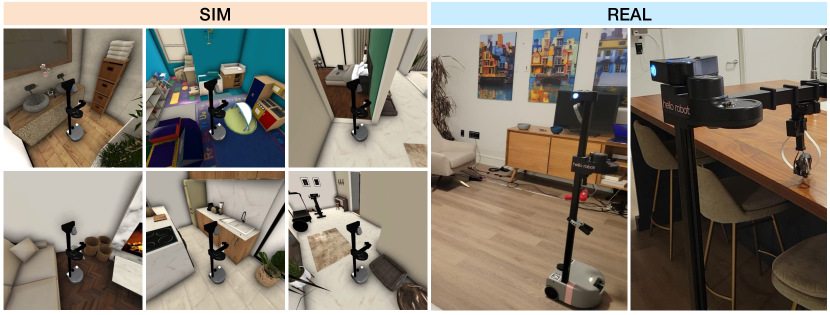
- Create a simulation dataset using Habitat with 60 scenes from HSSD and a diverse set of 2,535 objects across 129 categories and 21 receptacle categories; define training/validation/test splits with seen/unseen categories and instances.
- Provide a real-world benchmark environment (controlled apartment) and a low-cost Hello Robot Stretch platform for reproducible experiments.
- Implement HomeRobot library with identical APIs for simulation and real world, enabling end-to-end benchmarking and modular baselines.
- Develop two baseline policies: a heuristic motion-planner-based baseline using DETIC for object masks and an RL-based baseline trained with DDPPO on depth, segmentation, and proprioceptive inputs.
- Evaluate perception (ground-truth vs DETIC), navigation, gaze, grasp, and place sub-skills, and analyze sim-to-real gaps.
Experimental results
Research questions
- RQ1How can OVMM be defined and benchmarked in both simulated and real-world home environments with open vocabulary objects?
- RQ2What is the performance of heuristic vs. RL baselines on OVMM tasks, and how does perception quality (ground truth vs DETIC) affect results?
- RQ3To what extent can sim-to-real transfer be achieved for navigation and placement skills in OVMM?
- RQ4What are the bottlenecks (perception, navigation, manipulation) that limit real-world OVMM success, and how can a unified robotics stack address them?
Key findings
- RL baselines outperform heuristic methods in navigation and placement in simulation, but perception quality dramatically affects performance for all methods.
- Ground-truth perception yields higher success than DETIC-based perception, indicating perception is a major bottleneck.
- In simulation, partial and overall success rates show RL with ground truth segmentation achieving higher scores than heuristic baselines; DETIC segmentation reduces performance for both approaches.
- In real-world experiments, RL achieved a 20% overall success rate, improving over the heuristic baseline by 5 percentage points, driven by gains in pick and place sub-tasks.
- Detections from open-vocabulary models (DETIC) introduce misclassification failures that substantially impact both sim and real-world performance.
- The HomeRobot OVMM stack enables reproducible end-to-end benchmarking across sim and real hardware, highlighting sim-to-real gaps and the importance of a unified framework.
Read this paper
Open the full text in the Nubint reader and ask about any passage as you read.
Read this paper on NubintThis review was generated by AI from the original paper. Please check the paper before citing it.