
[Paper Review] HOTR: End-to-End Human-Object Interaction Detection with Transformers
HOTR proposes an end-to-end, transformer-based set prediction framework for human-object interaction (HOI) detection that directly predicts <human, object, interaction> triplets without post-processing. By leveraging parallel decoders with HO Pointers and a novel set-based loss, HOTR achieves state-of-the-art performance on V-COCO and HICO-DET with inference time under 1ms, significantly outpacing prior methods.
Human-Object Interaction (HOI) detection is a task of identifying "a set of interactions" in an image, which involves the i) localization of the subject (i.e., humans) and target (i.e., objects) of interaction, and ii) the classification of the interaction labels. Most existing methods have indirectly addressed this task by detecting human and object instances and individually inferring every pair of the detected instances. In this paper, we present a novel framework, referred to by HOTR, which directly predicts a set of triplets from an image based on a transformer encoder-decoder architecture. Through the set prediction, our method effectively exploits the inherent semantic relationships in an image and does not require time-consuming post-processing which is the main bottleneck of existing methods. Our proposed algorithm achieves the state-of-the-art performance in two HOI detection benchmarks with an inference time under 1 ms after object detection.
Motivation & Objective
- To eliminate time-consuming post-processing in existing HOI detection methods by enabling direct set-level prediction of <human, object, interaction> triplets.
- To model high-level semantic relationships between humans, objects, and interactions using self-attention mechanisms in a transformer architecture.
- To achieve state-of-the-art accuracy and inference speed in HOI detection benchmarks by replacing heuristic matching with end-to-end trainable components.
- To design a novel training and inference pipeline that supports joint learning of object detection and interaction prediction through shared and parallel decoders.
Proposed method
- HOTR employs a transformer encoder-decoder architecture with two parallel decoders: one for instance detection (human/object) and one for interaction prediction.
- HO Pointers are introduced to associate interaction predictions with specific human and object instances by predicting indices rather than regressing bounding boxes directly.
- A recomposition layer at inference time matches interaction predictions to detected instances using similarity scores between representation vectors.
- A novel set-based matching loss function enables end-to-end training by aligning predicted triplets with ground-truth <human, object, interaction> sets.
- Interactiveness suppression is applied during inference to suppress low-confidence redundant predictions, improving precision in multi-label interaction classification.
- The shared encoder enables feature sharing between decoders, enhancing contextual understanding and improving generalization across interactions.
Experimental results
Research questions
- RQ1Can a direct set prediction approach based on transformers eliminate the need for heuristic post-processing in HOI detection?
- RQ2How does modeling interdependencies between interactions through self-attention improve HOI detection performance?
- RQ3What is the impact of using HO Pointers instead of direct bounding box regression on accuracy and inference efficiency?
- RQ4How does shared encoding between instance and interaction decoders affect performance and generalization?
- RQ5To what extent does interactiveness suppression improve the quality of multi-label interaction predictions?
Key findings
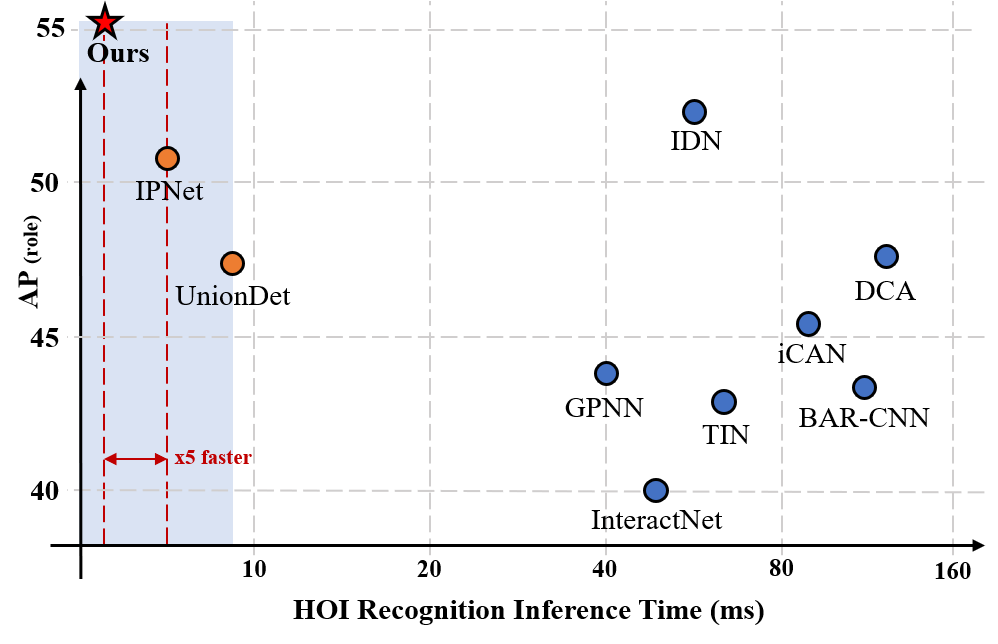
- HOTR achieves state-of-the-art performance on both V-COCO and HICO-DET benchmarks, with 55.2 mAP on V-COCO (scenario 1) and 23.5 mAP on HICO-DET (default setting).
- The model achieves an inference time of only 0.9ms for HOI recognition after object detection, making it 5–9× faster than previous parallel HOI detectors.
- Removing HO Pointers reduces performance to 39.3 mAP on V-COCO and 17.2 mAP on HICO-DET, demonstrating their critical role in reducing redundant regression and improving accuracy.
- Using separate encoders instead of a shared encoder leads to a 21.3 mAP drop on V-COCO and 9.0 mAP drop on HICO-DET, confirming the benefit of shared visual representation.
- Interactiveness suppression contributes 3 mAP improvement on V-COCO and 1.5 mAP on HICO-DET, showing its effectiveness in filtering low-confidence predictions.
- The ablation study confirms that the proposed training and inference pipeline, including recomposition and pointer-based matching, is essential for achieving high accuracy and speed.

Read this paper
Open the full text in the Nubint reader and ask about any passage as you read.
Read this paper on NubintThis review was generated by AI from the original paper. Please check the paper before citing it.