
[Paper Review] How AI Ideas Affect the Creativity, Diversity, and Evolution of Human Ideas: Evidence From a Large, Dynamic Experiment
The study investigates how exposure to AI-generated ideas, with or without disclosure, influences individual creativity and collective diversity in a dynamic, crowd-like brainstorming setup across 800+ participants from 40+ countries.
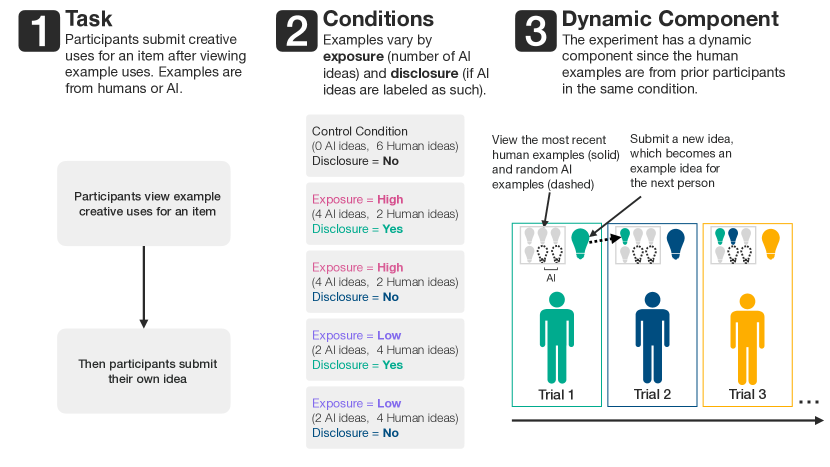
Exposure to large language model output is rapidly increasing. How will seeing AI-generated ideas affect human ideas? We conducted an experiment (800+ participants, 40+ countries) where participants viewed creative ideas that were from ChatGPT or prior experimental participants and then brainstormed their own idea. We varied the number of AI-generated examples (none, low, or high exposure) and if the examples were labeled as 'AI' (disclosure). Our dynamic experiment design -- ideas from prior participants in an experimental condition are used as stimuli for future participants in the same experimental condition -- speaks to the interdependent process of cultural creation: creative ideas are built upon prior ideas. Hence, we capture the compounding effects of having LLMs 'in the culture loop'. We find that high AI exposure (but not low AI exposure) did not affect the creativity of individual ideas but did increase the average amount and rate of change of collective idea diversity. AI made ideas different, not better. There were no main effects of disclosure. We also found that self-reported creative people were less influenced by knowing an idea was from AI and that participants may knowingly adopt AI ideas when the task is difficult. Our findings suggest that introducing AI ideas may increase collective diversity but not individual creativity.
Motivation & Objective
- Examine how exposure to AI-generated ideas affects human creativity in a dynamic, culture-loop context.
- Determine whether AI disclosure (labeling ideas as AI) moderates effects on creativity and diversity.
- Assess how AI ideas influence the evolution of idea diversity over successive generations of participants.
Proposed method
- Use a variant of the Alternate Uses Task (AUT) where participants see AI and/or human ideas before generating their own idea.
- Manipulate AI exposure levels (none, low, high) and AI disclosure (labeled vs. unlabeled) in a dynamic, forward-propagating design.
- Represent ideas as embeddings (SBERT) to measure idea diversity and AI-adoption via cosine similarity to AI exemplars.
- Estimate individual creativity with a GPT-3-based originality classifier correlated with human judgments (r=0.81 overall).
- Track temporal dynamics by allowing ideas to feed forward to future participants within the same condition.
Experimental results
Research questions
- RQ1Does high AI exposure increase individual creativity or crowd-level diversity?
- RQ2Does labeling AI-generated ideas (disclosure) alter creativity or adoption of AI ideas?
- RQ3How does AI exposure affect the rate of change in collective idea diversity over time?
- RQ4Do self-identified creative individuals respond differently to AI-disclosed ideas compared to those who do not identify as creative?
Key findings
- High AI exposure increases collective idea diversity but does not improve individual creativity.
- AI exposure accelerates the rate at which idea diversity develops over time.
- Self-identified creative participants are less influenced by AI disclosure when adopting AI ideas.
- Participants are more likely to adopt AI ideas when the task is difficult, particularly under disclosure.
- There are no main effects of disclosure on creativity or diversity across the full sample.

Read this paper
Open the full text in the Nubint reader and ask about any passage as you read.
Read this paper on NubintThis review was generated by AI from the original paper. Please check the paper before citing it.