
[Paper Review] How Can Large Language Models Help Humans in Design and Manufacturing?
The paper analyzes how GPT-4 can augment the entire design and manufacturing (CDaM) workflow, exploring text-to-design, design-space generation, design-for-manufacturing, performance prediction, and inverse design, with a focus on capabilities and limitations.
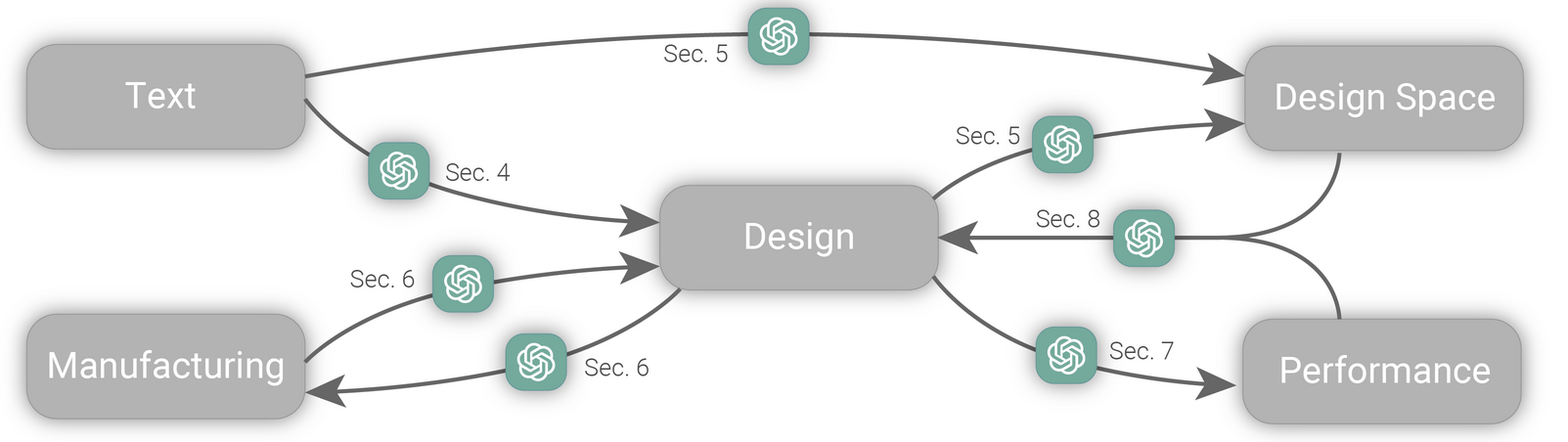
The advancement of Large Language Models (LLMs), including GPT-4, provides exciting new opportunities for generative design. We investigate the application of this tool across the entire design and manufacturing workflow. Specifically, we scrutinize the utility of LLMs in tasks such as: converting a text-based prompt into a design specification, transforming a design into manufacturing instructions, producing a design space and design variations, computing the performance of a design, and searching for designs predicated on performance. Through a series of examples, we highlight both the benefits and the limitations of the current LLMs. By exposing these limitations, we aspire to catalyze the continued improvement and progression of these models.
Motivation & Objective
- Motivate the use of Large Language Models to lower barriers in computational design and manufacturing workflows.
- Systematically examine GPT-4's ability to perform tasks across the five CDaM phases: design generation, design space generation, manufacturing preparation, performance evaluation, and inverse design.
- Identify practical strategies for prompting, human-in-the-loop feedback, and tooling to integrate LLMs with existing solvers and visualizers.
- Document limitations and dualities of GPT-4 in CDaM to guide future model improvements and workflow design.
Proposed method
- Represent CDaM components (design, design space, manufacturing instructions, performance metrics) as compact programs to enable LLM-style translation between input and output DSLs.
- Conduct a broad suite of experiments across design representations (2D vector, 3D parametric, robotics URDF/graphs) and manufacturing processes (CNC, additive/subtractive) using GPT-4.
- Evaluate text-to-design, text/design-to-design-space, bi-directional design-for-manufacturing, design-to-performance, and inverse design tasks.
- Assess prompting strategies, human feedback integration, and external tool usage to leverage GPT-4 effectively.
- Fabricate end-to-end examples (cabinet and quadcopter) to demonstrate practical CDaM workflows with GPT-4 support.
Experimental results
Research questions
- RQ1Can GPT-4 generate meaningful designs from high-level goals across multiple modeling representations?
- RQ2To what extent can GPT-4 respect user constraints and modular design intentions in generated designs?
- RQ3How effectively can GPT-4 generate design spaces and variations suitable for performance-driven exploration?
- RQ4Can GPT-4 assist in predicting performance and guiding inverse design within a CDaM pipeline?
- RQ5What are the practical limitations and dualities of GPT-4 when integrated into end-to-end CDaM workflows?
Key findings
- GPT-4 demonstrates capability to generate designs and supporting code for SVG and DXF vector formats with iterative refinement.
- GPT-4 can generate 3D constructs using CSG and sketch-based CAD representations but faces spatial and positional challenges that improve with targeted prompting.
- GPT-4 can produce simple table-like structures in 3D using predefined primitives, though alignment and placement issues persist without explicit corrections.
- GPT-4 supports manufacturing process selection, design modifications for manufacturability, and creation of machine-readable manufacturing instructions across additive and subtractive processes.
- The study reveals notable limitations in reasoning, verification, and multi-request scalability, along with dualities related to context dependence and unprompted inferences.
- End-to-end demonstrations (cabinet and quadcopter) illustrate both the potential and the iterative nature of GPT-4-enabled CDaM workflows.

Better researchstarts right now
From reading papers to final review, dramatically reduce your research time.
No credit card · Free plan available
This review was created by AI and reviewed by human editors.