
[Paper Review] How Does In-Context Learning Help Prompt Tuning?
This paper empirically analyzes how in-context learning (ICL), prompt tuning (PT), and instruction prompt tuning (IPT) interact across five text-generation tasks, revealing when IPT or PT excel and how transfer and stability behave.
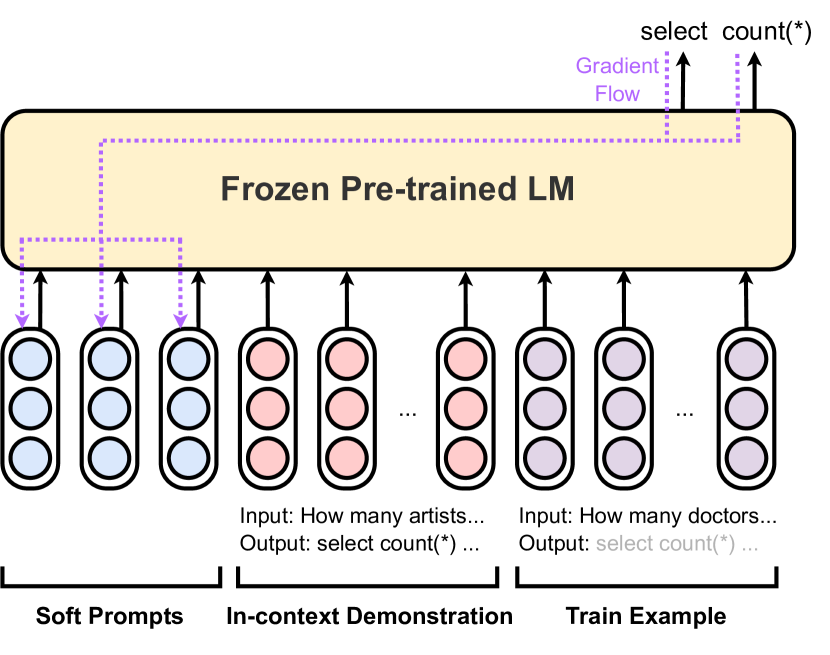
Fine-tuning large language models is becoming ever more impractical due to their rapidly-growing scale. This motivates the use of parameter-efficient adaptation methods such as prompt tuning (PT), which adds a small number of tunable embeddings to an otherwise frozen model, and in-context learning (ICL), in which demonstrations of the task are provided to the model in natural language without any additional training. Recently, Singhal et al. (2022) propose ``instruction prompt tuning'' (IPT), which combines PT with ICL by concatenating a natural language demonstration with learned prompt embeddings. While all of these methods have proven effective on different tasks, how they interact with each other remains unexplored. In this paper, we empirically study when and how in-context examples improve prompt tuning by measuring the effectiveness of ICL, PT, and IPT on five text generation tasks with multiple base language models. We observe that (1) IPT does \emph{not} always outperform PT, and in fact requires the in-context demonstration to be semantically similar to the test input to yield improvements; (2) PT is unstable and exhibits high variance, but combining PT and ICL (into IPT) consistently reduces variance across all five tasks; and (3) prompts learned for a specific source task via PT exhibit positive transfer when paired with in-context examples of a different target task. Our results offer actionable insights on choosing a suitable parameter-efficient adaptation method for a given task.
Motivation & Objective
- Motivate parameter-efficient adaptation for large language models due to infeasibility of full fine-tuning.
- Compare ICL, PT, and IPT across diverse OOD generation tasks.
- Investigate conditions under which IPT outperforms PT and the role of demonstration similarity.
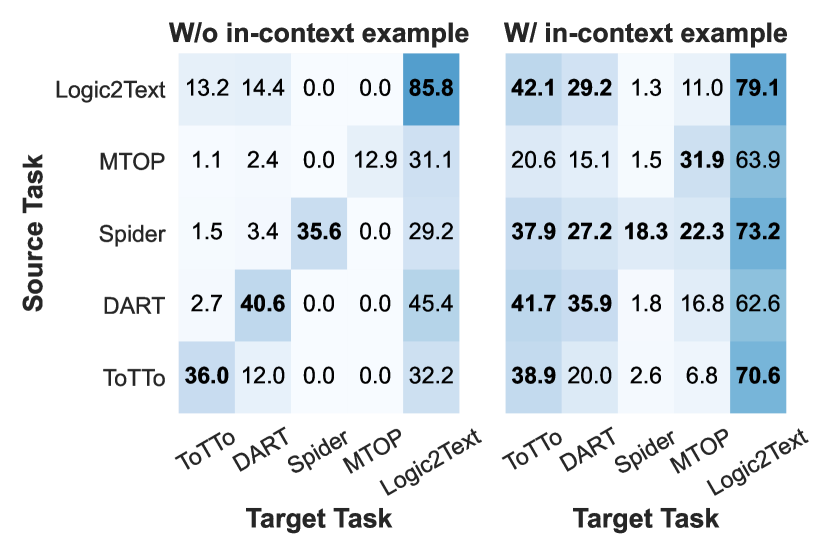
- Examine transferability of soft prompts learned on one task to other tasks when using in-context demonstrations.
Proposed method
- Empirically compare ICL, PT, and IPT on five language-generation tasks using BLOOM-1.1B, OPT-1.3B, and GPT-2-XL-1.5B as base LMs.
- Use soft prompt embeddings for PT and IPT, with two feed-forward layers atop initial prompts for stability.
- Retrieve in-context demonstrations with dense retrieval (nearest-neighbor) and evaluate one retrieved demonstration per test example.
- Train PT/IPT with randomly initialized prompts, evaluate via dev loss, and report averages over three runs with AdamW optimization.
- Assess how the similarity between in-context demonstrations and test inputs affects IPT vs PT performance.
- Explore cross-task transfer by pairing source-task prompts with target-task in-context demonstrations.
Experimental results
Research questions
- RQ1Under what conditions do IP T and PT outperform ICL across out-of-domain generation tasks?
- RQ2How does the similarity between retrieved in-context demonstrations and test inputs influence IPT vs PT performance?
- RQ3Does IPT reduce the variance of PT when adjusting hyperparameters like the number of soft prompt tokens?
- RQ4Can soft prompts learned on a source task transfer beneficially to a new target task when combined with target-task demonstrations?
- RQ5What is the effect of using retrieved demonstrations on five different data-to-text, logic-to-text, and semantic parsing tasks?
Key findings
- IPT and PT both outperform ICL across all five tasks, indicating training even a small number of parameters helps in out-of-domain tasks.
- There is no universal winner between PT and IPT; performance depends on task and configuration (e.g., number of prompt embeddings).
- IPT outperforms PT when the in-context demonstration is highly similar to the test input (notably in ToTTo).
- PT exhibits high variance as the number of tunable parameters increases, whereas IPT reduces variance and is less sensitive to the number of prompt tokens.
- Soft prompts learned for a source task can positively transfer to a new target task when paired with target-task demonstrations, outperforming ICL in some cross-task settings.
- IPT generally provides more stable convergence and robustness across hyperparameters compared to PT.
Read this paper
Open the full text in the Nubint reader and ask about any passage as you read.
Read this paper on NubintThis review was generated by AI from the original paper. Please check the paper before citing it.