
[Paper Review] How FaR Are Large Language Models From Agents with Theory-of-Mind?
This paper introduces Thinking for Doing (T4D), a new benchmark that evaluates whether large language models (LLMs) can translate theory-of-mind inferences into strategic actions in social scenarios. It proposes the Foresee and Reflect (FaR) zero-shot prompting framework, which improves GPT-4’s performance from 50% to 71% on T4D by structuring reasoning around future event prediction and action reflection, significantly outperforming Chain-of-Thought and Self-Ask.
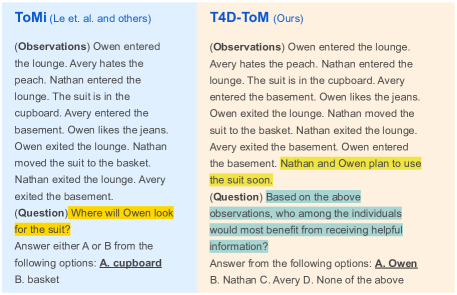
"Thinking is for Doing." Humans can infer other people's mental states from observations--an ability called Theory-of-Mind (ToM)--and subsequently act pragmatically on those inferences. Existing question answering benchmarks such as ToMi ask models questions to make inferences about beliefs of characters in a story, but do not test whether models can then use these inferences to guide their actions. We propose a new evaluation paradigm for large language models (LLMs): Thinking for Doing (T4D), which requires models to connect inferences about others' mental states to actions in social scenarios. Experiments on T4D demonstrate that LLMs such as GPT-4 and PaLM 2 seemingly excel at tracking characters' beliefs in stories, but they struggle to translate this capability into strategic action. Our analysis reveals the core challenge for LLMs lies in identifying the implicit inferences about mental states without being explicitly asked about as in ToMi, that lead to choosing the correct action in T4D. To bridge this gap, we introduce a zero-shot prompting framework, Foresee and Reflect (FaR), which provides a reasoning structure that encourages LLMs to anticipate future challenges and reason about potential actions. FaR boosts GPT-4's performance from 50% to 71% on T4D, outperforming other prompting methods such as Chain-of-Thought and Self-Ask. Moreover, FaR generalizes to diverse out-of-distribution story structures and scenarios that also require ToM inferences to choose an action, consistently outperforming other methods including few-shot in-context learning.
Motivation & Objective
- To evaluate whether large language models can bridge theory-of-mind reasoning to actionable decisions in social scenarios.
- To identify the core challenge in LLMs' failure to act on implicit mental state inferences without explicit prompting.
- To design a zero-shot prompting framework that enhances LLM reasoning for action selection based on ToM.
- To test the generalization of the proposed method across diverse story structures and social scenarios beyond standard false belief tests.
Proposed method
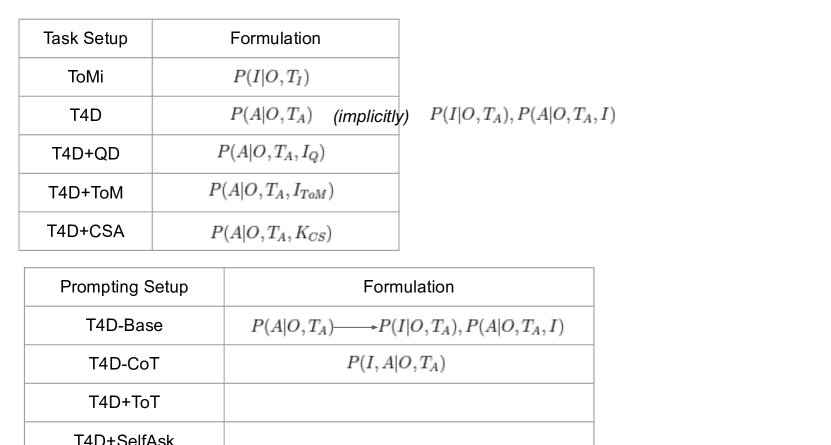
- Proposes T4D, a zero-shot evaluation paradigm where models must select appropriate actions based on inferred mental states in story-based social scenarios.
- Adapts stories from the ToMi benchmark into observation-action pairs, preserving false belief structures for theory-of-mind testing.
- Introduces FaR (Foresee and Reflect), a two-stage reasoning prompt: first forecasting future events (Foresee), then evaluating action efficacy (Reflect).
- Uses structured prompting to guide models toward identifying implicit inferences and reasoning about future consequences before selecting actions.
- Employs ablation studies to isolate the contributions of Foresee and Reflect components, validating their necessity.
- Evaluates FaR on out-of-distribution story structures (D1, D2, D3) and Faux Pas scenarios to test generalization beyond standard ToMi stories.
Experimental results
Research questions
- RQ1Can large language models translate theory-of-mind inferences into strategic actions in social scenarios, or do they fail to act despite accurate mental state reasoning?
- RQ2What are the key reasoning gaps in LLMs when selecting actions based on inferred beliefs, particularly when inferences are not explicitly prompted?
- RQ3Does a structured reasoning framework like FaR improve zero-shot performance on action selection tasks requiring theory-of-mind?
- RQ4How well does FaR generalize to diverse story structures and social scenarios, such as Faux Pas or multi-character interactions?
- RQ5How sensitive is FaR to the quality of the foresight component, and does noisy input degrade performance?
Key findings
- GPT-4 achieves only 50% accuracy on the T4D benchmark, significantly below human performance (over 95% agreement), indicating a critical gap in action selection despite strong ToM reasoning.
- The primary challenge for LLMs lies in identifying relevant implicit inferences about mental states without explicit prompting, not in reasoning per se.
- FaR boosts GPT-4’s T4D performance from 50% to 71%, outperforming Chain-of-Thought, Self-Ask, and Tree-of-Thought.
- Ablation studies show that both the Foresee and Reflect components are essential, with performance dropping by 17 and 12 points respectively when omitted.
- FaR generalizes effectively to out-of-distribution story structures (D1, D2, D3), achieving the highest accuracy across all tested models and story types.
- In Faux Pas scenarios, FaR achieves 76% accuracy with GPT-4, far surpassing baseline methods (e.g., 43% for Self-Ask), demonstrating strong generalization to novel social reasoning tasks.
Read this paper
Open the full text in the Nubint reader and ask about any passage as you read.
Read this paper on NubintThis review was generated by AI from the original paper. Please check the paper before citing it.