
[Paper Review] How Interpretable are Reasoning Explanations from Prompting Large Language Models?
The paper evaluates the interpretability of reasoning chains from prompting large language models across faithfulness, robustness, and utility, introducing SEA-CoT to improve alignment of explanations with context and answer.
Prompt Engineering has garnered significant attention for enhancing the performance of large language models across a multitude of tasks. Techniques such as the Chain-of-Thought not only bolster task performance but also delineate a clear trajectory of reasoning steps, offering a tangible form of explanation for the audience. Prior works on interpretability assess the reasoning chains yielded by Chain-of-Thought solely along a singular axis, namely faithfulness. We present a comprehensive and multifaceted evaluation of interpretability, examining not only faithfulness but also robustness and utility across multiple commonsense reasoning benchmarks. Likewise, our investigation is not confined to a single prompting technique; it expansively covers a multitude of prevalent prompting techniques employed in large language models, thereby ensuring a wide-ranging and exhaustive evaluation. In addition, we introduce a simple interpretability alignment technique, termed Self-Entailment-Alignment Chain-of-thought, that yields more than 70\% improvements across multiple dimensions of interpretability. Code is available at https://github.com/SenticNet/CoT_interpretability
Motivation & Objective
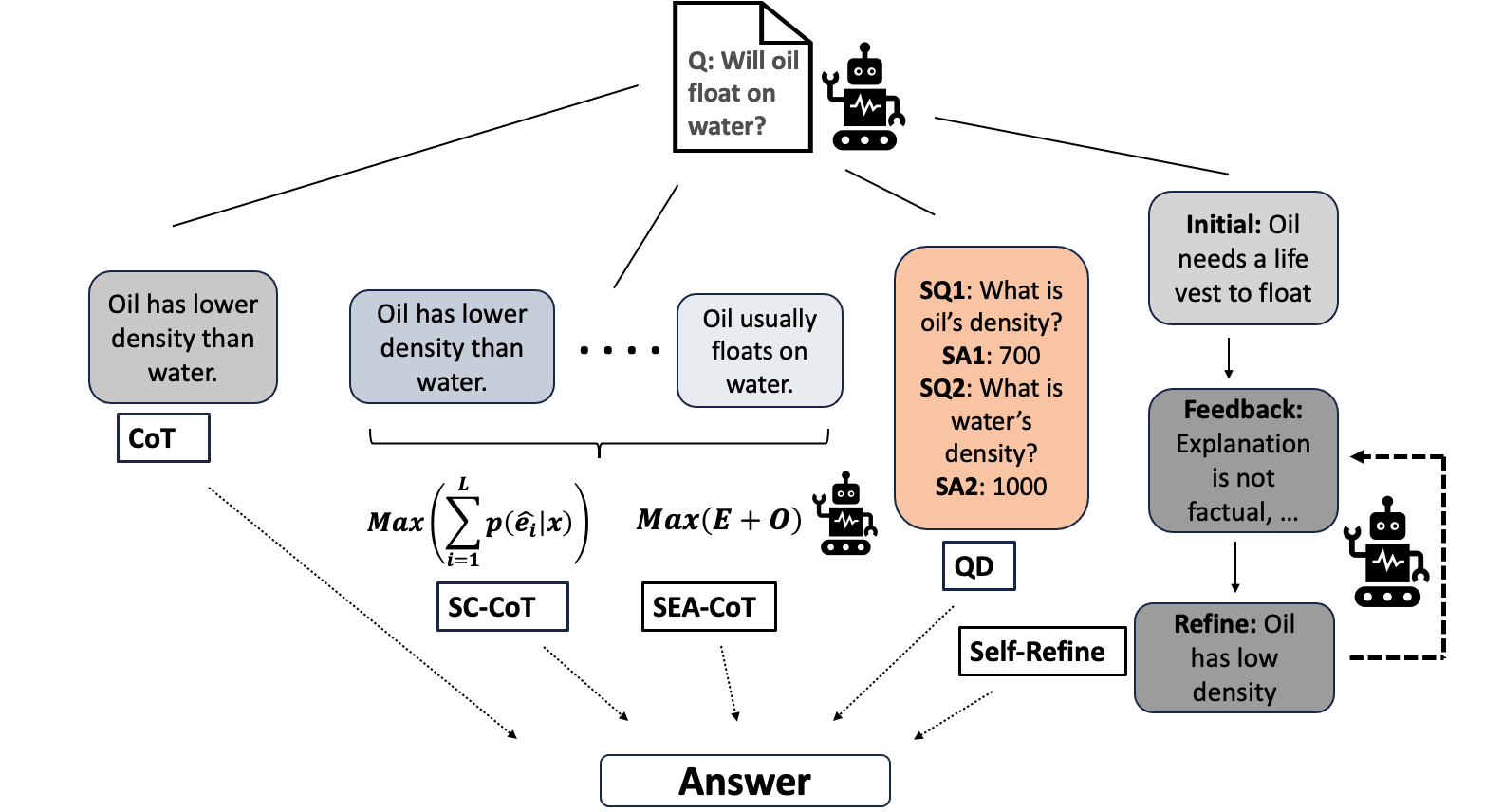
- Evaluate interpretability of reasoning chains from various prompting techniques (CoT, SC-CoT, SEA-CoT, QD, SR).
- Assess three interpretability axes—faithfulness, robustness, and utility—across commonsense reasoning benchmarks.
- Propose SEA-CoT to enhance alignment and interpretability of explanations.
Proposed method
- Review prompting techniques for reasoning chains (CoT, SC-CoT, QD, SR).
- Propose SEA-CoT: rank multiple explanations by S_T = S_e + S_o using entailment S_e and overlap S_o.
- Use few-shot NLI prompts to estimate entailment between explanations and context.
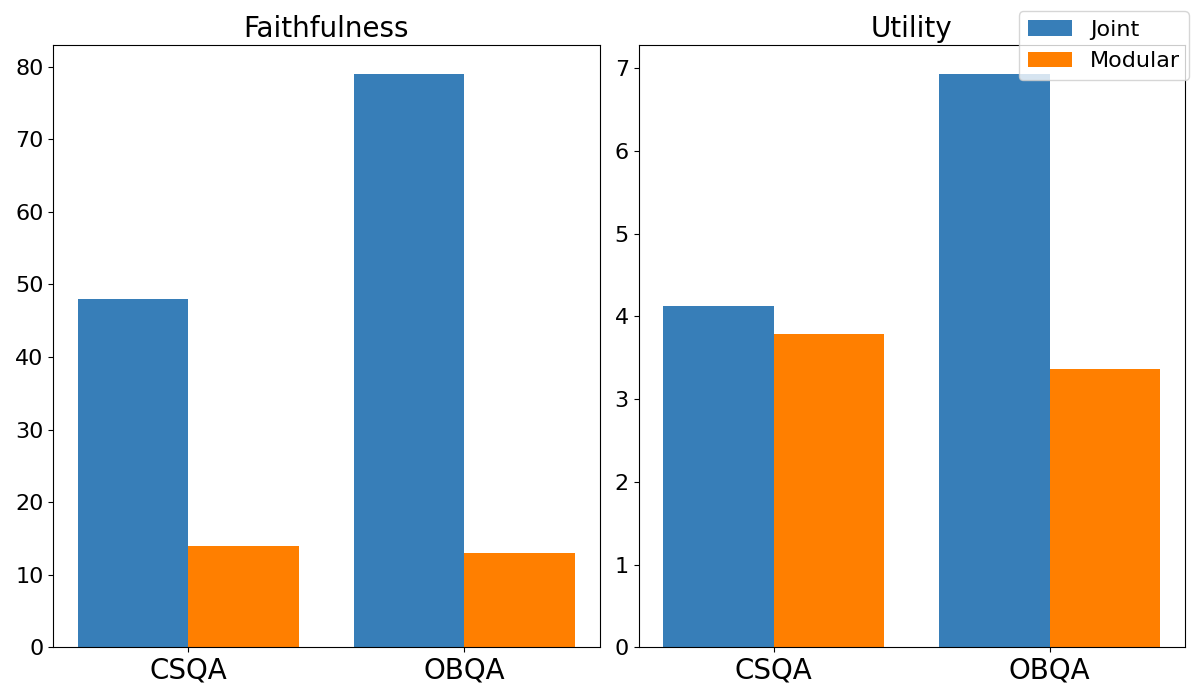
- Evaluate faithfulness via counterfactuals and mistakes, robustness via paraphrase, and utility via simulatability (LAS).
- Conduct perturbation tests on CSQA, OBQA, and StrategyQA using a 70B Llama-2 model (GPTQ quantized).
Experimental results
Research questions
- RQ1How faithful are prompting-derived reasoning explanations to the model's actual decision process?
- RQ2How robust are these explanations to paraphrasing and injected mistakes?
- RQ3Do explanations improve utility for downstream learning (simulatability)?
- RQ4Does SEA-CoT improve interpretability across multiple datasets and prompting variants?
- RQ5What is the impact of model size on interpretability traits?
Key findings
- SEA-CoT yields the highest aggregate interpretability scores across robustness, faithfulness, and utility on Commonsense QA, OpenBookQA, and StrategyQA.
- SEA-CoT achieves notably larger gains on OBQA (>75% relative improvement over many baselines).
- Compared to SC-CoT, SEA-CoT consistently improves interpretability without sacrificing task performance.
- Ablation shows that using both entailment and overlap (O&E) outperforms using either alone in selecting explanations.
- Larger models (70B) generally improve interpretability scores, but SEA-CoT can make smaller models (e.g., 7B) competitive in interpretability with other prompts.
- Table 1 indicates ablation results for reasoning selection methods; Table 2 shows model-size effects on interpretability metrics.
Read this paper
Open the full text in the Nubint reader and ask about any passage as you read.
Read this paper on NubintThis review was generated by AI from the original paper. Please check the paper before citing it.