
[Paper Review] How many words does ChatGPT know? The answer is ChatWords
This paper introduces ChatWords, an open-source, extensible tool to automatically evaluate the lexical knowledge of large language models like ChatGPT. By testing responses to a curated list of words—such as those from the Spanish Royal Academy dictionary and Cervantes' Don Quixote—ChatWords reveals that ChatGPT recognizes only about 80% of standard Spanish lexicon and 90% of Quixote-specific vocabulary, often with incorrect meanings, highlighting limitations in lexical fidelity and hallucination risks.
The introduction of ChatGPT has put Artificial Intelligence (AI) Natural Language Processing (NLP) in the spotlight. ChatGPT adoption has been exponential with millions of users experimenting with it in a myriad of tasks and application domains with impressive results. However, ChatGPT has limitations and suffers hallucinations, for example producing answers that look plausible but they are completely wrong. Evaluating the performance of ChatGPT and similar AI tools is a complex issue that is being explored from different perspectives. In this work, we contribute to those efforts with ChatWords, an automated test system, to evaluate ChatGPT knowledge of an arbitrary set of words. ChatWords is designed to be extensible, easy to use, and adaptable to evaluate also other NLP AI tools. ChatWords is publicly available and its main goal is to facilitate research on the lexical knowledge of AI tools. The benefits of ChatWords are illustrated with two case studies: evaluating the knowledge that ChatGPT has of the Spanish lexicon (taken from the official dictionary of the "Real Academia Española") and of the words that appear in the Quixote, the well-known novel written by Miguel de Cervantes. The results show that ChatGPT is only able to recognize approximately 80% of the words in the dictionary and 90% of the words in the Quixote, in some cases with an incorrect meaning. The implications of the lexical knowledge of NLP AI tools and potential applications of ChatWords are also discussed providing directions for further work on the study of the lexical knowledge of AI tools.
Motivation & Objective
- To develop a scalable, automated system to assess the lexical knowledge of large language models like ChatGPT.
- To address the lack of systematic evaluation tools for word-level knowledge in generative AI.
- To enable researchers to test lexical understanding across diverse lexicons, including domain-specific, rare, or incorrect words.
- To provide a flexible, open-source framework that supports evaluation of multiple AI models and custom word lists.
- To uncover limitations in LLMs' lexical fidelity, especially regarding word meanings and hallucinations.
Proposed method
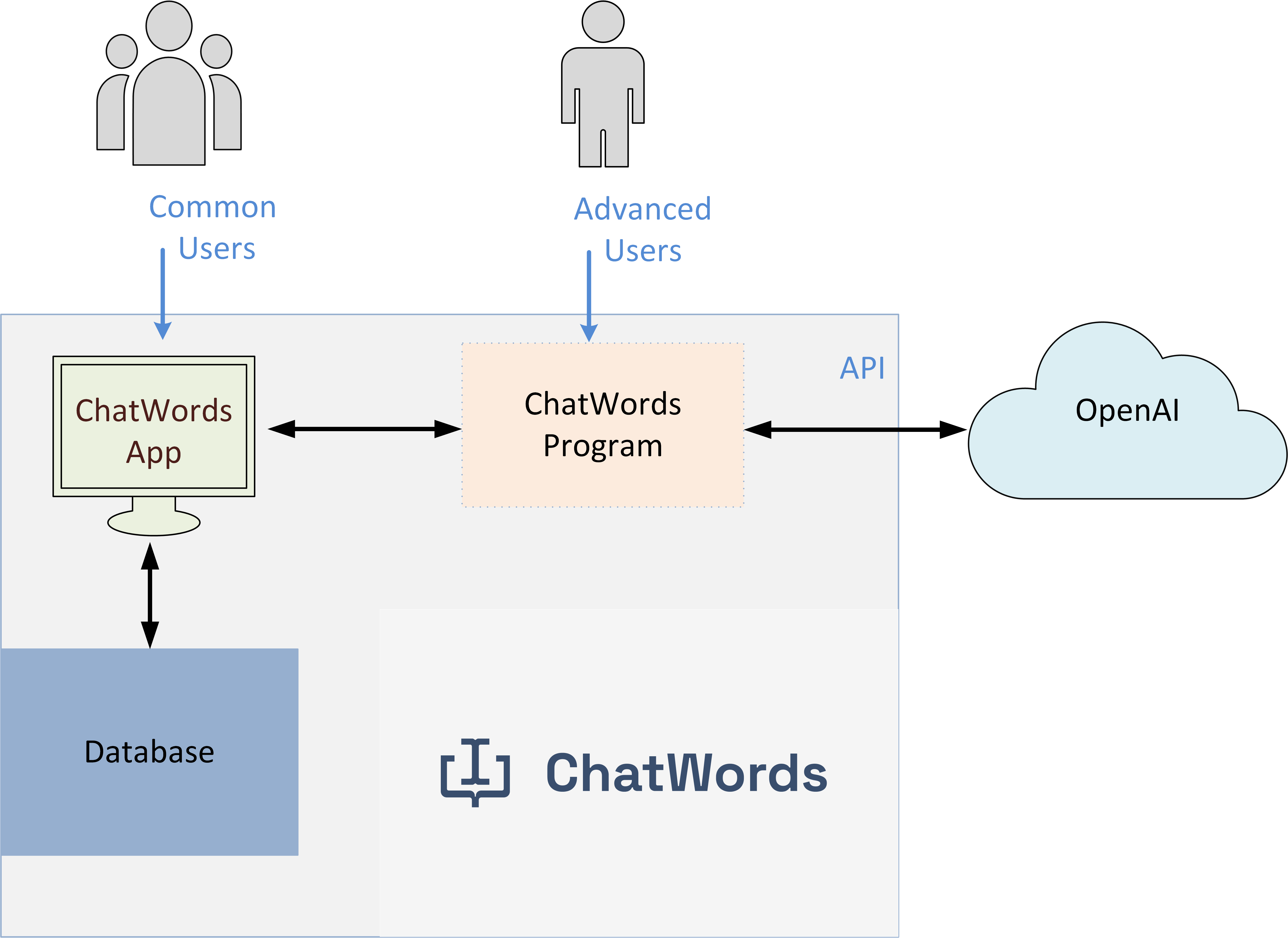
- Design a modular, extensible framework that accepts any list of words as input for testing.
- Automate prompt generation to query ChatGPT with each word, asking for definitions or meanings.
- Parse and validate responses using a lightweight natural language parser to detect correct, incorrect, or hallucinated definitions.
- Support multiple configurations: different LLM versions, system prompts, and response analysis strategies.
- Integrate with existing tools like Wuggy to generate pseudowords and test model sensitivity to non-existent terms.
- Enable integration with external datasets and support for multilingual and domain-specific lexicons.
Experimental results
Research questions
- RQ1How accurately does ChatGPT recognize and define words from a standard Spanish dictionary?
- RQ2To what extent does ChatGPT’s lexical knowledge vary across different word types, such as rare, archaic, or domain-specific terms?
- RQ3Can ChatGPT be tricked into accepting or misinterpreting non-existent or pseudowords that resemble real words?
- RQ4How does lexical knowledge correlate with performance in downstream NLP tasks like translation or summarization?
- RQ5What is the impact of training data quality on the model’s ability to distinguish between real and incorrect words?
Key findings
- ChatGPT correctly recognizes approximately 80% of the words in the Real Academia Española (RAE) dictionary, indicating a 20% failure rate in lexical knowledge.
- For the Spanish novel Don Quijote, ChatGPT recognizes about 90% of the unique vocabulary, suggesting better performance on literary over general lexicons.
- In several cases, ChatGPT provides plausible-sounding but incorrect definitions, demonstrating significant hallucination in lexical knowledge.
- The model sometimes confuses non-existent words like 'seglo' with real ones like 'siglo', suggesting it may learn from morphological similarity rather than semantic correctness.
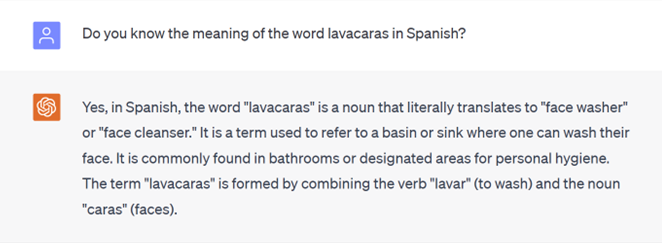
- ChatGPT’s performance on translation tasks degrades when encountering rare or unknown words, such as incorrectly translating 'majaderito' as 'majadero' instead of the correct term for a type of lace.
- The tool Wuggy was used to generate pseudowords, and ChatGPT frequently assigned false meanings, indicating vulnerability to similar-sounding non-words.
Read this paper
Open the full text in the Nubint reader and ask about any passage as you read.
Read this paper on NubintThis review was generated by AI from the original paper. Please check the paper before citing it.