
[Paper Review] How to build the best medical image segmentation algorithm using foundation models: a comprehensive empirical study with Segment Anything Model
The paper empirically compares 18 fine-tuning strategies for SAM across 17 medical imaging datasets, identifying effective PEFT-based approaches and dataset-availability scenarios for medical image segmentation.
Automated segmentation is a fundamental medical image analysis task, which enjoys significant advances due to the advent of deep learning. While foundation models have been useful in natural language processing and some vision tasks for some time, the foundation model developed with image segmentation in mind - Segment Anything Model (SAM) - has been developed only recently and has shown similar promise. However, there are still no systematic analyses or "best-practice" guidelines for optimal fine-tuning of SAM for medical image segmentation. This work summarizes existing fine-tuning strategies with various backbone architectures, model components, and fine-tuning algorithms across 18 combinations, and evaluates them on 17 datasets covering all common radiology modalities. Our study reveals that (1) fine-tuning SAM leads to slightly better performance than previous segmentation methods, (2) fine-tuning strategies that use parameter-efficient learning in both the encoder and decoder are superior to other strategies, (3) network architecture has a small impact on final performance, (4) further training SAM with self-supervised learning can improve final model performance. We also demonstrate the ineffectiveness of some methods popular in the literature and further expand our experiments into few-shot and prompt-based settings. Lastly, we released our code and MRI-specific fine-tuned weights, which consistently obtained superior performance over the original SAM, at https://github.com/mazurowski-lab/finetune-SAM.
Motivation & Objective
- Investigate which SAM fine-tuning strategies yield the best medical image segmentation performance.
- Compare SAM-based approaches to traditional UNet-based methods across diverse medical imaging modalities.
- Assess the impact of dataset availability scenarios on the choice of fine-tuning strategy.
- Explore pre-training strategies (task-expansive prompts and self-supervised learning) and few-shot/interactive segmentation settings in medical imaging.
Proposed method
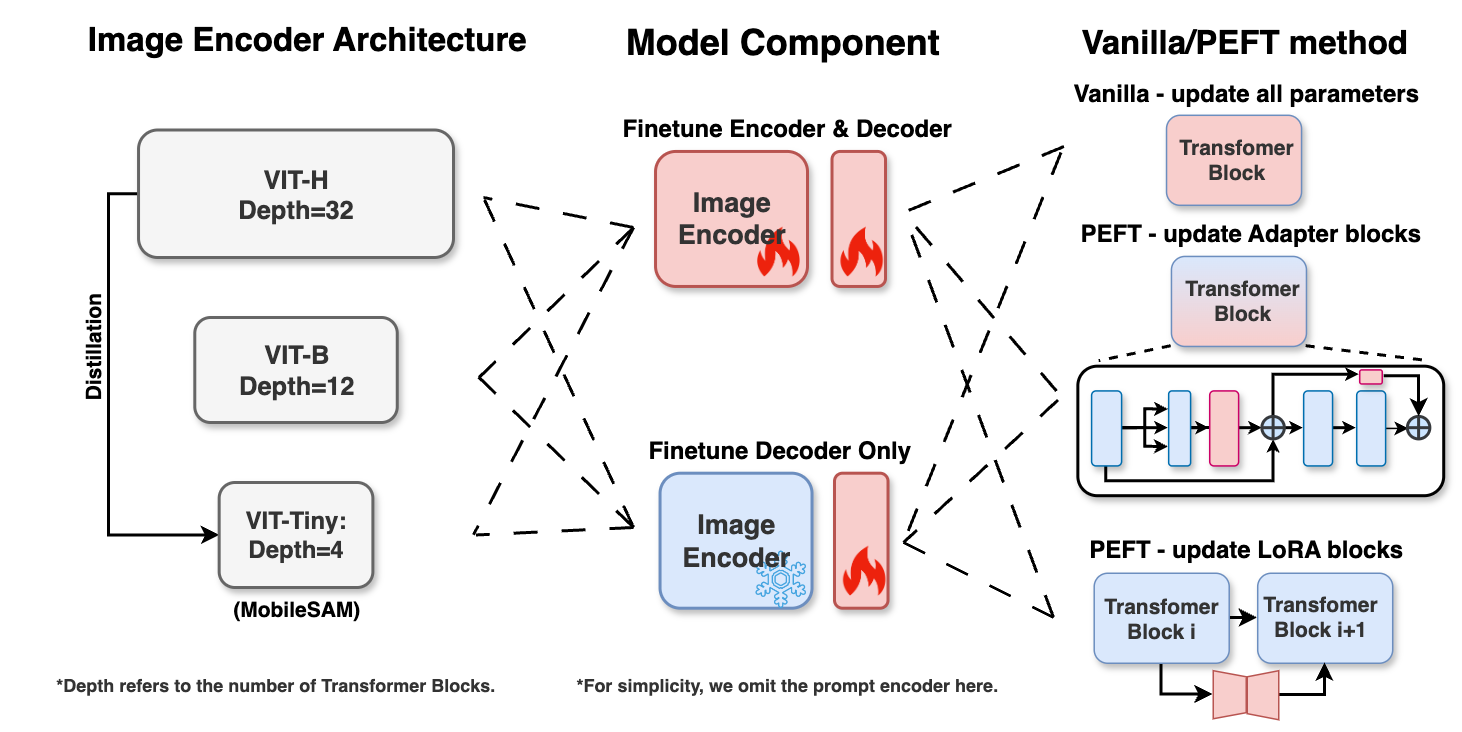
- Evaluate 18 architecture–component–method combinations by fine-tuning SAM on medical datasets.
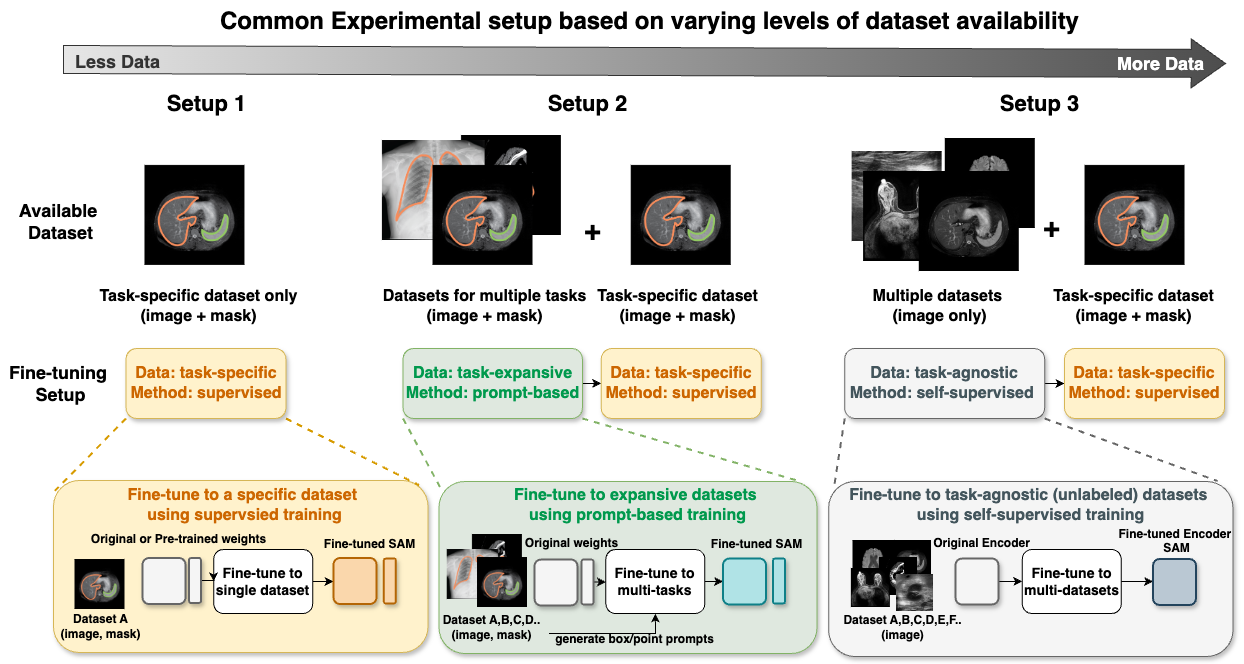
- Consider three data-availability scenarios: single labeled dataset, multiple labeled datasets, and multiple labeled plus unlabeled datasets.
- Use ViT-H, ViT-B, and ViT-T backbones with decoder/encoder/vanilla and PEFT variants (Adapter and LoRA).
- Apply task-specific supervised training, task-expansive prompt-based learning, and task-agnostic self-supervised learning (MAE) in sequence according to data availability.
- Compare SAM fine-tuning against UNet, nnUNet, and SwinUNet baselines on 17 datasets; report Dice Similarity Coefficient (DSC).
- Provide MRI-specific pre-trained weights and code for replication.
Experimental results
Research questions
- RQ1What is the best SAM fine-tuning strategy for medical image segmentation under different data availability scenarios?
- RQ2Do PEFT methods (Adapter/LoRA) outperform vanilla fine-tuning for SAM in medical imaging?
- RQ3Can additional pre-training (task-expansive prompts or self-supervised MAE) improve SAM performance on medical datasets?
- RQ4How does SAM compare to traditional UNet-based methods across diverse radiology modalities and organs?
Key findings
- Fine-tuning SAM with both encoder and decoder and using PEFT (Adapter or LoRA) generally yields better DSC than updating only the decoder.
- Encoder choice has a smaller impact when PEFT is used; smaller backbones (ViT-B or ViT-T) can outperform ViT-H in medical tasks due to data size and training stability.
- Self-supervised pre-training (MAE) and task-expansive prompt-based learning can further improve final performance in some setups.
- SAM-based methods can surpass some UNet variants on complex targets, but UNet variants (nnUNet) excel on simpler targets in certain datasets.
- Directly fine-tuning a large SAM (ViT-H, En/Decoder, Vanilla) can lead to model collapse on some datasets, highlighting benefits of PEFT in medical settings.
- The study provides MRI-focused pre-training and a publicly available codebase and fine-tuned weights for reproducibility.
Read this paper
Open the full text in the Nubint reader and ask about any passage as you read.
Read this paper on NubintThis review was generated by AI from the original paper. Please check the paper before citing it.