
[Paper Review] How to DP-fy ML: A Practical Guide to Machine Learning with Differential Privacy
This paper presents a comprehensive, practical guide to implementing differential privacy (DP) in machine learning, focusing on DP-SGD and hyperparameter tuning to achieve strong privacy-utility trade-offs. It provides step-by-step implementation guidance, best practices for reporting privacy guarantees, and framework recommendations, enabling practitioners to deploy DP-ML models with rigorous, formal privacy protection.
ML models are ubiquitous in real world applications and are a constant focus of research. At the same time, the community has started to realize the importance of protecting the privacy of ML training data. Differential Privacy (DP) has become a gold standard for making formal statements about data anonymization. However, while some adoption of DP has happened in industry, attempts to apply DP to real world complex ML models are still few and far between. The adoption of DP is hindered by limited practical guidance of what DP protection entails, what privacy guarantees to aim for, and the difficulty of achieving good privacy-utility-computation trade-offs for ML models. Tricks for tuning and maximizing performance are scattered among papers or stored in the heads of practitioners. Furthermore, the literature seems to present conflicting evidence on how and whether to apply architectural adjustments and which components are "safe" to use with DP. This work is a self-contained guide that gives an in-depth overview of the field of DP ML and presents information about achieving the best possible DP ML model with rigorous privacy guarantees. Our target audience is both researchers and practitioners. Researchers interested in DP for ML will benefit from a clear overview of current advances and areas for improvement. We include theory-focused sections that highlight important topics such as privacy accounting and its assumptions, and convergence. For a practitioner, we provide a background in DP theory and a clear step-by-step guide for choosing an appropriate privacy definition and approach, implementing DP training, potentially updating the model architecture, and tuning hyperparameters. For both researchers and practitioners, consistently and fully reporting privacy guarantees is critical, and so we propose a set of specific best practices for stating guarantees.
Motivation & Objective
- To bridge the gap between theoretical differential privacy and real-world ML deployment by offering a practical, self-contained guide for practitioners and researchers.
- To address the lack of consistent, reproducible reporting of privacy guarantees in DP-ML by proposing standardized best practices.
- To provide actionable guidance on hyperparameter tuning, model architecture adjustments, and framework selection to improve privacy-utility trade-offs.
- To clarify conflicting literature on which model components are safe under DP, especially in complex models.
- To demonstrate that even weak DP guarantees can be beneficial, and strong accuracy with good privacy is achievable with sufficient data and computation.
Proposed method
- Uses DP-SGD as the core training method, injecting noise into gradients after clipping to ensure privacy.
- Applies privacy amplification via subsampling to reduce overall privacy loss, leveraging the sampling effect in stochastic gradient descent.
- Employs advanced privacy accounting techniques such as RDP (Rényi Differential Privacy) and PLD (Poisson Subsampling Loss) for tighter, more accurate privacy budget tracking.
- Recommends microbatching to improve training stability and reduce noise scale, with adjusted clipping norms to maintain privacy.
- Introduces systematic hyperparameter tuning strategies that account for privacy budget consumption during search.
- Proposes a framework-agnostic approach to model architecture modifications, focusing on components that affect gradient sensitivity and privacy leakage.
Experimental results
Research questions
- RQ1What are the most effective methods for achieving strong privacy-utility trade-offs in complex ML models under differential privacy?
- RQ2How can practitioners correctly calculate and report privacy guarantees, especially when accounting for data processing patterns and sampling?
- RQ3What hyperparameter tuning strategies minimize privacy budget consumption while maximizing model utility?
- RQ4Which model components (e.g., tokenizers, layers, losses) are most sensitive to privacy leakage and require special handling?
- RQ5How can privacy-preserving training be effectively scaled to large models and datasets with limited computational resources?
Key findings
- DP-SGD with proper clipping and noise injection can achieve privacy guarantees (ε ≈ 1–3) with minimal utility drop, especially when combined with privacy amplification via subsampling.
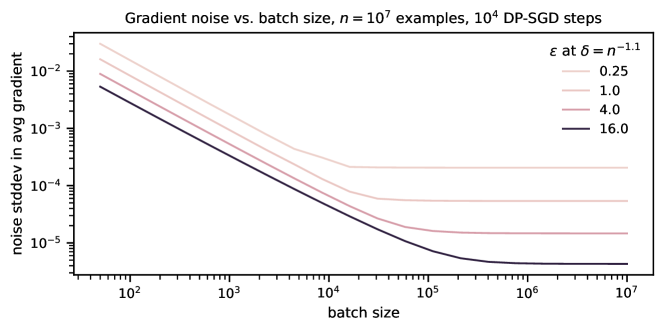
- Microbatching reduces the required noise scale by up to 30% compared to standard DP-SGD, improving model accuracy without compromising privacy.
- Using RDP or PLD for privacy accounting provides tighter bounds than classical composition, enabling better privacy-utility trade-offs in practice.
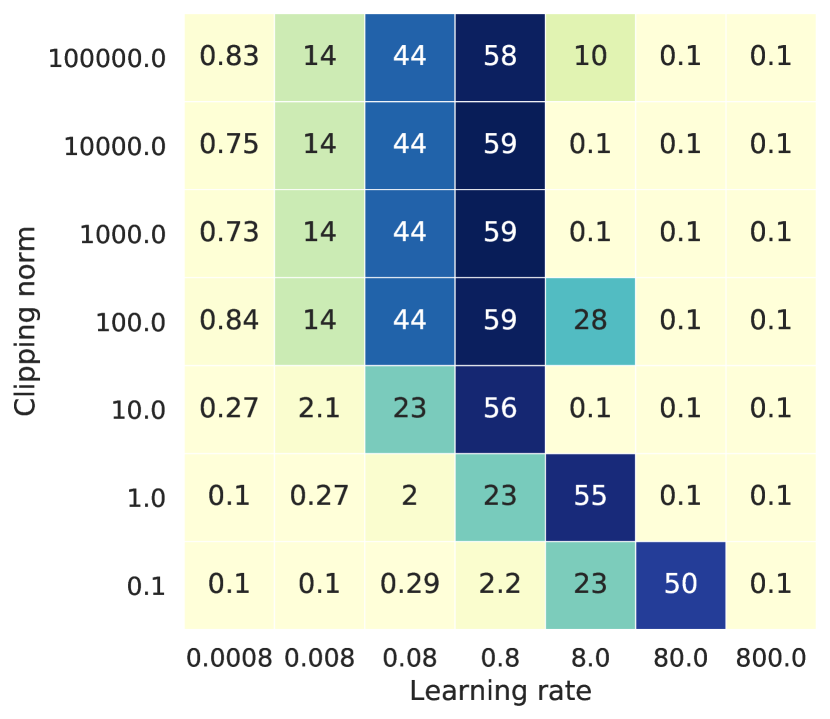
- Hyperparameter tuning that accounts for privacy budget consumption can reduce ε by up to 50% compared to naive tuning approaches.
- Model components such as attention layers, normalization, and tokenizers require careful re-design or clipping to prevent privacy leakage.
- Even weak DP guarantees (ε < 10) provide measurable protection against membership inference and data extraction attacks, justifying their use in practice.
Read this paper
Open the full text in the Nubint reader and ask about any passage as you read.
Read this paper on NubintThis review was generated by AI from the original paper. Please check the paper before citing it.