
[Paper Review] How to prepare your task head for finetuning
This paper proposes a principled approach to improving fine-tuning performance by analyzing how the initial training dynamics of the task head—specifically, its 'energy'—influences feature adaptation. By decomposing learning into energy and direction components, the authors show that early stopping of head probing, combined with label smoothing and architectural modifications, leads to better downstream performance through controlled feature adaptation.
In deep learning, transferring information from a pretrained network to a downstream task by finetuning has many benefits. The choice of task head plays an important role in fine-tuning, as the pretrained and downstream tasks are usually different. Although there exist many different designs for finetuning, a full understanding of when and why these algorithms work has been elusive. We analyze how the choice of task head controls feature adaptation and hence influences the downstream performance. By decomposing the learning dynamics of adaptation, we find that the key aspect is the training accuracy and loss at the beginning of finetuning, which determines the "energy" available for the feature's adaptation. We identify a significant trend in the effect of changes in this initial energy on the resulting features after fine-tuning. Specifically, as the energy increases, the Euclidean and cosine distances between the resulting and original features increase, while their dot products (and the resulting features' norm) first increase and then decrease. Inspired by this, we give several practical principles that lead to better downstream performance. We analytically prove this trend in an overparamterized linear setting and verify its applicability to different experimental settings.
Motivation & Objective
- To understand how the choice of task head and its initial training dynamics affect feature adaptation during fine-tuning.
- To challenge the assumption that pretrained features remain unchanged during fine-tuning, showing that even small adaptations significantly impact performance.
- To develop practical, theory-backed guidelines for designing better fine-tuning procedures beyond standard full-network fine-tuning or linear probing.
- To generalize beyond linear heads by analyzing non-linear head probing (HP) and its impact on representation learning.
- To provide a framework for controlling feature adaptation through energy and direction decomposition, leading to improved downstream accuracy.
Proposed method
- Decompose the learning dynamics of feature adaptation into 'energy' (magnitude of gradient updates) and 'direction' (change in feature vector orientation).
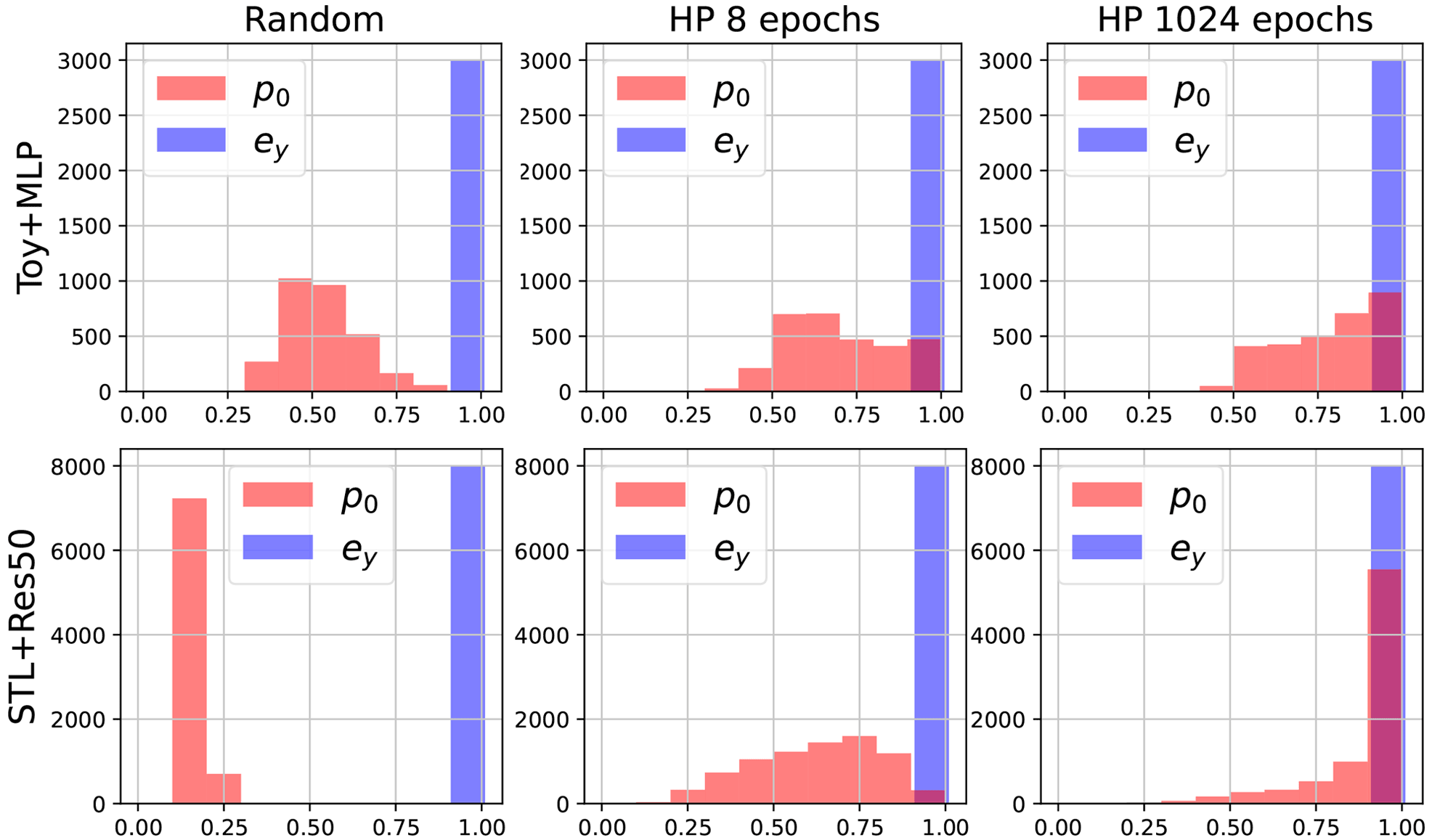
- Formalize the initial energy of the task head as the training accuracy and loss at the start of fine-tuning, which determines the available adaptation capacity.
- Analyze the effect of initial energy on three key metrics: Euclidean distance, cosine similarity, and dot product between original and adapted features.
- Use an overparameterized linear model to analytically prove that increasing initial energy leads to non-monotonic behavior in feature norms and distances.
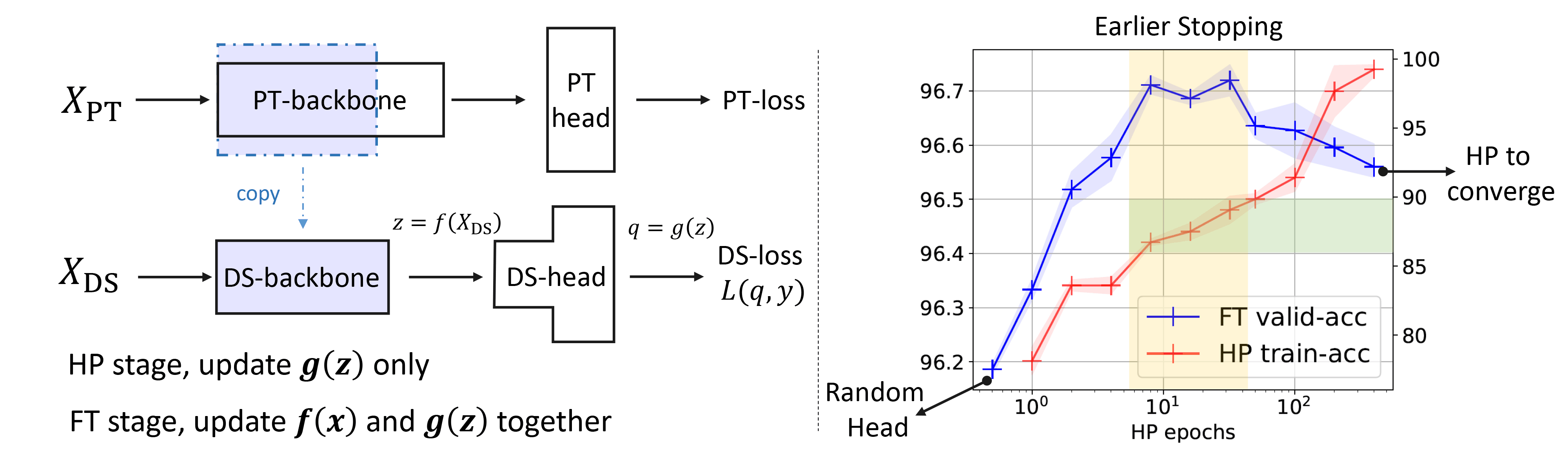
- Introduce practical techniques: early stopping of head probing, label smoothing during probing, and reinitializing later backbone layers attached to the task head.
- Verify the theoretical trends across diverse experimental settings, including vision and NLP benchmarks.
Experimental results
Research questions
- RQ1How does the initial training state of the task head (i.e., its 'energy') influence feature adaptation during fine-tuning?
- RQ2Why does early stopping of head probing outperform full convergence in downstream performance?
- RQ3What is the relationship between the initial energy of the task head and the resulting feature distance, norm, and cosine similarity?
- RQ4How do non-linear task heads affect feature adaptation compared to linear probing?
- RQ5Can controlling feature adaptation through energy manipulation lead to consistent performance gains across different architectures and datasets?
Key findings
- Increasing the initial energy of the task head leads to a monotonic increase in both Euclidean and cosine distances between original and adapted features.
- The dot product and norm of the adapted features first increase and then decrease with rising initial energy, indicating a non-monotonic adaptation pattern.
- The critical point where feature norm peaks occurs at intermediate levels of initial energy, suggesting an optimal window for adaptation.
- The assumption of 'unchanged features' during fine-tuning, as used in prior work, is rarely valid and can lead to suboptimal performance.
- Early stopping of head probing—before convergence—results in better downstream accuracy than full convergence, due to optimal energy control.
- Label smoothing during head probing and architectural modifications like merging and reinitializing later backbone layers further improve performance by stabilizing adaptation dynamics.
Read this paper
Open the full text in the Nubint reader and ask about any passage as you read.
Read this paper on NubintThis review was generated by AI from the original paper. Please check the paper before citing it.