
[Paper Review] How to represent part-whole hierarchies in a neural network
This paper proposes GLOM, a neural network architecture that represents part-whole hierarchies in images using islands of identical embedding vectors across spatial locations, enabling dynamic parsing without dynamic weight allocation. By combining transformers, capsules, neural fields, and contrastive learning, GLOM forms stable, viewpoint-invariant representations through iterative bottom-up, top-down, and lateral attention mechanisms, significantly improving interpretability of vision representations.
This paper does not describe a working system. Instead, it presents a single idea about representation which allows advances made by several different groups to be combined into an imaginary system called GLOM. The advances include transformers, neural fields, contrastive representation learning, distillation and capsules. GLOM answers the question: How can a neural network with a fixed architecture parse an image into a part-whole hierarchy which has a different structure for each image? The idea is simply to use islands of identical vectors to represent the nodes in the parse tree. If GLOM can be made to work, it should significantly improve the interpretability of the representations produced by transformer-like systems when applied to vision or language
Motivation & Objective
- To design a neural network architecture that can dynamically parse images into part-whole hierarchies with varying structures per image.
- To improve interpretability of transformer-like systems in vision and language by encoding structural, compositional relationships.
- To overcome the limitation of fixed neural hardware allocation by using shared embedding vectors to represent nodes in a parse tree.
- To unify Gestalt psychology's field-based perception with symbolic AI's structural descriptions using continuous vector spaces.
- To enable end-to-end training with regularizers that encourage formation of coherent, stable islands of similar vectors at each hierarchical level.
Proposed method
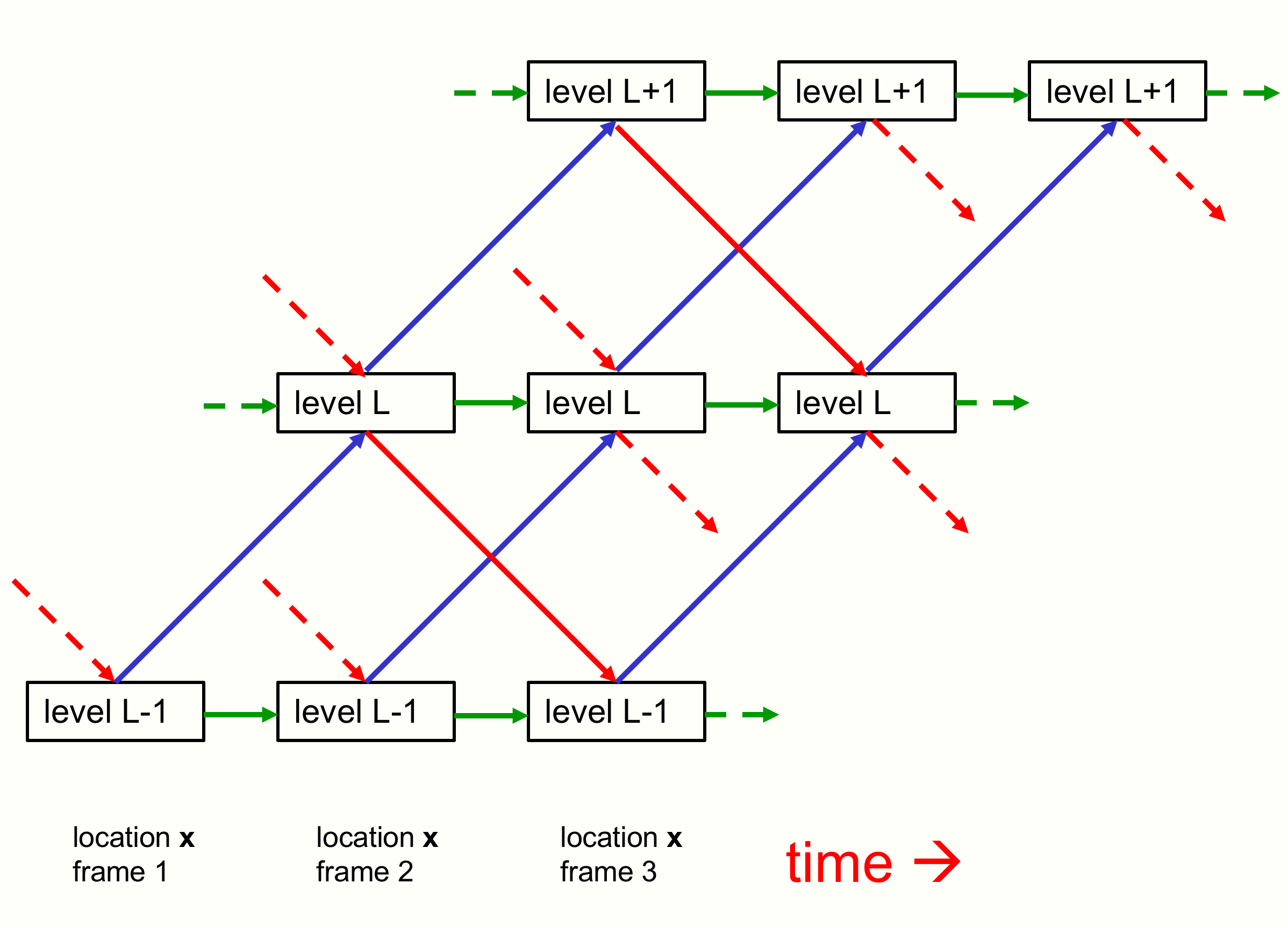
- Uses a stack of spatially local autoencoders in each column, with shared weights across all columns, to learn hierarchical representations from image patches.
- Applies bottom-up and top-down neural networks to predict embeddings at adjacent levels, using predictions as supervisory signals.
- Employs lateral attention between nearby columns at the same level to form islands of nearly identical embedding vectors.
- Updates each embedding at each time step as a weighted average of bottom-up prediction, top-down prediction, previous embedding, and averaged lateral neighbors.
- Introduces regularizers that maximize agreement between predicted and actual embeddings to encourage stable island formation.
- Uses end-to-end training with masked image reconstruction and contrastive regularization to learn hierarchical structure.
Experimental results
Research questions
- RQ1How can a neural network with a fixed architecture dynamically parse an image into a part-whole hierarchy that varies per input?
- RQ2Can islands of identical embedding vectors represent nodes in a parse tree without allocating dedicated neurons or weights?
- RQ3How can bottom-up and top-down predictions be used to guide the formation of coherent, viewpoint-invariant representations?
- RQ4Can contrastive regularization and lateral attention promote stable, localized clusters of similar vectors that correspond to perceptual wholes?
- RQ5To what extent can a system like GLOM achieve interpretability comparable to symbolic systems while retaining the inductive biases of deep learning?
Key findings
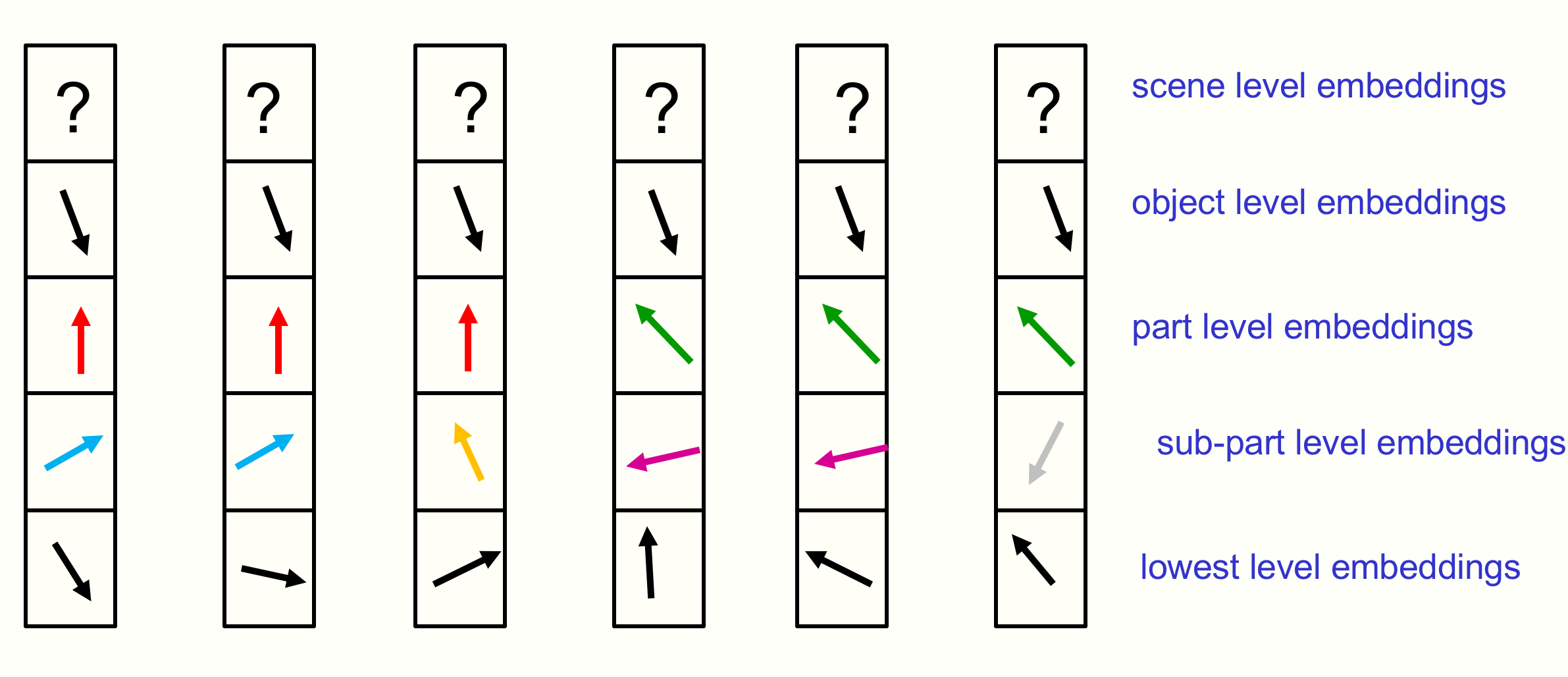
- The GLOM architecture successfully forms distinct islands of nearly identical embedding vectors at each hierarchical level, with larger islands at higher levels, indicating coherent grouping of parts into wholes.
- Islands of similarity emerge through lateral attention and regularized prediction agreement, without requiring dynamic weight allocation or explicit pointer structures.
- The system can be trained end-to-end to reconstruct images with missing regions, demonstrating its capacity to learn meaningful hierarchical representations.
- The method unifies Gestalt-like field-based perception with symbolic structural descriptions by using continuous vector similarity to encode hierarchical relationships.
- The approach avoids the need for a neurosymbolic interface by embedding structural descriptions directly in the continuous space of learned embeddings.
- While no working implementation exists yet, the design suggests that GLOM could generalize shape recognition to novel viewpoints, as validated in ongoing collaborative testing.
Read this paper
Open the full text in the Nubint reader and ask about any passage as you read.
Read this paper on NubintThis review was generated by AI from the original paper. Please check the paper before citing it.