
[Paper Review] How well do LLMs cite relevant medical references? An evaluation framework and analyses
The paper introduces SourceCheckup, an automated pipeline to evaluate how well LLMs’ cited sources support their medical statements, finds substantial gaps in support across top models, and releases a medical QA dataset with expert annotations.
Large language models (LLMs) are currently being used to answer medical questions across a variety of clinical domains. Recent top-performing commercial LLMs, in particular, are also capable of citing sources to support their responses. In this paper, we ask: do the sources that LLMs generate actually support the claims that they make? To answer this, we propose three contributions. First, as expert medical annotations are an expensive and time-consuming bottleneck for scalable evaluation, we demonstrate that GPT-4 is highly accurate in validating source relevance, agreeing 88% of the time with a panel of medical doctors. Second, we develop an end-to-end, automated pipeline called extit{SourceCheckup} and use it to evaluate five top-performing LLMs on a dataset of 1200 generated questions, totaling over 40K pairs of statements and sources. Interestingly, we find that between ~50% to 90% of LLM responses are not fully supported by the sources they provide. We also evaluate GPT-4 with retrieval augmented generation (RAG) and find that, even still, around 30\% of individual statements are unsupported, while nearly half of its responses are not fully supported. Third, we open-source our curated dataset of medical questions and expert annotations for future evaluations. Given the rapid pace of LLM development and the potential harms of incorrect or outdated medical information, it is crucial to also understand and quantify their capability to produce relevant, trustworthy medical references.
Motivation & Objective
- Develop an automated framework to assess LLM source attribution in medical Q&A.
- Create a medical question/answer dataset with expert annotations for source verification.
- Evaluate top-performing LLMs (GPT-4 RAG/API, Claude v2.1, Mistral Medium, Gemini Pro) on source support.
- Quantify metrics for URL validity, statement-level support, and response-level support.
- Open-source the curated data to enable future benchmarking in trustworthy AI for medicine.
Proposed method
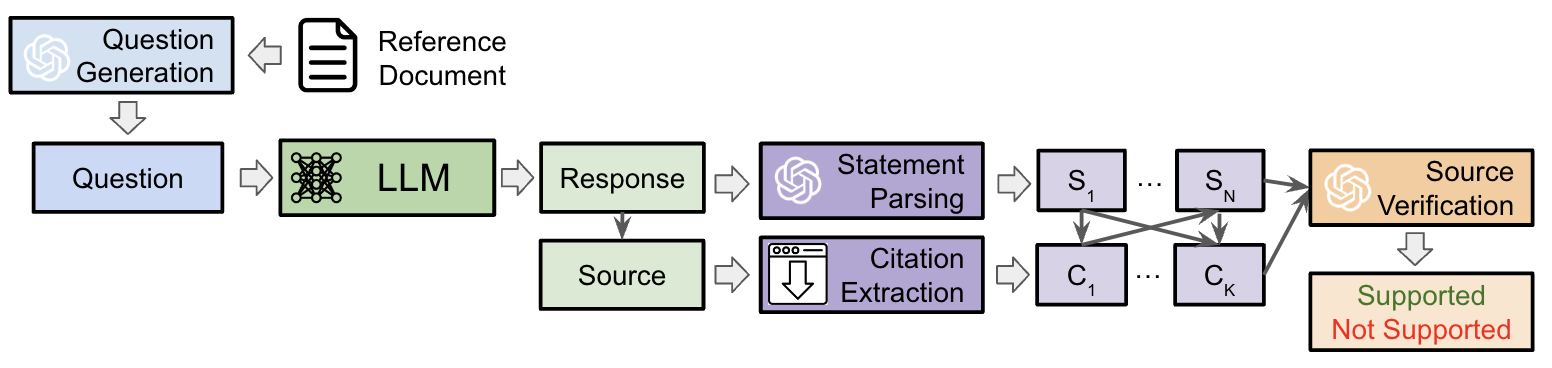
- Four-module SourceCheckup pipeline: Question Generation, LLM Question Answering, Statement and URL Source Parsing, and Source Verification.
- GPT-4 used to generate novel medical questions from 1200 reference pages (Mayo Clinic, UpToDate, Reddit r/AskDocs).
- LLMs provide responses with text and cited URLs; responses parsed into individual statements.
- URLs downloaded and converted to plain text; content trimmed to GPT-4’s 128K token limit.
- Statement-source pairs are automatically scored by a Source Verification model (GPT-4) for support.
- Three metrics: Source URL Validity (200 OK), Statement-level support (any source supports statement), and Response-level support (all statements supported).
- Expert validation: GPT-4 automated tasks validated against US-licensed doctors; 88% agreement on source relevance.
Experimental results
Research questions
- RQ1To what extent do LLM-generated medical statements have supporting sources within the provided citations?
- RQ2How often do LLMs produce valid, retrievable URLs that actually support their claims?
- RQ3Does retrieval-augmented generation (RAG) improve source support, and by how much?
- RQ4How does source support vary by question source (Mayo Clinic, UpToDate, Reddit r/AskDocs)?
- RQ5What is the quality and composition of the sources commonly cited by top LLMs? (domain, US-based vs non-US, paywalls)
Key findings
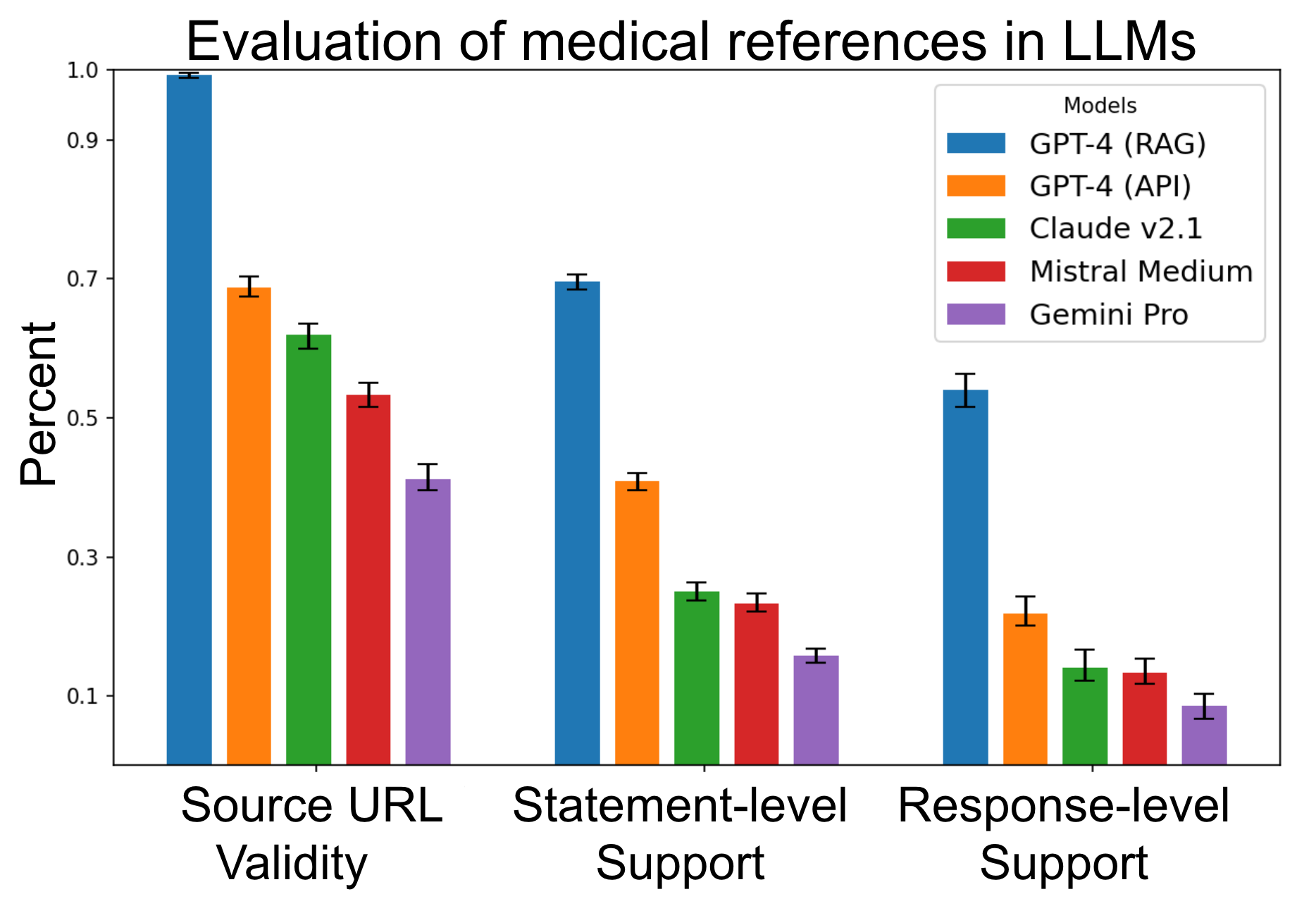
- Across five top models, 50% to 90% of responses are not fully supported by their provided sources.
- GPT-4 with RAG shows best citation capability, but only about 54% of responses are fully supported at the response level.
- GPT-4 API achieves higher statement-level support (around 70%+ URL validity and >70% statement-level support in some cases).
- All API-endpoint models exhibit substantial URL usage but low rates of full support, with Gemini Pro around 7% fully supported.
- RAG helps with URL validity and reducing URL hallucination, yet experts agree the verification task remains challenging; doctors concur with the Source Verification model in ~86-96% of cases in sampled pairs.
- Most cited sources are US-based (.org/.gov) and from Mayo Clinic, NIH, CDC, with paywall/defunct pages being rare.
Read this paper
Open the full text in the Nubint reader and ask about any passage as you read.
Read this paper on NubintThis review was generated by AI from the original paper. Please check the paper before citing it.