
[Paper Review] HSIDMamba: Exploring Bidirectional State-Space Models for Hyperspectral Denoising
Introduces HSIDMamba (HSDM), a Bidirectional State-Space Model for hyperspectral denoising that achieves state-of-the-art results with linear (nearly) complexity and faster inference than recent transformers.
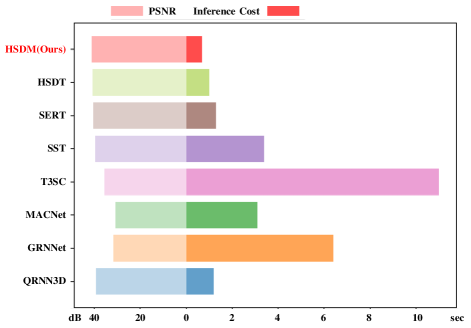
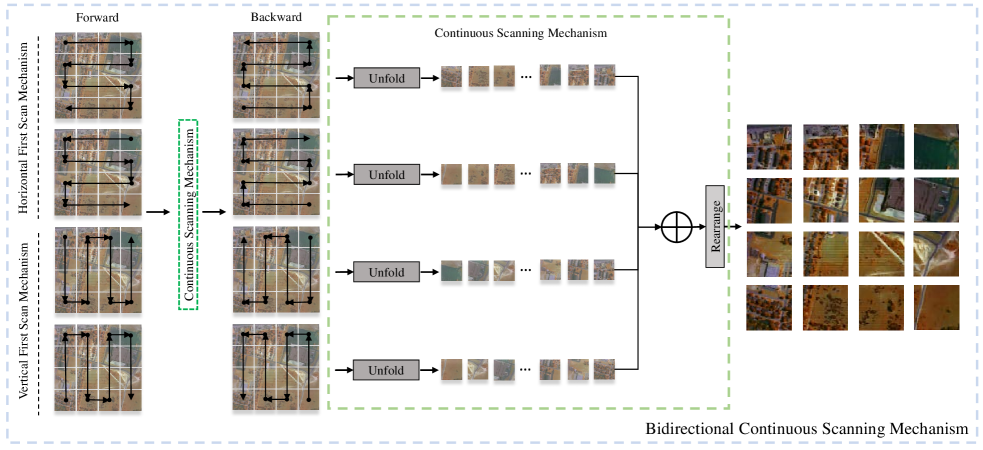
Effectively modeling global context information in hyperspectral image (HSI) denoising is crucial, but prevailing methods using convolution or transformers still face localized or computational efficiency limitations. Inspired by the emerging Selective State Space Model (Mamba) with nearly linear computational complexity and efficient long-term modeling, we present a novel HSI denoising network named HSIDMamba (HSDM). HSDM is tailored to exploit the capture of potential spatial-spectral dependencies effectively and efficiently for HSI denoising. In particular, HSDM comprises multiple Hyperspectral Continuous Scan Blocks (HCSB) to strengthen spatial-spectral interactions. HCSB links forward and backward scans and enhances information from eight directions through the State Space Model (SSM), strengthening the context representation learning of HSDM and improving denoising performance more effectively. In addition, to enhance the utilization of spectral information and mitigate the degradation problem caused by long-range scanning, spectral attention mechanism. Extensive evaluations against HSI denoising benchmarks validate the superior performance of HSDM, achieving state-of-the-art performance and surpassing the efficiency of the transformer method SERT by 31%.
Motivation & Objective
- Motivate the need for efficient long-range spatial-spectral modeling in hyperspectral denoising.
- Propose HSIDMamba (HSDM), a bidirectional, continuous-state-space architecture tailored for HSI denoising.
- Incorporate bidirectional continuous scanning, scale residuals, and spectral attention to capture long-range dependencies.
- Demonstrate state-of-the-art denoising performance and superior efficiency over transformer-based methods.
Proposed method
- Adopt Selective State Space Models (Mamba) with bidirectional continuous scanning to process long 1D spectral sequences.
- Introduce Hyperspectral Continuous Scan Blocks (HCSB) that combine 2D spatial scanning with channel attention.
- Use Bidirectional Continuous Scanning Mechanism (BCSM) to link forward and backward scans across eight directions.
- Apply layer normalization, Conv1D processing, and spectral attention to enhance spatial-spectral modeling.
- Train with mixed-noise synthetic data and evaluate against Denoising baselines using PSNR, SSIM, and SAM.
Experimental results
Research questions
- RQ1Can a bidirectional, linear-complexity state-space model capture long-range spatial-spectral dependencies more efficiently than CNNs or Transformers in hyperspectral denoising?
- RQ2Does the proposed BCSM and HCSL design improve denoising quality (PSNR/SSIM/SAM) on synthetic and real HSI datasets under diverse noise conditions?
- RQ3Is HSIDMamba faster and more parameter-efficient than recent transformer-based denoising methods while maintaining or improving accuracy?
- RQ4What is the impact of scanning strategy ( bidirectional vs unidirectional, sweep vs cross) and hidden-dim choices on performance?
Key findings
- HSIDM achieves state-of-the-art denoising performance on synthetic ICVL/CAVE datasets under Gaussian and mixture noise.
- HSIDM provides superior PSNR/SSIM/SAM metrics compared to multiple baselines, including transformer-based methods SST, SERT, and HSDT.
- The bidirectional adjacent scanning mechanism (BCSM) outperforms other scanning strategies in capturing spatial-spectral dependencies.
- HSIDM runs with linear-time complexity and shows faster inference (≈30% faster than latest transformer methods) and favorable parameter efficiency.
- Ablation studies confirm the importance of Conv1D processing, channel attention, and optimal block/hiddendim settings for best performance.
- Efficiency analysis shows HSIDM maintains GPU memory and FPS while scaling, outperforming baselines in speed for CAVE/WDC/Urban datasets.
Read this paper
Open the full text in the Nubint reader and ask about any passage as you read.
Read this paper on NubintThis review was generated by AI from the original paper. Please check the paper before citing it.