
[Paper Review] Human-Aware Object Placement for Visual Environment Reconstruction
MOVER proposes a novel optimization framework that leverages human-scene interactions (HSI) from monocular RGB video to reconstruct physically plausible 3D scene layouts and refine 3D human pose and shape (HPS). By jointly optimizing object positions and scene geometry using depth-ordering, collision-free motion, and contact constraints across multiple frames, MOVER achieves state-of-the-art 3D scene reconstruction and improves HPS estimation without requiring prior 3D scene scans.
Humans are in constant contact with the world as they move through it and interact with it. This contact is a vital source of information for understanding 3D humans, 3D scenes, and the interactions between them. In fact, we demonstrate that these human-scene interactions (HSIs) can be leveraged to improve the 3D reconstruction of a scene from a monocular RGB video. Our key idea is that, as a person moves through a scene and interacts with it, we accumulate HSIs across multiple input images, and optimize the 3D scene to reconstruct a consistent, physically plausible and functional 3D scene layout. Our optimization-based approach exploits three types of HSI constraints: (1) humans that move in a scene are occluded or occlude objects, thus, defining the depth ordering of the objects, (2) humans move through free space and do not interpenetrate objects, (3) when humans and objects are in contact, the contact surfaces occupy the same place in space. Using these constraints in an optimization formulation across all observations, we significantly improve the 3D scene layout reconstruction. Furthermore, we show that our scene reconstruction can be used to refine the initial 3D human pose and shape (HPS) estimation. We evaluate the 3D scene layout reconstruction and HPS estimation qualitatively and quantitatively using the PROX and PiGraphs datasets. The code and data are available for research purposes at https://mover.is.tue.mpg.de/.
Motivation & Objective
- To address the limitation of monocular 3D scene reconstruction methods that produce physically implausible scenes due to ignoring human interactions.
- To improve 3D human pose and shape (HPS) estimation by leveraging scene consistency derived from human-scene interactions.
- To develop a method that reconstructs a coherent 3D scene layout from a single static camera without requiring prior 3D scans of the environment.
- To exploit implicit and explicit human-scene interaction cues—such as occlusion, non-penetration, and surface contact—for improved geometric consistency.
- To demonstrate that accumulated HSI constraints across frames can jointly optimize scene layout and human body parameters for greater realism.
Proposed method
- MOVER uses a global optimization framework that jointly refines camera pose, ground plane, and 3D object positions using human-scene interaction (HSI) constraints.
- It incorporates three types of HSI constraints: depth ordering from occlusion, non-penetration of humans into objects, and spatial coincidence of contact surfaces.
- The method processes input from a monocular video, including estimated 3D human meshes and 3D object shapes, to accumulate interaction cues across frames.
- Optimization is performed using a differentiable loss function combining SDF-based contact, collision avoidance, and depth-ordering constraints.
- The framework supports refinement of both scene layout and initial HPS estimates via iterative optimization with contact and SDF losses.
- It operates without requiring a priori 3D scene scans, enabling reconstruction from RGB video alone.

Experimental results
Research questions
- RQ1Can human-scene interactions in monocular RGB video sequences be used to improve 3D scene layout reconstruction?
- RQ2How can occlusion, non-penetration, and contact constraints be jointly optimized across multiple frames to produce physically plausible 3D scenes?
- RQ3To what extent can a reconstructed 3D scene improve the accuracy of 3D human pose and shape estimation?
- RQ4Can a method achieve consistent 3D scene reconstruction without prior 3D scans of the environment?
- RQ5How do accumulated HSI cues across frames enhance geometric consistency compared to single-frame or isolated reconstruction?
Key findings
- MOVER reduces mean per-joint error (PJE) by 43.21 and mean vertex-to-vertex distance (V2V) by 42.41 when adding camera and ground plane constraints, significantly improving baseline HPS estimation.
- The full model with all HSI constraints achieves a PJE of 174.37 and V2V of 178.31 on the PROX dataset, outperforming HolisticMesh and approaching PROX performance without requiring a 3D scene scan.
- Contact constraints alone yield the highest human-scene contact scores but reduce non-collision scores, indicating a trade-off between contact fidelity and collision avoidance.
- The depth-ordering constraint alone produces slightly better scene reconstruction than the full model but leads to worse contact scores, highlighting the complementary role of contact and collision constraints.
- The integration of SDF and contact losses further refines HPS estimation, demonstrating that scene consistency improves human body reconstruction.
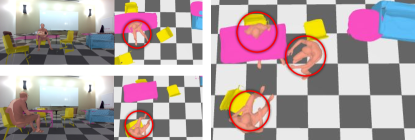
- Qualitative results on PROX and PiGraphs show that MOVER produces more coherent and physically plausible 3D scenes and human poses than Total3D and HolisticMesh.
Read this paper
Open the full text in the Nubint reader and ask about any passage as you read.
Read this paper on NubintThis review was generated by AI from the original paper. Please check the paper before citing it.