
[Paper Review] Human Grasp Classification for Reactive Human-to-Robot Handovers
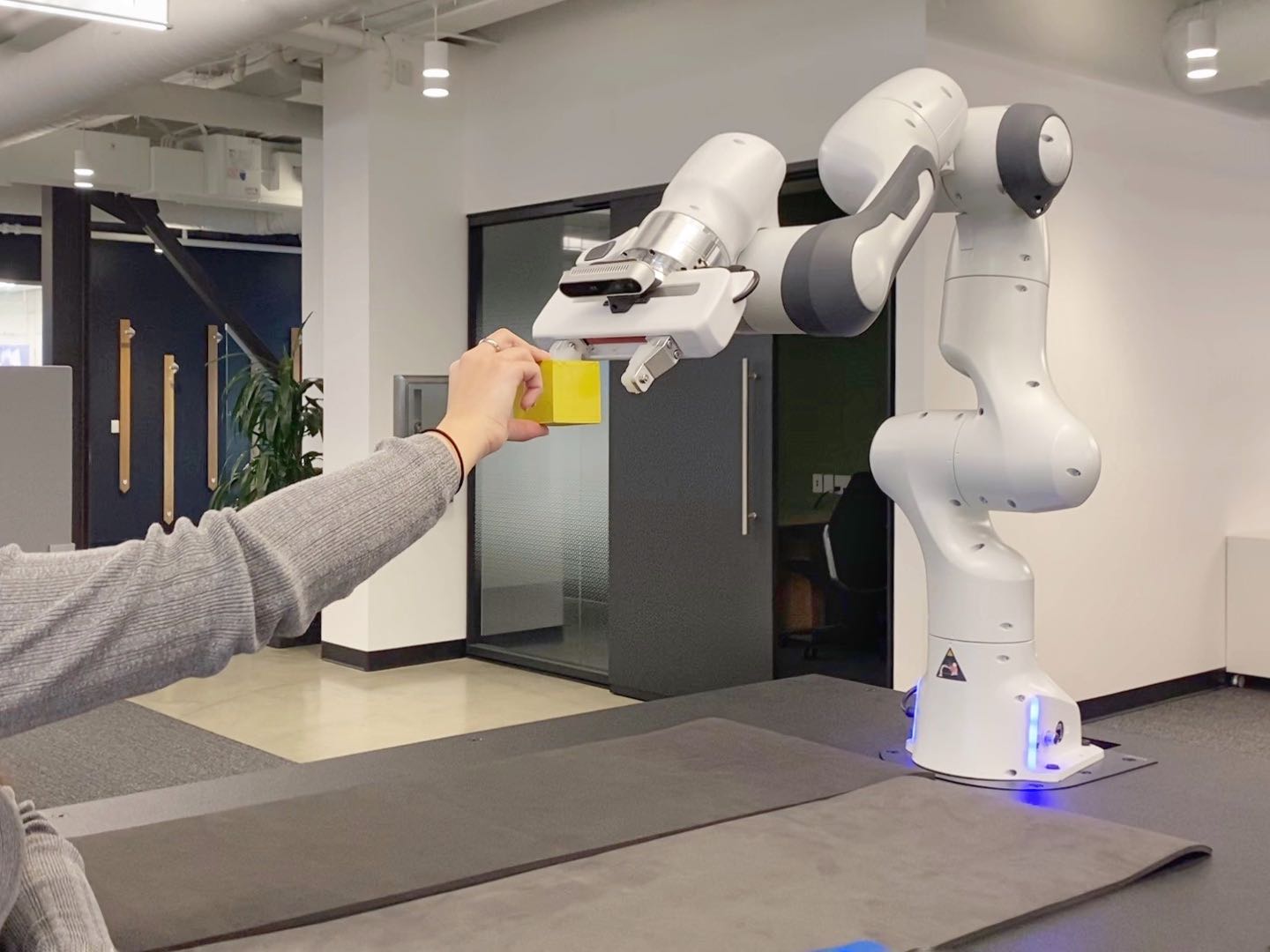
This paper proposes a reactive human-to-robot handover system that classifies human grasps into predefined categories using a deep learning model trained on a diverse grasp dataset, enabling the robot to dynamically plan and execute object transfers based on the detected grasp type. The system achieves more fluent handovers than baselines, with user studies confirming improved usability and perceived collaboration among naive users.
Transfer of objects between humans and robots is a critical capability for collaborative robots. Although there has been a recent surge of interest in human-robot handovers, most prior research focus on robot-to-human handovers. Further, work on the equally critical human-to-robot handovers often assumes humans can place the object in the robot's gripper. In this paper, we propose an approach for human-to-robot handovers in which the robot meets the human halfway, by classifying the human's grasp of the object and quickly planning a trajectory accordingly to take the object from the human's hand according to their intent. To do this, we collect a human grasp dataset which covers typical ways of holding objects with various hand shapes and poses, and learn a deep model on this dataset to classify the hand grasps into one of these categories. We present a planning and execution approach that takes the object from the human hand according to the detected grasp and hand position, and replans as necessary when the handover is interrupted. Through a systematic evaluation, we demonstrate that our system results in more fluent handovers versus two baselines. We also present findings from a user study (N = 9) demonstrating the effectiveness and usability of our approach with naive users in different scenarios. More results and videos can be found at http://wyang.me/handovers.
Motivation & Objective
- To enable fluid, reactive human-to-robot handovers where the robot adapts to the human's grasp in real time.
- To address the challenge of reliable perception during human-to-robot handovers, especially when hands and objects occlude each other.
- To reduce reliance on pre-specified robot grasps by learning grasp-type-specific motion plans from data.
- To improve usability and trust in collaborative settings through adaptive, responsive robot behavior.
- To evaluate the system in real-world scenarios with naive users, including distracted tasks.
Proposed method
- The system collects a human grasp dataset covering diverse hand shapes, object types, and grasp poses to train a deep learning model for grasp classification.
- A Robust Logical-Dynamical System (RLDS) is used to generate motion plans that avoid contact with the human hand while adapting to the detected grasp type.
- The robot plans its grasp trajectory based on the predicted grasp category and real-time hand position, with replanning capability if the handover is interrupted.
- The approach uses off-the-shelf hand and object pose estimation methods but integrates them through a grasp classification layer to improve robustness under occlusion.
- Motion planning is performed using RRT-connect, though the system acknowledges that some trajectories can be non-intuitive or hard to interpret.
- The system is evaluated against two baselines: one without grasp inference and one using independent hand and object pose estimation.
Experimental results
Research questions
- RQ1Can a deep learning-based grasp classification system improve the success rate and fluency of human-to-robot handovers?
- RQ2How does grasp classification enhance robot adaptability during reactive handovers under occlusion or uncertainty?
- RQ3To what extent does the system improve usability and perceived collaboration in real-world settings with non-expert users?
- RQ4How do users respond to robot motion planning that adapts to their grasp type, especially when distracted?
- RQ5What are the limitations of the system in handling unseen or edge-case grasps?
Key findings
- The proposed system achieved a higher success rate and greater time efficiency in handover tasks compared to two baselines, demonstrating improved performance in reactive handover scenarios.
- User studies with N=9 naive participants showed that the system was perceived as collaborative, trustworthy, and aware of human actions, especially after users were trained on the defined grasp types.
- The grasp classification system covered 77% of user grasps in freeform conditions, indicating strong generalization to common human grasp styles.
- Unseen or outlier grasps led to higher uncertainty and occasional failures, with users reporting finger pinching or needing to reposition, highlighting limitations in handling rare grasp types.
- Users reported that robot motions were sometimes unclear or non-intuitive, especially when trajectories involved complex detours or unexpected rotations, suggesting a need for more legible motion planning.
- Despite minor inaccuracies in grasp execution, the system remained robust overall, with users often able to assist by slight hand adjustments, indicating effective human-robot coordination.

Read this paper
Open the full text in the Nubint reader and ask about any passage as you read.
Read this paper on NubintThis review was generated by AI from the original paper. Please check the paper before citing it.