
[Paper Review] Human-Like Geometric Abstraction in Large Pre-trained Neural Networks
This study demonstrates that large pre-trained vision transformers (DINOv2 and CLIP) exhibit human-like geometric abstraction in visual reasoning tasks, outperforming standard ResNet models. The models show sensitivity to geometric complexity, regularity, and hierarchical parts-relations—key biases in human geometric cognition—suggesting that scale and self-supervised pre-training enable emergent abstract reasoning without explicit symbolic components.
Humans possess a remarkable capacity to recognize and manipulate abstract structure, which is especially apparent in the domain of geometry. Recent research in cognitive science suggests neural networks do not share this capacity, concluding that human geometric abilities come from discrete symbolic structure in human mental representations. However, progress in artificial intelligence (AI) suggests that neural networks begin to demonstrate more human-like reasoning after scaling up standard architectures in both model size and amount of training data. In this study, we revisit empirical results in cognitive science on geometric visual processing and identify three key biases in geometric visual processing: a sensitivity towards complexity, regularity, and the perception of parts and relations. We test tasks from the literature that probe these biases in humans and find that large pre-trained neural network models used in AI demonstrate more human-like abstract geometric processing.
Motivation & Objective
- To investigate whether large pre-trained neural networks exhibit human-like geometric abstraction, challenging the assumption that such reasoning requires explicit symbolic processing.
- To test if self-supervised vision transformers can reproduce three key cognitive biases in human geometric reasoning: sensitivity to complexity, regularity, and hierarchical parts-relations.
- To compare the performance of vision transformers (DINOv2, CLIP) and a standard CNN (ResNet-50) on geometric reasoning tasks to isolate the impact of architecture and training regime.
- To evaluate whether joint vision-language pre-training (CLIP) enhances or hinders geometric abstraction compared to image-only pre-training (DINOv2).
Proposed method
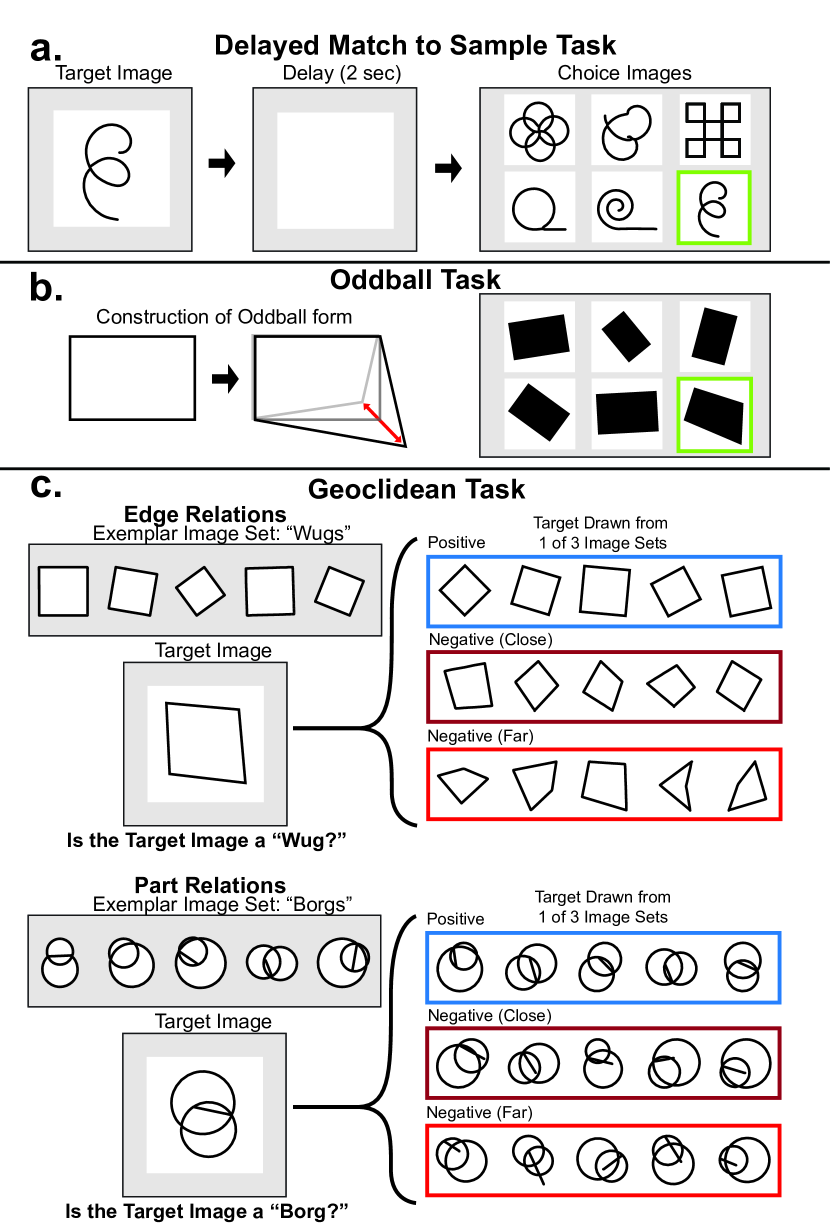
- Applied three behavioral tasks from cognitive science literature: delayed-match-to-sample with hierarchical shapes, quadrilateral oddball task for regularity sensitivity, and category judgment with part-relation structures.
- Used pre-trained vision transformers (DINOv2 and CLIP) and a ResNet-50 baseline, all fine-tuned or evaluated on geometric reasoning tasks.
- Employed a differentiable geometric stimulus generator (Dreamcoder DSL) to create stimuli with controlled hierarchical structure and geometric properties.
- Measured model performance by comparing prediction accuracy and response patterns to human behavioral data across tasks.
- Used internal representations (activations) to analyze whether geometric abstractions are encoded in feature space, particularly focusing on attention patterns and embedding similarity.
- Compared models across architectural differences: vision-only (DINOv2) vs. vision-language (CLIP), and transformer vs. CNN architectures (ResNet-50).
Experimental results
Research questions
- RQ1Do large pre-trained neural networks reproduce human-like sensitivity to geometric complexity in visual processing tasks?
- RQ2Can vision transformers demonstrate human-like preference for geometric regularity, such as symmetry and parallelism, in shape classification tasks?
- RQ3To what extent can neural networks decompose geometric stimuli into parts and relations, as humans do when generalizing to novel instances?
- RQ4Does joint vision-language pre-training (CLIP) enhance or impair geometric abstraction compared to image-only pre-training (DINOv2)?
- RQ5What architectural or training factors—model size, self-supervision, attention mechanisms—contribute most to human-like geometric reasoning in neural networks?
Key findings
- DINOv2 and CLIP outperformed ResNet-50 on all three geometric reasoning tasks, indicating that transformer-based architectures are better suited for abstract geometric processing.
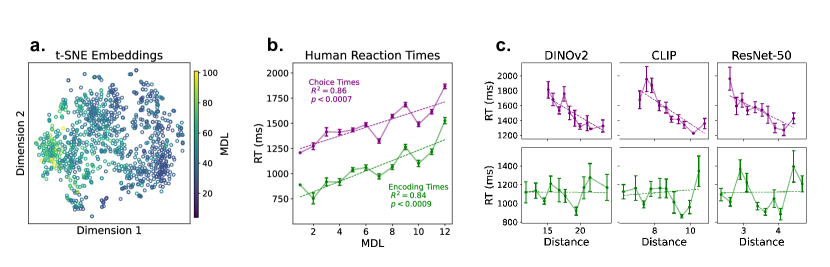
- Both DINOv2 and CLIP showed sensitivity to geometric complexity, with slower response times on more complex shapes—mirroring human behavioral patterns.
- The models demonstrated higher accuracy in classifying regular shapes (e.g., squares) over irregular ones (e.g., trapezoids), indicating a human-like bias toward geometric regularity.
- DINOv2 outperformed CLIP in reproducing human behavior, suggesting that joint vision-language pre-training may not enhance geometric abstraction and could even be detrimental.
- On the Geoclidean task involving hierarchical parts and relations, DINOv2 and CLIP generalized better than ResNet but still fell short of human-level performance, indicating a gap in part-relation decomposition.
- Internal representation analysis suggests that self-supervised contrastive objectives and transformer attention mechanisms may support abstract geometric reasoning, though explicit symbolic processing is not required.
Read this paper
Open the full text in the Nubint reader and ask about any passage as you read.
Read this paper on NubintThis review was generated by AI from the original paper. Please check the paper before citing it.