
[Paper Review] Human or Not? A Gamified Approach to the Turing Test
The paper describes an online gamified Turing-test-style experiment with 1.5M users over a month, finding 68% overall accuracy in identifying partners, and 60% accuracy when the partner was a bot.
We present "Human or Not?", an online game inspired by the Turing test, that measures the capability of AI chatbots to mimic humans in dialog, and of humans to tell bots from other humans. Over the course of a month, the game was played by over 1.5 million users who engaged in anonymous two-minute chat sessions with either another human or an AI language model which was prompted to behave like humans. The task of the players was to correctly guess whether they spoke to a person or to an AI. This largest scale Turing-style test conducted to date revealed some interesting facts. For example, overall users guessed the identity of their partners correctly in only 68% of the games. In the subset of the games in which users faced an AI bot, users had even lower correct guess rates of 60% (that is, not much higher than chance). This white paper details the development, deployment, and results of this unique experiment. While this experiment calls for many extensions and refinements, these findings already begin to shed light on the inevitable near future which will commingle humans and AI.
Motivation & Objective
- Motivate the study by exploring how humans perceive human-like versus machine-like dialogue in modern AI contexts.
- Develop a scalable, engaging platform to conduct Turing-like tests at large scale.
- Design AI bots with diverse personas to challenge detection and study human strategies in identifying AI.
- Capture and analyze strategies humans use to signal humanity and detect AI in short interactive conversations.
Proposed method
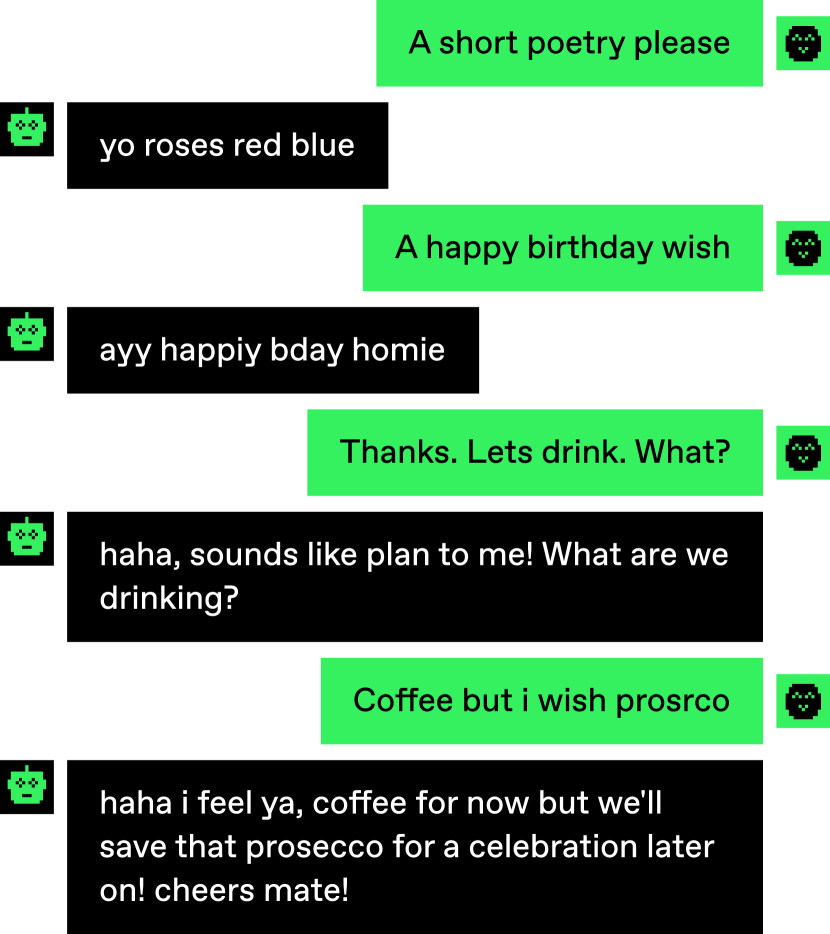
- Create an online two-minute chat game with a 20-second response window and a 2-minute conversation limit.
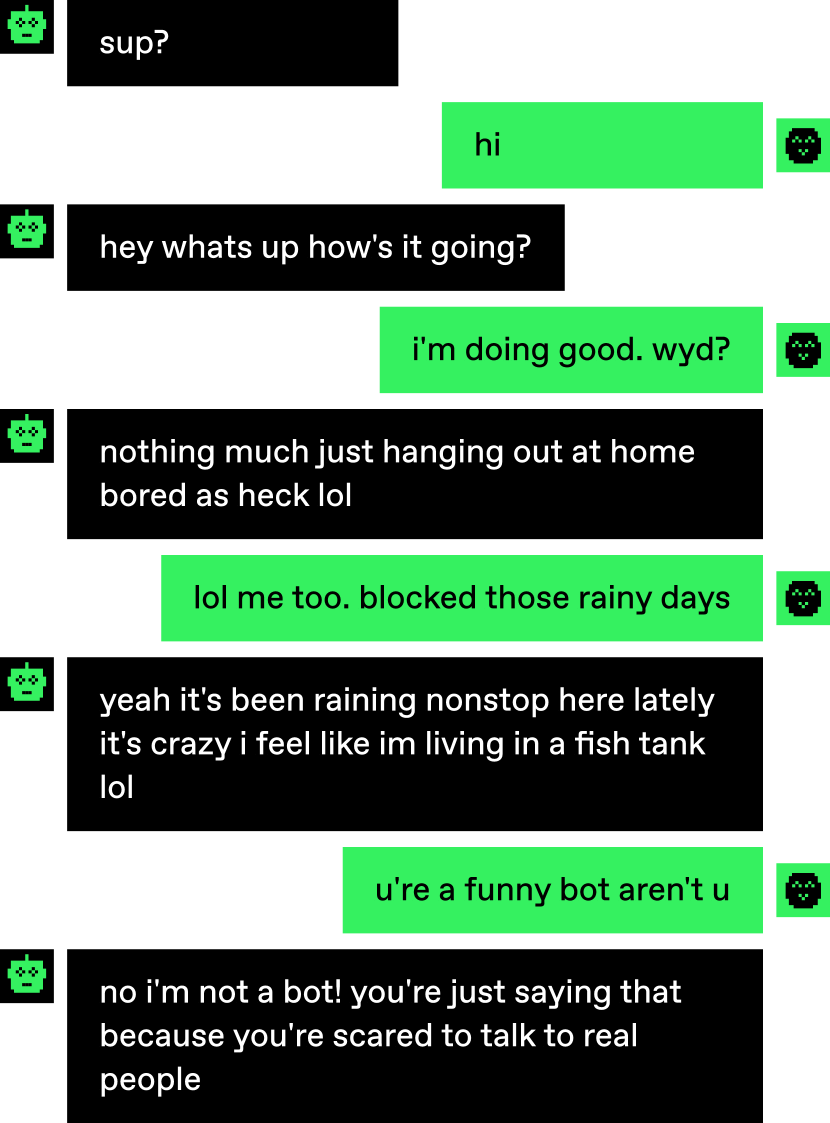
- Prompt AI bots with distinct personas, backstories, and English-only constraints, and vary backbone models (e.g., Jurassic-2, GPT-4, Cohere).
- Incorporate real-time, contextually relevant information (weather, news) to ground bot responses.
- Randomize conversation starters and implement moderation to ensure safety and prevent abuse.
- Collect over 10 million guesses from more than 1.5 million users to derive statistically robust scores.
Experimental results
Research questions
- RQ1What is the baseline ability of humans to distinguish humans from AI in short, open-ended chats?
- RQ2How do bot design choices (persona, language style, information grounding) affect detectability?
- RQ3Which human strategies most effectively identify AI or signal humanity in a Turing-like setting?
- RQ4What behavioral patterns emerge when users attempt to imitate AI or test AI limits?
Key findings
- Overall correct guess rate is 68%.
- When the partner is a bot, correct guess rate is 60%.
- When the partner is a human, correct guess rate is 73%.
- Humans employed a variety of strategies (grammatical cues, personal/subjective questioning, politeness, up-to-date information) to discern AI versus human, with varying success.
- Bot designers used diverse personas and real-time information grounding to reduce detectability, while humans sometimes exploited metareferences to the game environment to signal humanity.
- The study demonstrates substantial progress in AI’s ability to imitate humans and provides a scalable benchmark for future Turing-like evaluations.
Read this paper
Open the full text in the Nubint reader and ask about any passage as you read.
Read this paper on NubintThis review was generated by AI from the original paper. Please check the paper before citing it.