
[Paper Review] Human Preference Score v2: A Solid Benchmark for Evaluating Human Preferences of Text-to-Image Synthesis
This paper introduces HPD v2, a large-scale human preference dataset for text-to-image outputs, and HPS v2, a fine-tuned CLIP-based model that predicts human image preferences, plus a robust evaluation benchmark across multiple prompts and models.
Recent text-to-image generative models can generate high-fidelity images from text inputs, but the quality of these generated images cannot be accurately evaluated by existing evaluation metrics. To address this issue, we introduce Human Preference Dataset v2 (HPD v2), a large-scale dataset that captures human preferences on images from a wide range of sources. HPD v2 comprises 798,090 human preference choices on 433,760 pairs of images, making it the largest dataset of its kind. The text prompts and images are deliberately collected to eliminate potential bias, which is a common issue in previous datasets. By fine-tuning CLIP on HPD v2, we obtain Human Preference Score v2 (HPS v2), a scoring model that can more accurately predict human preferences on generated images. Our experiments demonstrate that HPS v2 generalizes better than previous metrics across various image distributions and is responsive to algorithmic improvements of text-to-image generative models, making it a preferable evaluation metric for these models. We also investigate the design of the evaluation prompts for text-to-image generative models, to make the evaluation stable, fair and easy-to-use. Finally, we establish a benchmark for text-to-image generative models using HPS v2, which includes a set of recent text-to-image models from the academic, community and industry. The code and dataset is available at https://github.com/tgxs002/HPSv2 .
Motivation & Objective
- Create a bias-reduced, large-scale dataset of human preferences for images generated from text prompts across multiple models and real images.
- Train a state-of-the-art preference predictor (HPS v2) by fine-tuning CLIP on HPD v2.
- Provide a stable, fair set of evaluation prompts spanning multiple styles for benchmarking text-to-image models.
- Demonstrate HPS v2’s generalization across image distributions and sensitivity to model improvements.
Proposed method
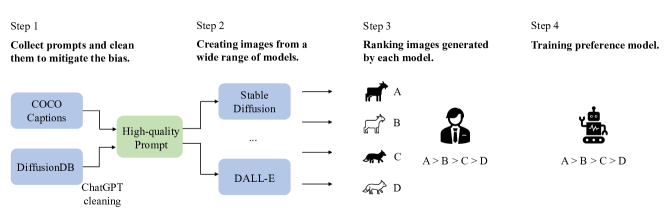
- Collect HPD v2 with 798,090 human preference choices on 433,760 image pairs from 9 models plus COCO captions.
- Clean prompts to reduce style-word bias using ChatGPT and reorganize prompts into clear sentences.
- Train HPS v2 by fine-tuning ViT-H/14 OpenCLIP-encoded CLIP on HPD v2 with KL-divergence objective for binary preferences.
- Evaluate HPS v2 against prior predictors and baseline metrics on HPD v2 test set and ImageReward, plus ablation studies.
- Assemble a robust evaluation protocol with prompts categorized into Animation, Concept-art, Painting, and Photo, totaling 3,200 prompts for benchmarking.
Experimental results
Research questions
- RQ1Can HPD v2 produce human-aligned evaluation data with reduced bias across diverse image distributions?
- RQ2Does HPS v2 outperform existing preference predictors in generalizing to new models and prompts?
- RQ3What prompt sets yield stable, fair, and scalable evaluation of text-to-image models?
- RQ4Is HPS v2 sensitive enough to detect algorithmic improvements in text-to-image generation?
Key findings
- HPD v2 contains 798k binary preferences for 434k images from 9 models plus COCO, designed to reduce source- and prompt-biases.
- HPS v2, trained by fine-tuning CLIP on HPD v2, achieves higher accuracy than prior predictors on HPD v2 and ImageReward benchmarks (e.g., superior to HPD v1, ImageReward, and PickScore on reported tests).
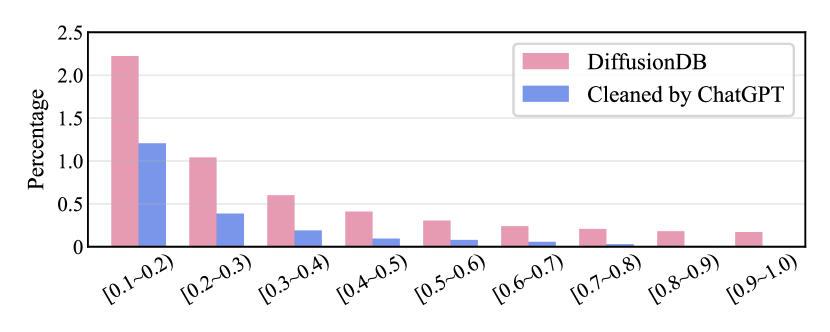
- Prompt cleaning with ChatGPT reduces NSFW and style-word bias in prompts, improving evaluation fairness.
- HPS v2 correlates with human judgments and is responsive to model improvements, enabling a practical benchmark for modern T2I models.
- Benchmark results show HPS v2 scores across a suite of recent models, indicating community models often outperform some academic ones in this evaluation.
Read this paper
Open the full text in the Nubint reader and ask about any passage as you read.
Read this paper on NubintThis review was generated by AI from the original paper. Please check the paper before citing it.